
Thermal management is at the heart of modern electronics, industrial equipment, and energy systems. From smartphones and GPUs to electric vehicles and data centers, heat must be efficiently controlled to ensure performance and longevity. One of the most important properties governing heat transfer in materials is độ dẫn nhiệt.

If you work with thermal interface materials, heat sinks, or electronic cooling solutions—like the thermally conductive products produced by HakTak—understanding thermal conductivity is essential. But what exactly does it mean, how is it measured, and why does it matter so much in engineering and electronics?
This guide explains everything you need to know about thermal conductivity, from the fundamental physics to real-world applications.
Understanding Thermal Conductivity
Thermal conductivity refers to a material’s ability to conduct or transfer heat. In simple terms, it describes how quickly heat moves through a substance when there is a temperature difference.
When one side of a material is hot and the other side is cooler, heat energy flows from the hotter region toward the cooler region. Thermal conductivity determines how fast that heat transfer occurs.
Materials with cao độ dẫn nhiệt move heat quickly, while those with Độ dẫn nhiệt thấp resist heat flow and act as insulators.
Ví dụ:
| Vật liệu | Thermal Conductivity (W/mK) |
| Đồng | ~401 |
| Graphite | ~200 |
| Glass | ~1 |
| Water | ~0.6 |
| Không khí | ~0.025 |
These values illustrate why metals are widely used in heat sinks and cooling solutions, while materials like foam or air are used as insulation.
In physics, thermal conductivity is usually represented by the symbols k, λ (lambda), hoặc κ (kappa). The standard unit is watts per meter-kelvin (W/mK).
How Heat Moves Through Materials
To understand thermal conductivity, it helps to look at how heat travels through matter.
Heat transfer occurs through three primary mechanisms:
- Conduction
- Convection
- Radiation
Thermal conductivity specifically refers to heat transfer through conduction.
Conduction Explained
In conduction, heat moves through a material via microscopic interactions between particles.
When atoms or molecules in a hot region vibrate more intensely, they transfer energy to neighboring particles through collisions. Over time, this process spreads heat through the material.
In solids, atoms are tightly packed, allowing energy to transfer quickly from particle to particle. That is why solids typically conduct heat better than liquids or gases.
In gases, particles are farther apart, so collisions happen less frequently, making heat transfer much slower.
The Basic Equation of Thermal Conductivity
Thermal conductivity is mathematically described by Fourier’s Law of Heat Conduction, which relates heat flow to temperature differences.
q = -k \∇T
Where:
- q = heat flux (heat transfer per unit area)
- k = thermal conductivity of the material
- ∇T = temperature gradient
This equation shows that the heat transfer rate depends on:
- The thermal conductivity of the material
- The temperature difference across it
- The distance heat must travel
In practical terms, higher k-values mean faster heat transfer.
Why Thermal Conductivity Matters
Thermal conductivity is one of the most critical parameters in thermal engineering. It directly influences how efficiently systems manage heat.
Electronics Cooling
Modern electronic devices generate significant heat.
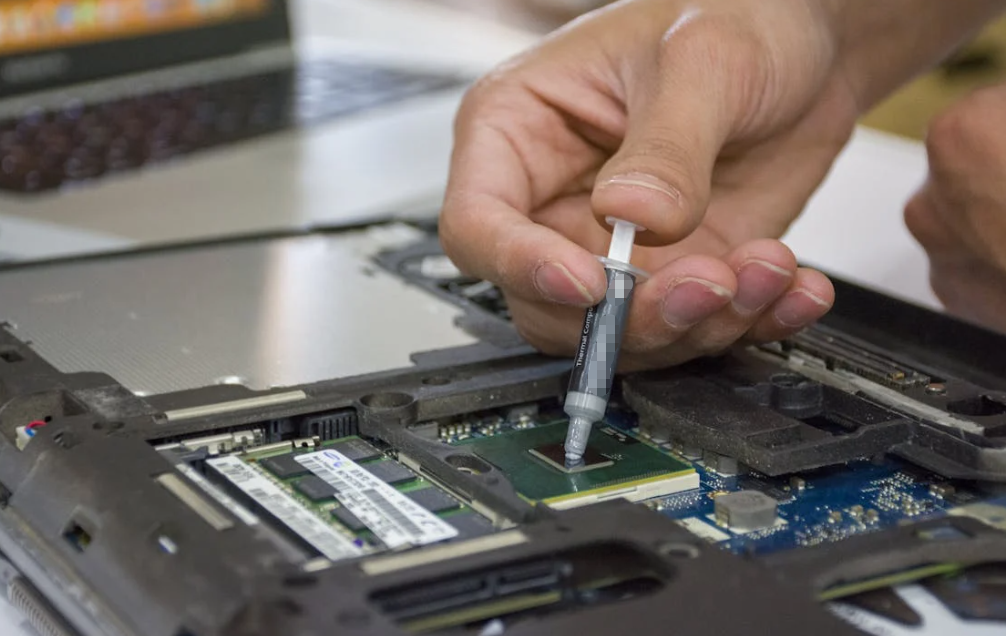
Processors, GPUs, and power modules require efficient heat transfer to prevent overheating and maintain performance. Thermal interface materials such as:
help transfer heat from chips to heat sinks.
High thermal conductivity ensures minimal resistance to heat flow.
Energy Efficiency
Thermal conductivity determines how well buildings, pipes, and insulation materials retain or dissipate heat.
Ví dụ:
- Low conductivity → insulation materials
- High conductivity → heat exchangers
This principle plays a major role in HVAC systems and energy-efficient building design.
Industrial Equipment
Machines such as turbines, batteries, and manufacturing equipment produce heat during operation.
Materials with appropriate thermal conductivity help:
- Prevent overheating
- Improve reliability
- Extend product lifespan
Automotive and EV Batteries
Electric vehicle batteries require strict temperature control. Efficient heat dissipation improves:
- battery safety
- performance
- charging efficiency
Thermally conductive materials are widely used in battery packs and power electronics.
What Affects Thermal Conductivity?
Thermal conductivity is not a fixed number—it depends on several factors.
Material Composition
Different materials conduct heat differently due to their atomic structure.
- Metals have high conductivity because free electrons carry heat efficiently.
- Ceramics and polymers rely mainly on lattice vibrations to transfer heat.
This is why copper and aluminum are commonly used in heat sinks.
Nhiệt độ
Thermal conductivity can change as temperature changes.
Ví dụ:
- In many metals, conductivity decreases at higher temperatures.
- In some non-metal materials, conductivity may increase with temperature.
Density and Structure
The arrangement of atoms or molecules significantly affects heat transfer.
Factors include:
- crystal structure
- bonding strength
- atomic mass
- lattice defects
Highly ordered structures typically conduct heat better.
Porosity
Materials containing air pockets often have lower thermal conductivity because air itself is a poor conductor of heat.
That is why insulation materials such as foam or fiberglass perform well.
Moisture Content
Water has higher thermal conductivity than air, so moisture can increase heat transfer in porous materials.
This factor is especially important in building materials and insulation systems.
High vs Low Thermal Conductivity Materials
Different applications require different thermal conductivity levels.
High Thermal Conductivity Materials
These materials are used for heat dissipation.
Examples include:
- copper
- aluminum
- graphite
- diamond
- graphene
Graphene can reach thermal conductivity values of several thousand W/mK, making it one of the most thermally conductive materials known.
Low Thermal Conductivity Materials
These materials are used for insulation.
Examples include:
- air
- foam
- fiberglass
- rubber
- plastics
Such materials slow down heat transfer and help maintain temperature stability.
Thermal Conductivity vs Thermal Resistance

Another key concept in thermal management is Điện trở nhiệt.
Thermal resistance measures how strongly a material chống lại dòng nhiệt, and it is essentially the opposite of thermal conductivity.
Nói một cách đơn giản:
- High conductivity → good heat transfer
- High resistance → poor heat transfer
Engineers often use thermal resistance to calculate the performance of cooling systems.
For example, thermal interface materials are designed to reduce the total Điện trở nhiệt between electronic components and heat sinks.
Measuring Thermal Conductivity
Engineers use several techniques to measure thermal conductivity.
Common methods include:
Laser Flash Method
This method measures how quickly heat spreads through a sample after a short laser pulse.
It is widely used for solid materials.
Hot Wire Method
A heated wire is placed in the material, and the temperature change is monitored.
This technique is commonly used for liquids, powders, and insulation materials.
Guarded Hot Plate Method
Often used for insulation testing, this method measures steady-state heat flow through a material sample.
Thermal Conductivity in Electronics Cooling
In electronics, thermal conductivity is crucial for effective heat transfer between components.
Typical conductivity ranges for thermal interface materials include:
| Material Type | Độ dẫn nhiệt |
| Keo tản nhiệt | 1–10 W/mK |
| Miếng đệm nhiệt | 3–15 W/mK |
| Graphite sheets | 100–500 W/mK |
Thermal interface materials fill microscopic air gaps between surfaces. Since air has extremely low conductivity (~0.025 W/mK), removing those gaps dramatically improves heat transfer.
Companies like HakTak focus on developing materials with optimized thermal conductivity to enhance heat dissipation in electronics and industrial systems.
Thermal Conductivity in Everyday Life
Although it may sound technical, thermal conductivity affects many everyday situations.
Cooking
Metal cookware heats quickly because metals conduct heat efficiently.
Handles are often made from materials with low conductivity to prevent burns.
Clothing
Winter jackets use insulating materials that trap air and reduce heat loss.
Smartphones and Computers
Modern electronics rely heavily on thermally conductive materials to prevent overheating.
Without proper thermal management, devices could throttle performance or fail.
Choosing the Right Thermal Conductivity
Selecting the correct conductivity depends on the application.
Consider the following factors:
- Heat load
- Operating temperature
- Vật liệu compatibility
- Yêu cầu về cách điện
- Mechanical properties
Ví dụ:
- CPUs require high conductivity thermal paste.
- Building insulation requires low conductivity materials.
- EV batteries require controlled heat spreading.
Balancing these factors is key to effective thermal design.
Kết luận
Thermal conductivity is one of the most fundamental properties in heat transfer. It describes how efficiently a material can move heat from one area to another and plays a critical role in industries ranging from electronics and automotive engineering to construction and energy systems.
Understanding thermal conductivity helps engineers select the right materials, design efficient cooling systems, and improve the reliability of modern technology.
As electronic devices continue to become smaller and more powerful, the demand for advanced thermally conductive materials—such as thermal pads, pastes, and graphene-based solutions—will only continue to grow.
Câu hỏi thường gặp
What is thermal conductivity in simple terms?
Thermal conductivity measures how well a material transfers heat. A higher value means heat moves through the material more easily.
What is the unit of thermal conductivity?
The standard unit is watts per meter-kelvin (W/mK).
Which materials have the highest thermal conductivity?
Materials such as diamond, graphene, copper, and aluminum have very high thermal conductivity.
Why is thermal conductivity important for electronics?
It helps move heat away from chips and components, preventing overheating and improving device performance.
What is the difference between thermal conductivity and thermal resistance?
Thermal conductivity measures how easily heat flows, while thermal resistance measures how much a material resists heat flow.