
Modern electronics are getting smaller, faster, and more powerful. That combination creates one stubborn engineering problem: heat. Whether it is an EV battery module, an LED driver, a telecom power supply, or an industrial control board, excessive heat quietly shortens service life and increases the risk of failure.
This is where thermally conductive potting compounds step in.
At first glance, these materials look similar to ordinary resins or encapsulants. But their job goes far beyond filling empty space. A thermally conductive potting compound protects sensitive electronics from moisture, dust, vibration, chemicals, and thermal shock while simultaneously moving heat away from critical components.
For engineers and manufacturers, that dual role matters. A poorly selected compound can trap heat inside a device. A properly engineered one can dramatically improve thermal management and long-term reliability.
In this guide, we will break down what thermally conductive potting compounds are, how they work, the main material types, thermal conductivity ratings, real-world applications, selection factors, and common mistakes buyers make when sourcing these materials.
What Is a Thermally Conductive Potting Compound?
A thermally conductive potting compound is a liquid encapsulation material designed to surround electronic or electrical components while transferring heat away from them.
After curing, the compound forms a solid or semi-flexible protective layer around the device. Unlike standard potting materials, thermally conductive formulations contain special fillers that improve heat transfer performance.
Most conventional polymers are naturally poor heat conductors. Standard epoxy systems, for example, may only achieve thermal conductivity values around 0.14–0.3 W/m·K. To overcome this limitation, manufacturers add thermally conductive fillers such as:
- Aluminum oxide
- Boron nitride
- Aluminum nitride
- Magnesium oxide
- Ceramic powders
- Silica blends
- Graphite in some specialized systems
The result is a material capable of both environmental protection and heat dissipation.
In practical terms, a thermally conductive potting compound helps electronics run cooler and survive longer.
Why Thermal Management Matters in Electronics

Heat is one of the leading causes of electronic failure.
Every electronic component generates heat during operation. If that heat cannot escape efficiently, temperatures rise inside the enclosure. Over time, elevated temperatures can lead to:
- Component degradation
- Solder joint fatigue
- Reduced electrical efficiency
- Premature capacitor failure
- PCB warping
- Shortened battery life
- Thermal runaway risks
This challenge becomes even more serious in compact electronic designs where airflow is limited.
Industries such as electric vehicles, renewable energy, telecommunications, medical electronics, aerospace, and consumer electronics increasingly rely on thermal management materials because power density continues to rise year after year.
Thermally conductive potting compounds create a thermal pathway between hot components and external heat sinks or metal housings. Instead of allowing heat to remain trapped around semiconductors or coils, the compound spreads and transfers the heat more efficiently.
According to industry technical data, specialized thermally conductive epoxy potting compounds can reach thermal conductivity values above 1.5 W/m·K, while some advanced formulations exceed 3 W/m·K.
How Thermally Conductive Potting Compounds Work

The working principle is relatively straightforward, although the chemistry behind it is highly engineered.
The compound starts as a liquid resin system, usually supplied as:
- One-component material
- Two-component resin and hardener system
Once mixed and dispensed into an enclosure, the material flows around components and fills air gaps.
This is important because air is a terrible conductor of heat. Even tiny voids reduce thermal efficiency. By replacing air pockets with thermally conductive material, heat transfer improves significantly.
After curing, the potting compound forms a dense matrix containing thermally conductive particles distributed throughout the material. These fillers create conductive pathways that allow heat to move through the cured resin.
The compound then transfers heat from:
- Power semiconductors
- MOSFETs
- Transformers
- LEDs
- Battery cells
- Sensors
- PCB hot spots
…toward:
- Aluminum housings
- Heat sinks
- Chassis walls
- Cooling plates
At the same time, the cured material protects the electronics against environmental stress.
That combination of thermal management and physical protection explains why thermally conductive potting compounds are widely used in demanding industrial applications.
Main Types of Thermally Conductive Potting Compounds
Not all potting compounds are the same. Different chemistries provide different balances of thermal conductivity, flexibility, mechanical strength, and chemical resistance.
Thermally Conductive Epoxy Potting Compounds
Epoxy systems are among the most widely used materials in electronics encapsulation.
They offer:
- Strong adhesion
- Excellent chemical resistance
- High mechanical strength
- Good moisture protection
- Reliable electrical insulation
Thermally conductive epoxy compounds are commonly used in:
- Power supplies
- LED drivers
- Automotive electronics
- Industrial control systems
- High-voltage modules
Many epoxy formulations achieve thermal conductivity values between 1.0 and 3.5 W/m·K depending on filler loading.
The tradeoff is rigidity. Once cured, epoxy systems are usually hard and less flexible than silicone alternatives.
This makes them ideal for structurally stable assemblies but less suitable for components exposed to significant thermal expansion mismatch.
Thermally Conductive Silicone Potting Compounds
Silicone-based compounds are valued for flexibility and thermal stability.
Compared with epoxies, silicone systems typically provide:
- Better flexibility
- Improved thermal cycling resistance
- Lower mechanical stress on components
- Wider operating temperature ranges
Silicone potting compounds are often selected for:
- Outdoor electronics
- Automotive sensors
- LED lighting
- Aerospace electronics
- Sensitive circuit assemblies
Their softness helps absorb vibration and mechanical shock.
In harsh thermal cycling environments, silicone compounds can outperform rigid epoxy systems because they reduce stress on solder joints and delicate components.
Thermally Conductive Polyurethane Potting Compounds
Polyurethane systems sit somewhere between epoxy and silicone in performance.
They offer:
- Moderate flexibility
- Good environmental resistance
- Better abrasion resistance
- Lower hardness than epoxy
Polyurethane compounds are commonly used in:
- Transformers
- Coils
- Automotive electronics
- Outdoor electrical assemblies
For applications requiring both toughness and moderate flexibility, polyurethane can be an effective compromise.
Common Thermal Conductivity Values Explained
One of the first specifications engineers check is thermal conductivity, usually expressed in W/m·K (watts per meter-kelvin).
This value indicates how efficiently heat moves through the material.
Here is a simplified reference range:
| Material | Approximate Thermal Conductivity |
| Air | 0.024 W/m·K |
| Standard epoxy resin | 0.14–0.3 W/m·K |
| Basic thermally conductive potting compound | 0.8–1.5 W/m·K |
| Advanced thermal potting compound | 2–5+ W/m·K |
| Aluminum | ~205 W/m·K |
| Copper | ~385 W/m·K |
Most thermally conductive potting compounds for electronics remain electrically insulating.
This is crucial because electronic assemblies often require heat dissipation without electrical conduction.
Ceramic fillers are commonly used because they improve thermal transfer while maintaining dielectric insulation.
Viscosity
Low-viscosity materials flow more easily into tight spaces and around miniature components.
High-viscosity compounds may trap air bubbles if not processed carefully.
Applications with dense PCB layouts often require lower-viscosity formulations.
Hardness and Flexibility
Hard epoxy compounds provide excellent structural stability.
Flexible silicone systems reduce stress caused by thermal expansion and vibration.
The ideal choice depends on the application environment.
Flame Retardancy
Many industrial and automotive applications require UL94 flame-retardant ratings.
Certain epoxy formulations achieve UL94 V-0 performance while maintaining thermal conductivity.
Operating Temperature Range
Some electronics operate in extremely harsh environments.
High-quality thermal potting materials may withstand temperatures from -40°C to +150°C or higher.
Chemical and Moisture Resistance
Encapsulation protects electronics from:
- Water ingress
- Salt spray
- Oil exposure
- Solvents
- Corrosion
- Dust contamination
This is especially important in automotive and outdoor systems.
Applications of Thermally Conductive Potting Compounds
Thermally conductive encapsulation materials are used across many industries.
LED Lighting
LEDs are highly sensitive to heat.
Excessive junction temperature reduces brightness and lifespan. Thermal potting compounds help transfer heat away from LED drivers and modules.
Electric Vehicles
EV systems generate substantial heat in:
- Battery packs
- Inverters
- DC-DC converters
- On-board chargers
Thermally conductive potting compounds improve both thermal management and vibration resistance.
Power Electronics
Industrial power supplies and converters often contain high-power semiconductors that require efficient heat dissipation.
Potting compounds help stabilize temperatures while protecting circuitry.
Telecommunications Equipment
5G infrastructure and telecom power modules operate continuously under demanding conditions.
Thermally conductive encapsulation helps prevent overheating in compact enclosures.
Renewable Energy Systems
Solar inverters and energy storage systems rely heavily on thermal management materials for long-term reliability.
Outdoor exposure also requires strong environmental protection.
Automotive Electronics
Modern vehicles contain dozens of electronic control units.
These modules experience:
- Vibration
- Moisture
- Temperature cycling
- Chemical exposure
Thermally conductive potting compounds help maintain stable operation over long service lives.
Aerospace and Defense
Mission-critical electronics require high reliability under extreme conditions.
Thermally conductive encapsulation materials provide:
- Shock resistance
- Environmental sealing
- Thermal stability
Thermally Conductive Potting Compound vs Thermal Paste
These materials are often confused, but they serve different purposes.
Thermal Paste
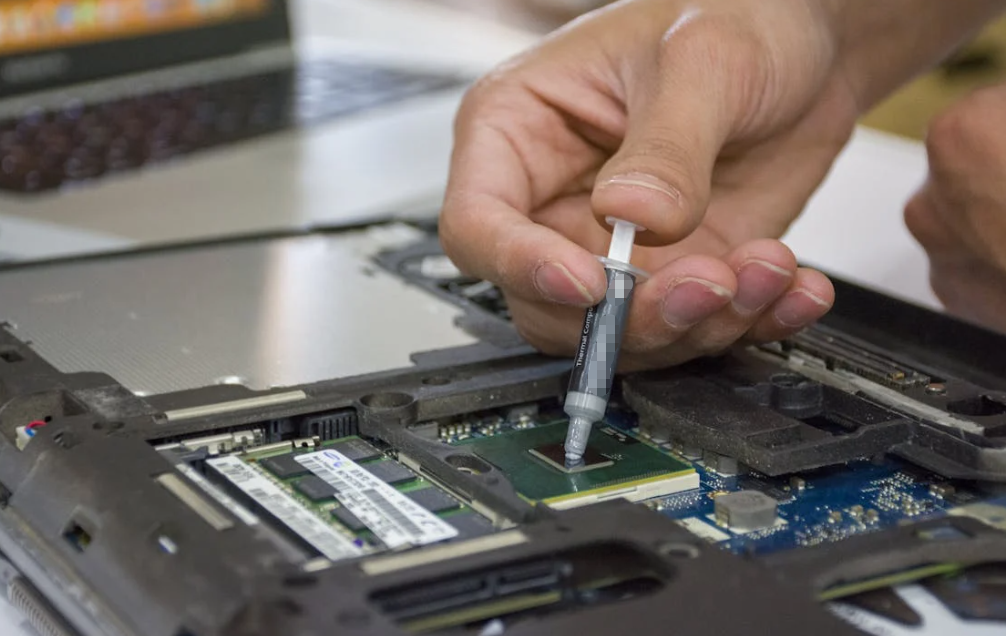
Thermal paste is designed to fill microscopic air gaps between two surfaces, such as a CPU and a heat sink.
It remains semi-fluid and is not intended for structural protection.
Thermally Conductive Potting Compound
Potting compounds fully encapsulate electronic assemblies and cure into a solid or elastomeric material.
They provide:
- Heat transfer
- Mechanical support
- Environmental sealing
- Vibration resistance
- Electrical insulation
Thermal paste is a thermal interface material.
Potting compound is both a protective encapsulant and a thermal management solution.
How to Choose the Right Thermally Conductive Potting Compound
Selecting the wrong material can create serious reliability issues.
Here are the main factors engineers should evaluate.
Thermal Requirements
Start by calculating:
- Heat generation
- Maximum operating temperature
- Heat dissipation path
Higher-power devices generally require higher thermal conductivity.
Mechanical Stress
Rigid compounds may crack sensitive assemblies during thermal cycling.
Flexible systems work better for:
- Automotive electronics
- Outdoor equipment
- High-vibration environments
Dispensing and Processing
Consider:
- Pot life
- Cure time
- Mixing ratio
- Degassing requirements
- Automated dispensing compatibility
Production efficiency matters just as much as thermal performance.
Environmental Exposure
Will the assembly encounter:
- Water?
- Salt fog?
- Chemicals?
- UV exposure?
- Extreme temperatures?
Environmental conditions strongly influence material selection.
Regulatory Requirements
Certain industries require compliance with:
- UL94
- RoHS
- REACH
- Automotive standards
Always confirm certification requirements before material approval.
Common Problems and Mistakes
Even premium materials can fail if used incorrectly.
Air Bubble Entrapment
Air pockets reduce thermal transfer efficiency and may weaken insulation performance.
Vacuum degassing is often necessary for high-reliability applications.
Incorrect Mixing Ratios
Two-part systems require precise mixing.
Improper ratios may cause:
- Incomplete curing
- Soft spots
- Reduced thermal performance
Excessive Rigidity
Hard compounds may place stress on components during expansion and contraction cycles.
This is one reason silicone systems are increasingly popular in automotive electronics.
Choosing Thermal Conductivity Alone
Many buyers focus only on the W/m·K number.
In reality, factors like viscosity, adhesion, flexibility, and reliability are equally important.
Emerging Trends in Thermally Conductive Potting Materials
Thermal management technology continues to evolve rapidly.
Several trends are shaping the industry.
Higher Power Density Electronics
Smaller devices with higher power output demand more advanced thermal materials.
EV Battery Expansion
The rapid growth of electric vehicles is driving demand for lightweight, thermally stable encapsulation materials.
Advanced Ceramic Fillers
New filler technologies improve thermal conductivity while maintaining electrical insulation.
Low-Stress Materials
Manufacturers increasingly seek soft, low-modulus compounds that protect delicate electronics during thermal cycling.
Automated Manufacturing Compatibility
Modern production lines require materials optimized for:
- Robotic dispensing
- Fast curing
- Stable viscosity
- Reduced void formation
Why Material Formulation Matters
Not all thermally conductive potting compounds perform the same, even if thermal conductivity values appear similar on paper.
The formulation itself determines:
- Long-term stability
- Moisture resistance
- Mechanical stress behavior
- Processability
- Adhesion strength
- Thermal aging resistance
This is why experienced manufacturers pay close attention to filler distribution, resin chemistry, and curing behavior rather than focusing on one specification alone.
At HakTak, thermal management materials are engineered for demanding industrial applications where both heat dissipation and reliability matter. In practical engineering environments, consistency often matters just as much as peak thermal performance.
Conclusion
Thermally conductive potting compounds have become essential materials in modern electronics manufacturing.
They do much more than encapsulate components. These advanced materials protect sensitive electronics while helping move heat away from critical areas, improving both performance and lifespan.
As electronics continue becoming smaller and more powerful, efficient thermal management will only become more important.
Choosing the right thermally conductive potting compound requires balancing thermal conductivity, flexibility, electrical insulation, environmental resistance, and manufacturing requirements. There is no universal solution for every application.
For engineers and manufacturers, understanding those tradeoffs is the key to building reliable, long-lasting electronic systems.
FAQs
What is a thermally conductive potting compound used for?
It is used to protect electronic components while transferring heat away from sensitive areas.
Are thermally conductive potting compounds electrically conductive?
Most are electrically insulating because they use ceramic fillers instead of conductive metals.
Which is better: epoxy or silicone potting compound?
Epoxy offers higher strength and chemical resistance, while silicone provides better flexibility and thermal cycling performance.
What thermal conductivity value is considered good?
For many electronics applications, values between 1 and 3 W/m·K are commonly used. High-performance systems may require higher values.
Can thermally conductive potting compounds waterproof electronics?
Yes. Many formulations provide excellent moisture and environmental protection after curing.