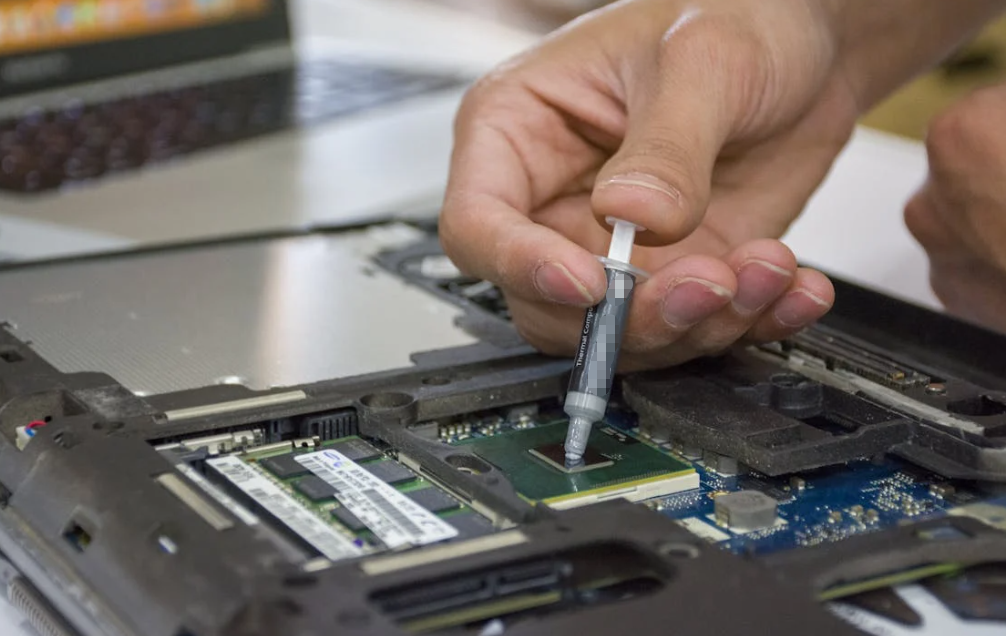
Thermal paste is one of those materials that quietly determines whether a high-performance device runs efficiently—or slowly cooks itself over time. When it performs well, it is invisible. When it fails, the consequences show up quickly: rising temperatures, unstable performance, and in severe cases, hardware damage.
Among the various failure modes of vật liệu dẫn nhiệt (TIMs), powdering—also called chalking or dry-out fragmentation—is one of the most misunderstood. It’s often mistaken as “just drying,” but in reality, it’s a more complex, multi-factor degradation process involving chemistry, physics, and environmental stress.
This article breaks down what causes powdering in thermal paste, why it happens, and how manufacturers and users can prevent it. The perspective is grounded in real-world application behavior, reliability studies, and material science—not just surface-level explanations.
Understanding Thermal Paste at a Material Level
Before diving into failure, it’s worth grounding ourselves in what keo tản nhiệt actually is.
A typical thermal paste consists of three main components:
- Base fluid (carrier): usually silicone oil or synthetic polymer
- Thermally conductive fillers: aluminum oxide, silver, boron nitride, etc.
- Chất phụ gia: stabilizers, thickeners, anti-oxidants
Its job is simple but critical: fill microscopic air gaps between a heat source (CPU, GPU, power module) and a heatsink. Air is a poor conductor; paste replaces it with a conductive medium.
However, thermal paste is not a solid adhesive—it remains semi-fluid. That very property, which enables good thermal contact, also makes it vulnerable to long-term degradation.
What Does “Powdering” Actually Mean?
Powdering is a late-stage failure phenomenon where thermal paste:
- Loses cohesion
- Becomes brittle
- Cracks into fine particles or dust-like residue
- Detaches from the interface
In this state, the material can no longer maintain a continuous thermal path. Air gaps form, and thermal resistance rises sharply.
From a reliability standpoint, powdering is typically the result of combined mechanisms, not a single cause.
Core Causes of Thermal Paste Powdering

Loss of Volatile Components (Carrier Evaporation)
The most fundamental cause begins at the molecular level.
Thermal paste relies on a fluid medium—often silicone oil—to maintain its spreadability. Over time:
- Volatile components evaporate or migrate
- The paste loses viscosity
- The remaining material becomes dry and crumbly
This process accelerates under heat. As one source explains, solvents or liquid components gradually evaporate, leading to drying and brittleness .
Once enough carrier is lost, the filler particles are no longer bound effectively—resulting in powder-like residue.
Key insight: Powdering is not just “drying”—it’s structural collapse after binder loss.
Thermal Cycling Fatigue (Expansion & Contraction)
Electronic devices rarely operate at a constant temperature. Instead, they undergo repeated heating and cooling cycles:
- Power on → temperature rises
- Power off → temperature drops
This constant expansion and contraction causes:
- Mechanical stress within the paste
- Micro-cracking
- Gradual loss of elasticity
Over time, the paste becomes brittle and fractures. This process is well documented as a primary degradation mechanism, where repeated cycles cause the material to “lose its smooth, conductive properties” and crack .
Once cracking starts, powdering often follows.
High-Temperature Oxidation and Aging
Temperature is not just a physical stress—it also drives chemical reactions.
Under prolonged heat exposure:
- Silicone matrices can oxidize
- Polymer chains degrade
- Chemical structure changes
This leads to:
- Làm cứng
- Loss of flexibility
- Increased brittleness
In industrial environments (e.g., power electronics, automotive), this is a dominant failure mode. Oxidative aging alters both the base fluid and filler interaction, accelerating the transition to a powdery state .
Pump-Out Effect and Phase Separation
A less obvious—but critical—cause is the pump-out effect.
During thermal cycling:
- The paste expands and contracts
- Mechanical movement pushes it out of the interface
- The remaining material becomes uneven
At the same time, phase separation can occur:
- The liquid carrier migrates away
- Fillers remain behind
This separation results in a dry, filler-rich residue—essentially a powder layer.
Reliability studies identify pump-out and dry-out as the two dominant failure mechanisms in thermal grease systems .
Filler–Matrix Separation at Elevated Temperatures
At high temperatures, the bond between:
- Polymer matrix (binder)
- Thermally conductive fillers
can weaken.
When the matrix flows or degrades:
- Fillers become loosely packed
- The structure collapses
- Powdering occurs
This phenomenon is especially common in lower-cost formulations with poor dispersion or weak compatibility between components.
Environmental Factors (Humidity, Contamination, Chemicals)
Thermal paste doesn’t operate in a vacuum. Environmental conditions play a significant role:
Độ ẩm
- Can trigger hydrolysis reactions
- Weakens chemical stability
Dust and Contaminants
- Trap heat
- Accelerate degradation
- Introduce structural defects
Chemical Exposure
- Acidic or alkaline gases can degrade materials
Studies show that moisture and environmental exposure can significantly alter điện trở nhiệt and material stability .
Poor Material Formulation
Not all thermal pastes are created equal.
Low-quality formulations often suffer from:
- Low-grade silicone oil
- Poor filler distribution
- Incompatible additives
These issues lead to:
- Faster oil bleed
- Uneven structure
- Early-stage powdering
In practical terms, cheaper pastes may degrade in as little as 1–2 years, while high-quality ones last significantly longer .
Improper Application and Interface Conditions
Even the best thermal paste can fail prematurely if applied incorrectly.
Common issues include:
- Too little paste → incomplete coverage
- Too much paste → increased stress and pump-out
- Uneven spreading → air pockets
Air gaps not only reduce thermal performance but also create localized hotspots that accelerate degradation .
The Hidden Timeline: From Paste to Powder

Powdering doesn’t happen overnight. It follows a progression:
- Initial Stage – Optimal viscosity, full contact
- Early Aging – Slight oil loss, minor viscosity change
- Dry-Out Phase – Reduced flow, micro-cracks
- Fracture Stage – Visible cracking and separation
- Powdering Stage – Crumbly, dust-like residue
In most consumer applications, this process unfolds over 2–5 năm, depending on quality and operating conditions .
Why Powdering Is a Serious Problem
Once powdering occurs:
- Độ dẫn nhiệt drops sharply
- Air gaps dominate the interface
- Heat transfer becomes inefficient
This leads to:
- Rising chip temperatures
- Điều tiết nhiệt
- Reduced lifespan of components
In severe cases, overheating can cause permanent damage to CPUs, GPUs, or power modules.
How to Prevent Thermal Paste Powdering

From a practical and engineering standpoint, prevention focuses on controlling the root causes:
Use High-Quality Formulations
- Stable base oils
- Well-dispersed fillers
- Anti-oxidation additives
Minimize Thermal Cycling Stress
- Stable operating conditions
- Avoid extreme on/off cycles when possible
Optimize Application
- Correct amount
- Even distribution
- Proper mounting pressure
Control Environment
- Reduce dust buildup
- Maintain airflow
- Avoid high humidity
Regular Maintenance
- Replace paste every 2–3 years in demanding systems
- Inspect for signs of drying or cracking
A Practical Insight from Industry Experience
In real-world electronics manufacturing—especially in power electronics and LED modules—powdering is rarely caused by a single factor. It’s usually the result of:
“Heat + Time + Mechanical Stress + Material Limitations”
Remove one factor, and the lifespan increases dramatically. Ignore all of them, and failure accelerates.
This is why premium thermal materials often cost more—they are engineered to resist multiple degradation pathways simultaneously.
Kết luận
Powdering in thermal paste is not a random defect—it is the natural outcome of material aging under thermal, mechanical, and environmental stress.
The key drivers include:
- Sự bay hơi của chất lỏng mang
- Mỏi do chu kỳ nhiệt
- Oxidation and chemical aging
- Pump-out and phase separation
- Tiếp xúc với môi trường
- Poor formulation or application
Understanding these mechanisms allows engineers, buyers, and end users to make better decisions—whether that’s selecting a higher-quality TIM or designing systems that reduce stress on the material.
In the end, thermal paste may be a small component—but its failure can have outsized consequences.
Câu hỏi thường gặp
What is powdering in thermal paste?
It is when thermal paste becomes dry, brittle, and breaks into powder-like particles, losing its thermal performance.
How long does it take for thermal paste to powder?
Typically 2–5 years, depending on quality, temperature, and usage conditions.
Is powdering the same as drying out?
Not exactly. Drying is an earlier stage; powdering is a more severe, advanced degradation stage.
Can powdering be reversed?
No. Once paste powders, it must be removed and replaced.
How can I prevent thermal paste from powdering?
Use high-quality paste, apply it correctly, control temperature and environment, and replace it periodically.