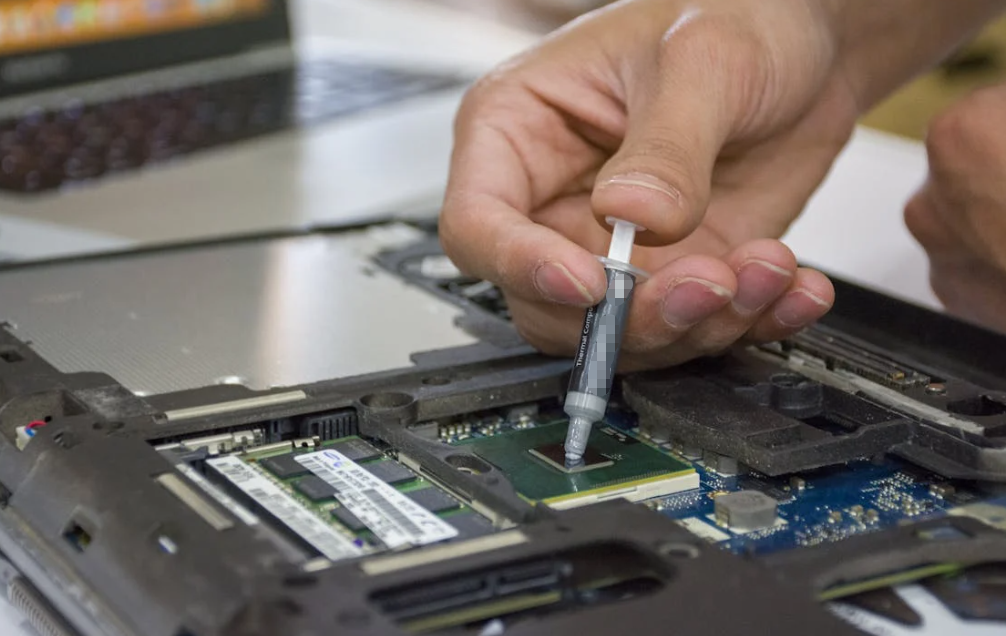
A thermal interface material, or TIM, improves heat transfer between a heat source and a cooling surface. It fills small surface irregularities or a designed gap, helping heat cross a joint that would otherwise contain poorly conducting air.

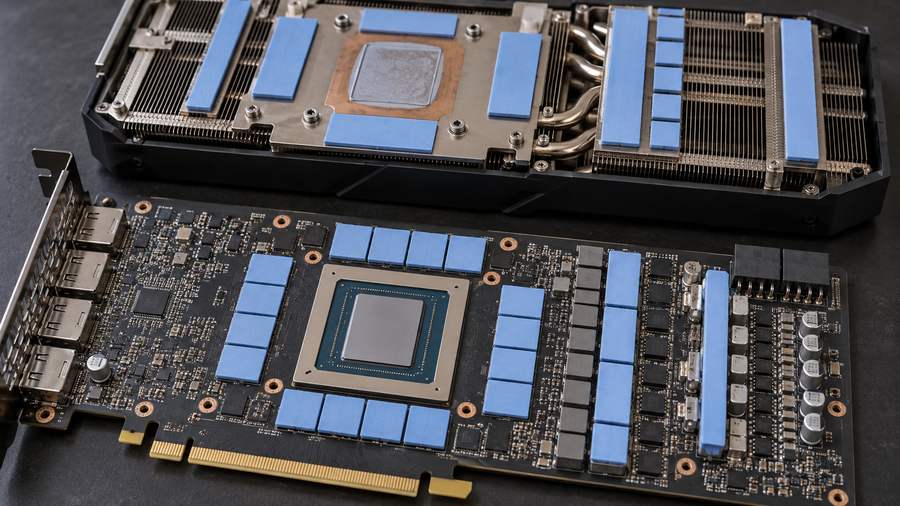
That sounds straightforward until one cold plate has to contact several components of different heights. Now the material must transfer heat, accommodate tolerances, and avoid overloading the board.
For engineers and buyers, the useful starting points are the assembled gap, the available mounting load, and the production process. Those details help you narrow the material family before comparing individual grades or prices.
What Does a Thermal Interface Material Actually Do?
From surface roughness to a usable heat path
Two surfaces can look flat and still touch only at small high points. Their microscopic valleys trap air. Larger gaps can also come from component heights, board curvature, and mounting tolerances.
A suitable TIM conforms to the intended interface and improves the heat path. Think of it as filling the uneven space beneath a tile: the result depends on coverage and contact, as well as the filling material.
The TIM works within a larger cooling system. Heat still needs somewhere to go, whether that is a heat sink, enclosure, or liquid-cooled plate. Better interface material cannot fix an undersized cooler or inadequate airflow.
Identify the interface before choosing the material
The term TIM covers several locations. In common semiconductor packaging terminology, TIM1 connects the die to a lid or heat spreader. TIM2 sits between that lid and the external cooler. MacDermid Alpha uses these distinctions in its public TIM guidance.
Other assemblies connect components directly to housings or cooling plates. Their geometry may require a much thicker, more compliant material.
Write down the two surfaces being joined. Include their materials, flatness, temperature range, and attachment method. A label such as “TIM for power electronics” is too broad to specify a product.
Packaging materials such as solder or sintered metal also require specialized processes. They are not interchangeable with a removable pad used between a circuit board component and its enclosure.
The Main Types of Thermal Interface Materials

Grease and phase-change materials for thin interfaces
Thermal grease, often called thermal paste or heat sink compound, is spreadable and usually non-curing. It can form a thin interface between closely mating surfaces held together mechanically. Review thermal grease options when the assembly supports that kind of joint.
Phase-change materials are designed to soften or transition within specified conditions, improving surface contact. Their performance depends on temperature, pressure, and the final interface. A product becoming softer when warm does not automatically make it a PCM. Compare vật liệu tản nhiệt chuyển pha using their activation and mounting requirements.
Pads, gels, and putty for gap filling
Soft thermal gap pads arrive as sheets or cut shapes. They can suit defined footprints and gaps, provided their compression force remains acceptable.
Dispensable materials can follow complex layouts and component height variation. With chất lấp đầy khoảng trống dạng lỏng, the supplied state, placed volume, rheology, and any required cure all influence the result.
Thermal putty describes a formable or dispensable material, but its name alone does not establish whether it cures or remains soft. “Gel” is similarly broad. Confirm the exact formulation and final state.
| Nhóm vật liệu | Điểm khởi đầu hữu ích | Main checks |
|---|---|---|
| Grease or paste | Thin contact between closely mating surfaces | Coverage, bond line, retention, and aging |
| Vòng đệm | Defined gap with controlled compression | Thickness tolerance, force, and contact |
| Dispensable filler or gel | Complex gaps and automated placement | Volume, flow, voids, mixing, and cure where required |
| Putty | Irregular gaps with controlled placement | Conformability, stability, and removal procedure |
| Vật liệu chuyển pha | Thin interface with suitable operating conditions | Activation, pressure, final thickness, and cycling |
| Keo tản nhiệt | Heat transfer combined with bonding | Surface preparation, cure, stress, and bond durability |
Adhesives and specialist interface materials
If the joint must attach a component, thermally conductive adhesives add a bonding function. Their strength and durability must suit the load. Tackiness in a soft pad or grease does not establish structural capability.
Many polymer-based TIMs combine a matrix with conductive fillers such as alumina or boron nitride. The matrix and filler are different parts of the formulation. A silicone-based material can also be ceramic-filled.
Graphite sheets need attention to direction: heat spreading along the sheet can differ greatly from conduction through its thickness. Graphite also conducts electricity unless the finished construction provides suitable isolation.
Liquid metal requires electrical and surface-compatibility checks. Solder and sintered materials belong to suitable metallurgical attachment processes. These specialist options expand the available toolbox, but none is an automatic upgrade over a polymer TIM in every assembly.
Choose a TIM by Gap, Load, and Thermal Resistance
Measure minimum and maximum assembled gaps
Use the assembled geometry, including tolerances. Record the minimum, nominal, and maximum gap, along with the intended contact area.
At the largest gap, check whether the material maintains contact. At the smallest gap, check the resulting force, displacement, and squeeze-out. A sample that works at the nominal dimension may fail at either end of production variation.
Check pressure, compression, and component limits
Hardness describes indentation behavior. It does not replace compression-deflection data for the actual material thickness and loading conditions.
For pads, ask how much force is needed to reach the intended installed thickness. For dispensables, consider the force generated as material flows during assembly. Large contact areas can produce substantial total load even at modest pressure.
Check the limits of components, solder joints, boards, and fasteners. There is no universal compression percentage that works for every pad.
Compare the complete interface, not conductivity alone
Thermal conductivity, measured in W/m·K, is one part of the picture. Installed thickness and resistance at both contact surfaces also matter.
A simplified, steady-state, one-dimensional model is:
R_interface ≈ R_contact,1 + t / (k × A) + R_contact,2
All resistance terms here use K/W. Thickness t is in meters, conductivity k in W/m·K, and area A in square meters.
Check units when comparing supplier data. Area-normalized thermal impedance, often reported in K·cm²/W, cannot be compared directly with resistance in K/W. Pressure, temperature, thickness, and test method should also be comparable.
A short resistance calculation—and what it leaves out
Consider a hypothetical 1 mm layer with conductivity of 5 W/m·K over a 20 × 20 mm contact area. Its calculated bulk resistance is:
0.001 / (5 × 0.0004) = 0.5 K/W
If 10 W flows uniformly through that layer, its calculated temperature difference is 5°C. Reducing the thickness to 0.5 mm halves the bulk resistance, assuming conductivity and area stay unchanged.
This is an illustrative calculation, not a product test or predicted processor temperature. It excludes contact resistance, spreading effects, and the rest of the cooling system. Thinning a material only helps if it still makes dependable contact and meets the assembly’s other requirements.
Match the Material to the Application

Server processors and cold plates
A processor lid and cold plate may need a thin, stable interface under controlled mounting load. Grease or a suitable PCM can be candidates. Confirm the package requirements, surface geometry, and performance after representative cycling.
Nearby memory or power components may have different gaps. One material does not necessarily serve every interface in the server.
Industrial controls and power supplies
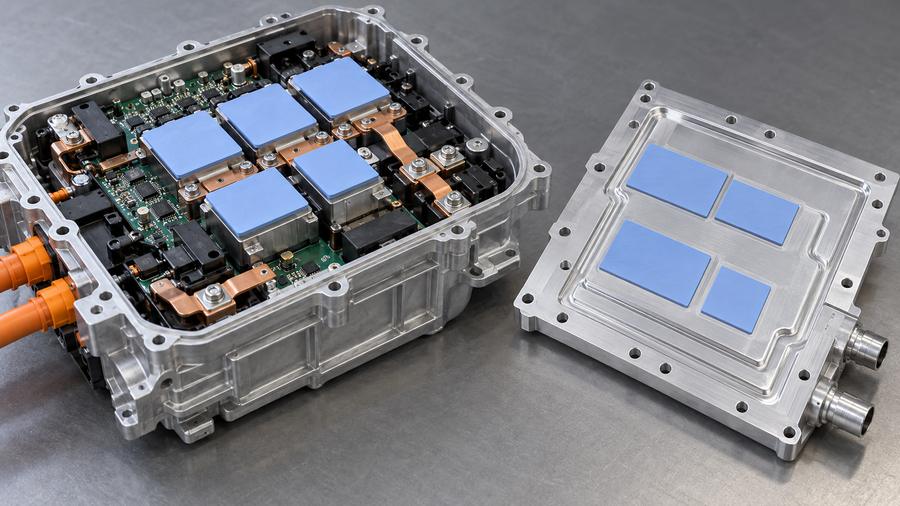
Picture several components sharing an enclosure wall as their cooling surface. Height variation may favor pads or a dispensable filler. Check load on the tallest component and contact at the largest gap.
Electrical requirements can change the shortlist. A thermally conductive material is not automatically electrically insulating, and an insulating material alone does not establish a safe final assembly.
EV systems and outdoor electronics
Battery modules, power electronics, and telecom equipment can involve large areas, vibration, moisture exposure, or repeated temperature changes. Material selection must reflect the particular joint and operating environment.
A battery cooling interface and an inverter’s thin module-to-cold-plate joint may need different approaches. Likewise, a TIM in outdoor electronics should not be assumed to provide environmental sealing. Sealing and heat transfer are separate functions unless the selected product and joint have been qualified for both.
Across these examples, the industry name starts the conversation. The interface details determine the shortlist.

Assembly Can Make or Break TIM Performance
The material and the application process need to be selected together.
For pads, control the cut shape, placement, liner removal, and fastening sequence. Remove designated protective liners, while leaving permanent reinforcement or insulation layers intact. Do not stretch a pad to make it fit.
For dispensables, control the delivered quantity and pattern. Material density matters when converting a required volume into a target mass. Confirm how temperature, equipment, and storage affect dispensing consistency.
Consider a hypothetical enclosure with a broad gap. A bead that closes around its edges before the center fills may trap air. A useful development trial would compare patterns and closure conditions, then inspect coverage. Simply increasing pressure may overload the board without removing the void.
Two-component products need a controlled mix ratio and suitable mixing equipment. Pot life and assembly timing apply where specified. A one-component product may still require curing; “1K” only describes the number of supplied components.
For PCM, confirm the required activation conditions. For adhesives, verify surface preparation, fixture time, and cure. There is no single temperature or waiting period that fits every chemistry.
Document the process that produced the approved sample. Operators and production equipment need to reproduce that interface, including its preparation and assembly sequence.
Test the Interface Before Approving the Material
Read test methods with their conditions
ASTM D5470 addresses measurement of thermal impedance and calculation of apparent thermal conductivity for thermally conductive electrical insulation materials. Referencing the method does not certify a product or prove its performance in your hardware.
Request the test conditions and clarify what the reported value includes. A single conductivity figure cannot describe every thickness and pressure combination.
Electrical evidence needs similar care. Dielectric strength, often expressed as voltage per thickness, differs from breakdown voltage under a particular test. Neither should be treated as an automatic working-voltage approval for the finished assembly.
Where flammability matters, UL’s explanation of plastics combustion testing helps clarify the scope of UL 94 classifications. Check the specific grade and applicable thickness. A material classification does not certify the complete device.
Repeat performance checks after relevant aging
| Validation question | Useful comparison | Lỗi phổ biến |
|---|---|---|
| Does the interface meet the thermal target? | Representative hardware at controlled load and ambient conditions | Comparing unrelated supplier conductivity figures |
| Is the assembly mechanically acceptable? | Contact and load across the tolerance range | Approving only the nominal gap |
| Does contact survive service conditions? | Thermal measurements and inspection before and after relevant aging | Treating an initial result as a lifetime result |
| Can it be serviced? | Removal, cleaning, replacement, and retesting | Assuming “reworkable” means reusable |
Set acceptance criteria before starting the test. Define the allowable temperature rise or interface resistance, the mechanical limits, and the electrical checks that apply. Keep the baseline and aged measurements comparable. Changing the fixture, power, or sensor position halfway through makes the results harder to interpret.
For a production trial, include assemblies near both ends of the gap tolerance. Check more than the easiest sample to build. A material can pass a laboratory coupon test while the actual dispensing or fastening process leaves inconsistent contact. Record those process differences so the team can address their cause.
Choose aging conditions from the intended service environment. Thermal cycling, vibration, and humidity may matter, but their severity and acceptance limits need a reason.
Look for failure mechanisms relevant to the material: movement or pump-out, separation, compression set, cracking, or loss of adhesion. No single mechanism describes every TIM family. Record the thermal result alongside the physical condition so that a change has an explanation.

What Buyers Should Request from a TIM Supplier
A useful request for quotation starts with an application brief. “Please quote a high-conductivity pad” leaves too many decisions open.
Give the supplier:
- A drawing showing contact area, surfaces, and minimum, nominal, and maximum gaps.
- Heat load, operating temperatures, mounting limits, and electrical requirements.
- Placement or dispensing method, available equipment, cycle-time targets, and any cure restrictions.
- Planned order quantities, sample format, packaging needs, and service expectations.
Request the exact grade, technical data sheet, safety data sheet, storage conditions, processing instructions, and relevant test evidence. Ask whether reported values are typical results or guaranteed acceptance limits.
Agree on batch traceability, change notification, minimum order quantity, and lead time. If a backup material is needed, qualify it against the same assembly requirements rather than accepting an apparently similar datasheet.
Compare cost per accepted assembly. A lower price per kilogram may be offset by greater density, higher consumption, purge waste, longer curing, or additional rework. Cut pads bring their own costs, including shape yield, liners, and placement.
Keep the approved sample grade and production supply specification connected. Otherwise, a successful prototype can turn into a different material on the line.
Once the requirements are clear, review the relevant thermal interface material options and request evidence for the shortlisted grades. The goal is a repeatable joint with a documented supply specification.
Kết luận
Choosing a TIM begins with the joint: its gap, surfaces, loading, and manufacturing process. Use those constraints to select a material family, then compare specific grades under relevant conditions.
Validate the initial interface and its behavior after service-related stresses. Give purchasing a clear specification, including processing and acceptance requirements.
A dependable material choice is one the engineering team can verify and the production team can reproduce. That is a more useful target than the highest conductivity number on a brochure.
Câu hỏi thường gặp
What is a thermal interface material used for?
A TIM improves thermal contact between a heat source and a cooling surface. It fills surface irregularities or a designed gap, reducing the effect of trapped air. The surrounding heat sink, cold plate, or enclosure still needs to carry that heat away.
What is the difference between TIM1 and TIM2?
TIM1 commonly refers to the interface between a semiconductor die and its lid or heat spreader. TIM2 commonly connects the lid to an external cooler. Check the package drawing and supplier terminology before treating either label as a complete material specification.
Độ dẫn nhiệt cao hơn có luôn tốt hơn không?
Not by itself. A material with higher conductivity can create more installed resistance if it leaves poor contact or requires a thicker layer. Compare interface performance at the intended gap, pressure, temperature, and assembly conditions, including relevant aging results.
How do I choose between a thermal pad and a gap filler?
Compare the gap range, contact shape, allowable load, and production process. Pads can suit defined footprints and controlled compression. Dispensable fillers can suit complex layouts, but require control of quantity, flow, and any curing. Validate both where the choice remains uncertain.
Can thermal grease replace a thick thermal pad?
Only if the interface is redesigned or verified for that change. Grease usually serves a thin, mechanically mounted joint. A space originally bridged by a thick pad may exceed its suitable application conditions. Check geometry, containment, contact, and electrical requirements.
Are all TIMs electrically insulating?
No. Graphite and liquid metal can conduct electricity, and other formulations vary. Check the selected grade and finished construction. Even an insulating TIM needs assembly-level evaluation for thickness, edges, puncture risk, and the required electrical separation.
Do all thermal gels and putties cure?
No. These names do not fully define the chemistry or final state. Ask whether the material stays soft, sets, or cures, and confirm the applicable conditions. One-component packaging does not prove that a product is non-curing or ready for immediate service.
When should I use a silicone-free TIM?
Consider one when customer specifications or nearby optics, contacts, coatings, or bonding operations restrict silicone-containing materials. Define the actual compatibility requirement. Silicone-free does not automatically mean zero residue, zero outgassing, or better thermal performance, so the selected grade still needs evaluation.
Can a thermal interface material be reused?
That depends on the product and service procedure. Removal can tear, contaminate, deform, or otherwise disturb the interface. Reworkability means the joint can be serviced; it does not necessarily mean the old material can be installed again with unchanged performance.
What information should I send for a TIM quotation?
Provide the interface drawing, gap range, contact area, surfaces, heat load, temperature range, and mounting constraints. Add electrical requirements, production method, expected quantities, and packaging needs. Ask suppliers to identify the proposed grade and provide test conditions alongside performance claims.