In the world of advanced materials and modern manufacturing, UV curable materials have emerged as a vital class of functional substances. From coatings and adhesives to 3D printing and electronics, these materials enable rapid, efficient, and high-performance processing that traditional methods simply can’t match. Below, we examine what these materials are, how they work, why they’re important, and where they are commonly used — all from the perspective of a material science and industrial professional.
1. What Are UV Curable Materials?
At its core, a UV curable material is a formulation that undergoes a chemical transformation — from a liquid or semi-liquid state to a solid polymer — when exposed to ultraviolet (UV) light. The hardening process is initiated by a photochemical reaction called photopolymerization, where energy from UV radiation triggers the rapid cross-linking of reactive molecules.
In other words, instead of waiting for heat-driven evaporation, solvent drying, or multi-component mixing, these materials set in a matter of seconds under controlled light exposure. This is a major departure from conventional thermal curing and makes UV curing highly attractive in high-throughput manufacturing environments.
The basic list of components in a UV curable formulation typically includes:
- Photoinitiators, which absorb UV light and generate reactive species that start the curing reaction.
- Monomers and oligomers, which are the primary building blocks that polymerize and form the solid network.
- Additives such as stabilizers, plasticizers, pigments, or fillers tailored to specific performance needs.
Related Read: MS Polymer Sealant Explained: Benefits, Uses, and Key Advantages
2. How UV Curable Materials Work
The mechanism behind UV curing hinges on a few well-orchestrated steps in chemistry and light activation:
- Application of the liquid material: The uncured resin, ink, adhesive, or coating is applied to the intended surface. This could be through spraying, printing, brushing, or dispensing in manufacturing.
- Exposure to UV light source: A UV lamp, LED array, or other UV-emitting device targets the applied material with specific wavelengths that activate the photoinitiators.
- Photochemical activation: Upon absorbing UV photons, photoinitiators generate free radicals or cations. These reactive species rapidly trigger polymerization, binding monomers and oligomers into a solid polymer network.
- Solidification and cross-linking: Within seconds or minutes, the initially liquid material becomes a tough, crosslinked solid with enhanced mechanical and chemical properties.
This entire sequence bypasses heat-dependent reactions, making UV curable materials especially useful for thermally sensitive substrates.
3. Key Characteristics That Set UV Curable Materials Apart
UV curable materials benefit from several unique properties that distinguish them from traditional solvent-based or heat-cured systems. The following points outline these advantages in professional terms:
Ultra-Fast Curing
Cure times are typically measured in seconds rather than minutes or hours. This allows manufacturers to significantly accelerate production cycles and improve throughput.
Low Thermal Impact
Curing occurs at or near room temperature with minimal heat generation, making UV curable materials ideal for substrates that warp, degrade, or soften under heat — such as plastics, films, wood, or composites.
Environmental Advantage
Most UV curable formulations are solvent-free or contain low levels of volatile organic compounds (VOCs), reducing environmental emissions and improving workplace safety.
High Performance Properties
Once cured, these materials typically exhibit:
- Excellent chemical and abrasion resistance.
- High adhesion to various substrates, including metals, glass, and polymers.
- High gloss, hardness, and dimensional stability.
Formulation Flexibility
By tailoring the mix of monomers, oligomers, and additives, UV curable materials can be designed for specific hardness, flexibility, optical clarity, or electrical properties.
4. How UV Curing Compares with Thermal Curing
Traditionally, many materials have relied on heat-driven or two-component curing systems. These methods tend to involve:
- Oven baking or infrared heating.
- Long cure times (30 minutes to several hours).
- High energy consumption.
By contrast, UV curing eliminates much of this overhead:
- No ovens or heat chambers are needed.
- UV materials cure in seconds.
- Energy and production costs are reduced drastically.
Additionally, UV curing can deliver 100% solid curing — meaning nearly all applied material becomes part of the final product, with minimal waste or off-gassing.
5. Common Applications Across Industries
UV curable materials have wide-ranging industrial relevance due to their versatility and performance. Here are several high-impact applications:
Coatings
Used in protective finishes for wood, metal, and plastics, UV coatings enhance hardness, gloss, and chemical resistance — especially on heat-sensitive substrates like furniture or flooring.
Printing & Packaging
UV curable inks and coatings enable high-speed printing on various materials — including films, foils, paper, plastics, and metals — without waiting for solvent evaporation.
Electronics & PCB Assembly
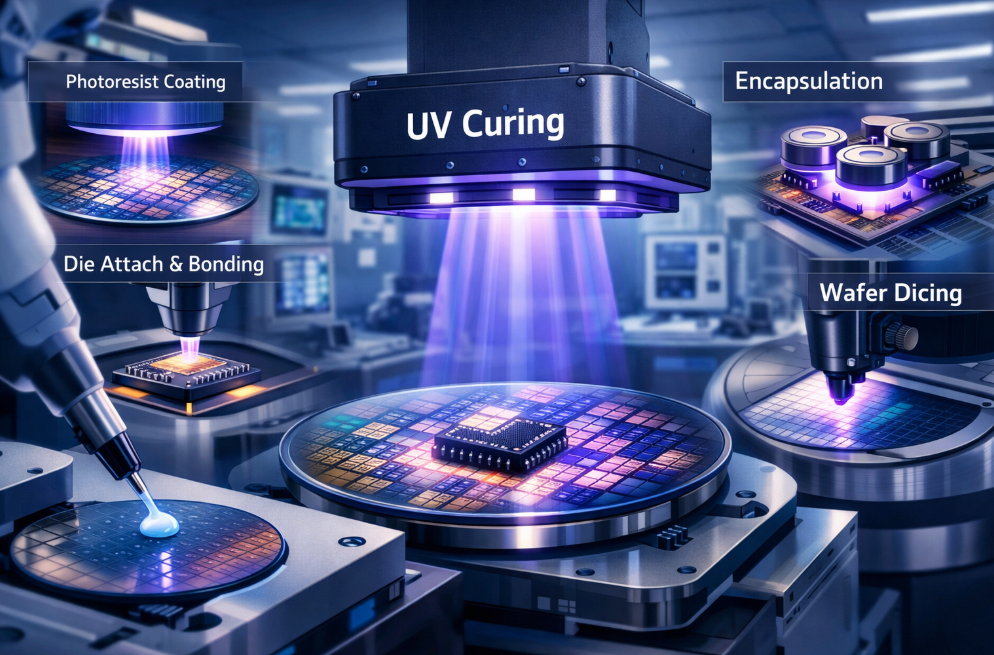
UV curable adhesives and encapsulants protect delicate electronic components and printed circuit boards (PCBs) from moisture and mechanical stress, supporting rapid assembly lines.
Dental & Medical Devices
Dentistry heavily relies on UV curable composites for fillings, sealants, and restorative work, where precise, fast curing is essential. UV curing is also used in bonds and coatings on medical equipment.
3D Printing & Rapid Prototyping
In additive manufacturing, UV curable resins are the cornerstone of stereolithography (SLA) and digital light processing (DLP), delivering high resolution and surface quality in parts.
Optical & Precision Components
UV curable materials are used in coatings for displays, touch panels, and lenses where optical clarity and surface hardness are critical.
6. Challenges and Considerations
While UV curable materials offer many benefits, they also come with practical considerations:
- Depth Limitations: UV light penetration is limited, so curing thick or opaque sections may require special equipment or multiple passes.
- Bulb/Wavelength Matching: The UV source must match the photoinitiator’s absorption spectrum to ensure efficient curing.
- Safety Protocols: Operators must shield eyes and skin from direct UV exposure and handle materials with appropriate PPE.
7. Conclusion
UV curable materials represent one of the most transformative advances in materials processing over the past few decades. By harnessing ultraviolet light to trigger rapid polymerization, industries can achieve faster production, better performance, and greener manufacturing practices. Whether it’s coating a luxury wood floor, printing vibrant packaging, bonding electronics, or 3D printing intricate parts, UV-curable systems deliver a compelling blend of speed, precision, and versatility that continues to expand their industrial footprint.
8. Frequently Asked Questions (FAQs)
What does “UV curable” mean?
It refers to materials that solidify through a chemical reaction when exposed to UV light.
How fast do UV curable materials cure?
Typically in seconds to a few minutes under a proper UV source.
Are UV cured materials heat resistant?
Cured polymers often have good thermal and chemical resistance but vary by formulation.
Is UV curing better than thermal curing?
For many applications, yes — due to faster cure, lower energy use, and environmental benefits.
Where are UV curable materials commonly used?
In coatings, inks, adhesives, electronics, dental devices, and 3D printing.