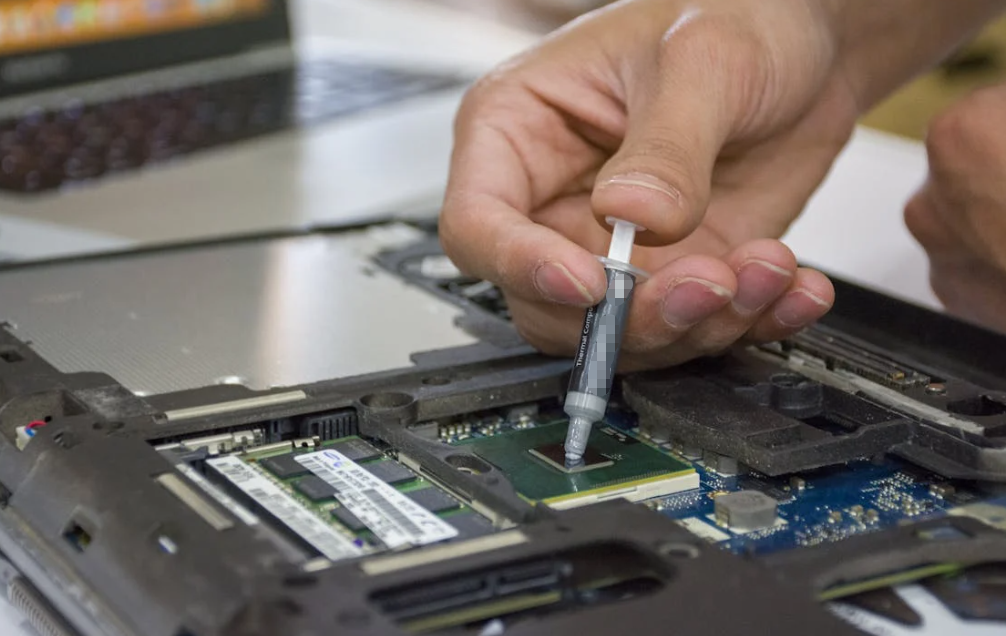
A chip gets hot. A metal heat sink sits on top of it. They look like a perfect match until you zoom in. Both surfaces have tiny hills and valleys, and those valleys trap air. Imagine putting two clean dinner plates together: they seem flat, but they do not touch at every point. Thermal grease fills the little spaces between electronic parts and their cooling hardware.
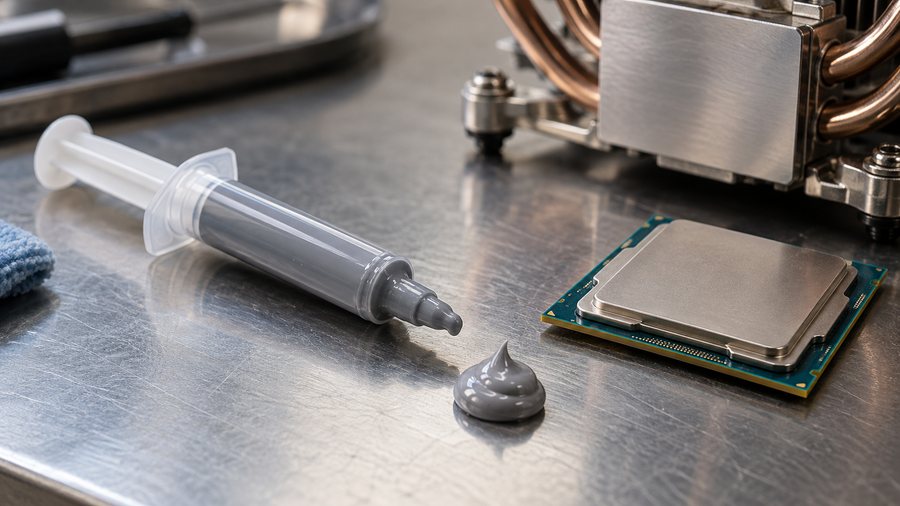
That sounds like a small job. It is. Yet a small bottleneck in the wrong place can leave a processor throttling or a power module running hotter than expected. Let’s follow the heat, see what the grease actually changes, and work out when another material would be the smarter choice.
Where Thermal Grease Fits in the Cooling Path
Thermal grease is a soft, spreadable matériau d'interface thermique, or TIM. You may also see it called thermal paste, thermal compound, heat sink compound, or CPU paste. In ordinary product descriptions, these names often refer to the same basic type of material. Specific formulations still behave differently, so the data sheet wins over the label on the tube.
The heat path in a typical assembly looks like this:
Hot chip or power device → package or heat spreader → thin interface → heat sink or housing → surrounding air or coolant.
Grease works at that thin interface. It does not make heat disappear. It helps heat cross from one solid surface to another. The heat sink, cold plate, fan, liquid loop, or enclosure then has to carry the heat away.
This matters during troubleshooting. If the interface is already good but the fan is blocked or the sink is too small, a premium paste will not rescue the design. That is a little like making the doorway wider when the hallway beyond it is packed.
Why two flat faces still trap air
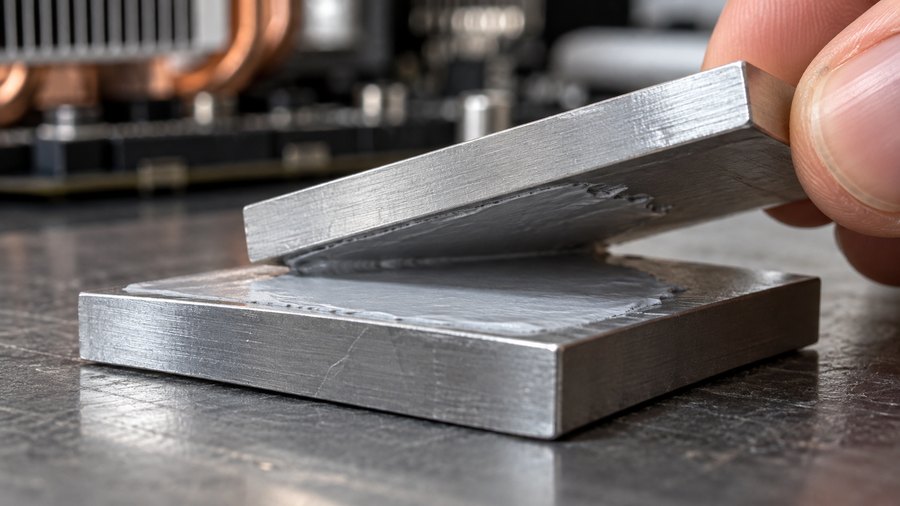
Even polished metal has microscopic roughness. Tighten a heat sink against a chip package and some high spots touch, while the low spots remain separated. Air occupies those spaces. It is a much poorer route for heat than a suitable filled compound.
Grease flows into those valleys under assembly pressure and wets the two surfaces. The aim is a continuous, thin layer that displaces air without holding the parts farther apart than necessary. Metal-to-metal contact where the high spots meet remains useful; paste is there to deal with the spaces they leave.
Think of grout between uneven tiles, except this joint should be much thinner. The detailed mechanics and handling are covered in HAKTAK’s guide to how thermal grease works and is applied. Here, the bigger question is what that joint does for the whole cooling system.
What Is Thermal Grease Made Of?
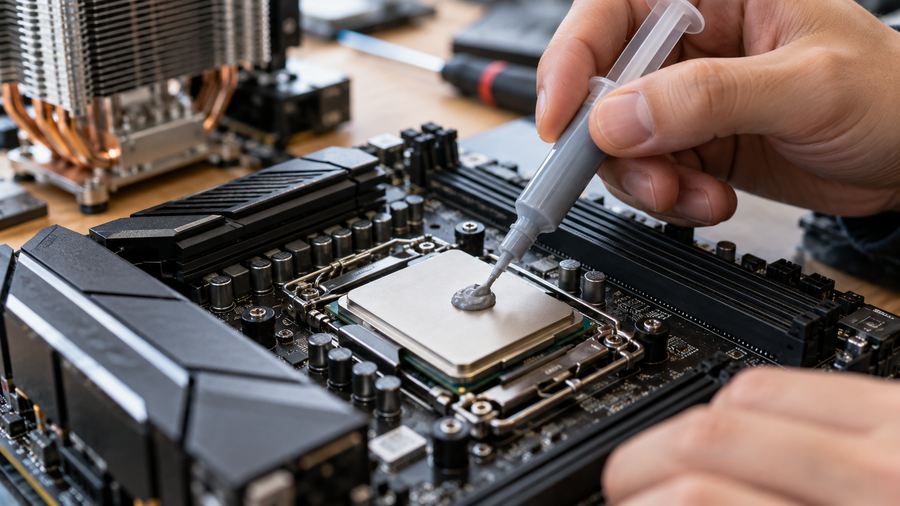
Most familiar greases have two main ingredients: a carrier that makes the material spreadable and thermally conductive particles suspended in it. The carrier may be silicone based or silicone free. Fillers can include metal oxides such as zinc oxide or alumina, ceramic materials such as boron nitride, and, in some formulations, carbon or metal particles.
The choice changes more than a headline conductivity number. It changes viscosity, how the compound spreads, how it survives storage and repeated heating, and whether it fits the assembly process. A thick, highly filled compound might look impressive on paper but resist spreading under a light clamp. A material that spreads beautifully on day one may need a closer look for long term pump-out or oil separation.
Silicone is common because it can give a workable, stable carrier. Silicone free options exist where migration or contamination of nearby surfaces is a concern. Neither family is automatically better. Check the actual application and supplier evidence.
One more thing: do not assume every grease is electrically insulating. Many ceramic filled products are formulated for electrical insulation. Others may contain conductive ingredients or have electrical behavior that makes accidental contact with traces risky. Liquid metal is a separate, electrically conductive TIM category; it also has compatibility limits with certain metals. If electrical clearance matters, read the product’s electrical properties and assembly guidance before the syringe goes anywhere near the board.
How Grease Improves Heat Transfer — and Why More Can Hurt
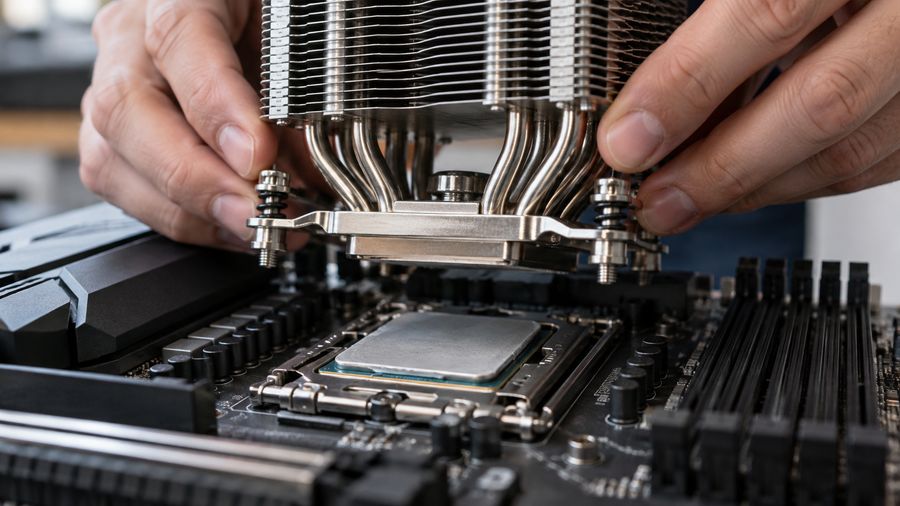
What matters is the resistance of the interface installée, not how shiny or thick the applied material looks. There are three parts to consider: contact between the hot surface and grease, heat traveling through the grease, and contact between grease and cooler.
For a uniform layer in a simple, one dimensional model, the bulk part can be estimated as:
R<sub>bulk</sub> ≈ t ÷ (k × A)
Voici, t is layer thickness, k est la conductivité thermique, et A is the effective area carrying heat. The relation is useful for direction, not a complete prediction of real hardware. It leaves out both contact resistances, uneven pressure, edge effects and changes over time.
If the same grease ends up twice as thick under otherwise identical conditions, its en vrac resistance doubles in this simplified model. That is why adding a thick cushion of paste is a poor fix for a badly fitting sink. You gain material thickness while the real problem, the gap or mounting geometry, stays put.
| État de l’interface | Likely result | Better next move |
|---|---|---|
| Dry rigid surfaces with microscopic gaps | Air remains in surface valleys; contact resistance can rise. | Use a suitable thin TIM and consistent mounting pressure. |
| Even, thin grease layer under proper clamp load | Air is displaced while the heat path stays short. | Check coverage and installed temperatures under a repeatable load. |
| Thick layer bridging a large or uneven gap | More bulk resistance; grease may move or leave poor coverage over time. | Correct the geometry or assess a pad, putty or gap filler. |
Conductivity is a material property; performance is an assembly result
Thermal conductivity is normally reported in W/m·K. It tells you how readily heat travels through the material in specified test conditions. Thermal resistance, often in K/W ou °C/W, describes the temperature difference across a particular heat path per watt of heat flowing through it. Supplier data may also report thermal impedance normalized by area, so check the units before putting two numbers side by side.
For a clearly labeled illustration, a 60 W heat flow across an interface measured at 0.10 K/W would mean roughly a 6 K temperature difference across that interface. It says nothing by itself about the chip’s final temperature, because the package, sink and air path add their own resistance. This is arithmetic, not a claim about a HAKTAK product or a typical device.
A paste with a higher reported W/m·K can lose to another paste if it leaves a thicker bond line or poorer contact under your actual clamp force. HAKTAK’s explanation of Conductivité thermique comparée à la résistance thermique goes deeper on that distinction. For this guide, remember the practical test: compare materials after mounting them as the product will be mounted.
Where Does Thermal Grease Make Sense?
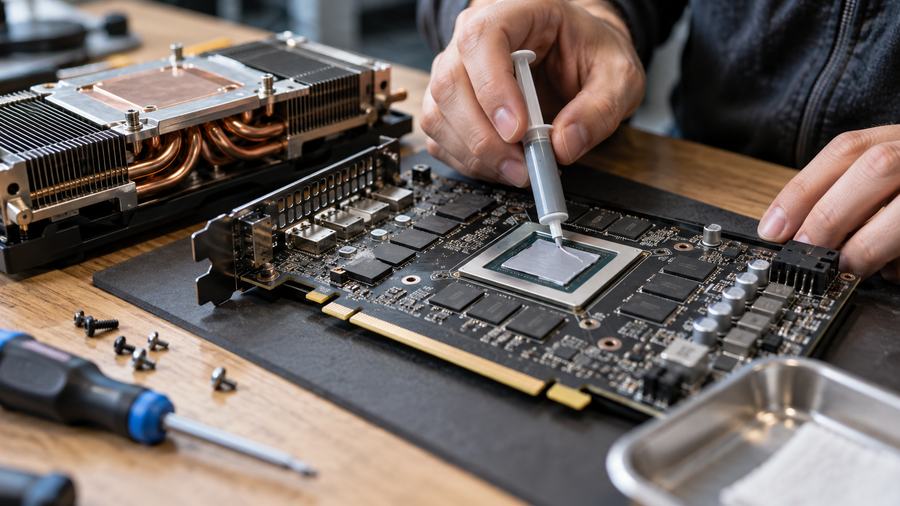
The classic example is a desktop CPU. Its metal heat spreader meets a cooler base with substantial, controlled mounting pressure. A thin paste layer deals with the small surface defects between them. A GPU cooler may use grease on the processor itself, while pads or another gap material sit over surrounding memory or power components. Mixing up those positions is an easy way to create a fit problem.
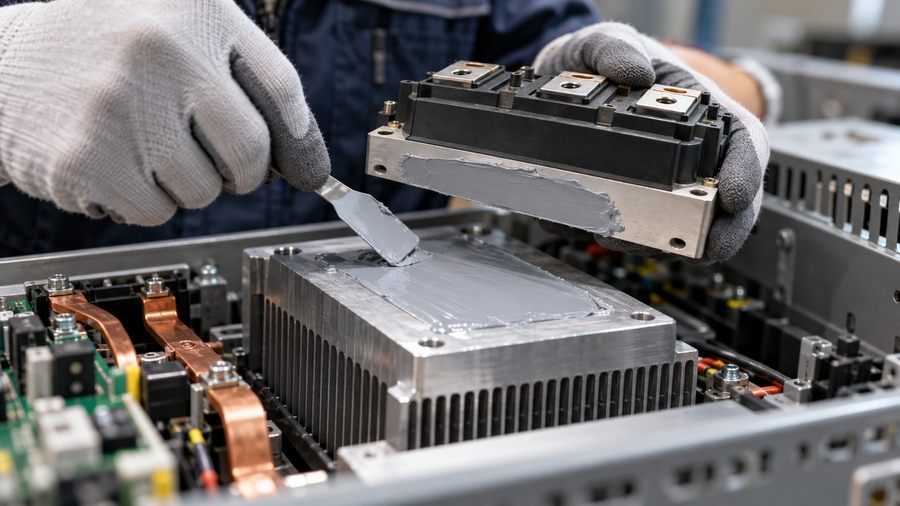
Power electronics bring the same idea into a different package. A MOSFET assembly, an IGBT module, or a converter can transfer heat into a bolted heat sink or metal chassis. Here, the engineer also has to consider the module’s baseplate, any separate electrical insulation, screw torque, operating temperature and thermal cycling. Grease does non provide structural fastening or automatically replace an electrical insulation sheet.
In LED lighting, a metal core board may transfer heat toward a housing. A thin interface can help where the surfaces and clamping suit it. In industrial controls or telecom equipment, a power supply or radio component may be tied thermally to an enclosure. Again, the real question is whether the assembled joint is thin, well supported and serviceable. A weatherproof box does not make every internal interface a grease joint.
The common thread is easy to miss: grease likes close, fairly rigid mating surfaces. It is not a general stuffing material for every empty space in an electronics box.
Choosing Grease for the Assembly You Actually Have
Start with the mechanical drawing, not a list of products ranked by W/m·K. Where does the heat start? Where does it have to go? What is the assembled gap across the full tolerance range? How much pressure can the component safely take? If those answers are fuzzy, a new compound will not make the design predictable.
Then look at dispensing. A viscous grease that stays neatly in place may suit one process but be hard to spread in another. Hand assembly and automated dispensing need different repeatability checks. Temperature range, storage, rework and the expected number of heat cycles matter as much as first day performance.
| Design question | Pourquoi c'est important | À vérifier |
|---|---|---|
| Is the gap thin and consistent when clamped? | Grease needs a controlled bond line. | Tolerance stack, surface flatness, final mounted thickness. |
| Is there enough safe mounting pressure? | Pressure helps the compound wet both surfaces. | Hardware design, torque guidance, component stress limits. |
| Does the circuit need electrical isolation? | Thermal contact and electrical insulation are separate requirements. | Product electrical data, creepa ge/clearance design, any required insulator. |
| Will it see repeated temperature swings? | Material can migrate or separate over time. | Cycling data, oil bleed, pump-out and end-of-test coverage. |
| How will operators apply and inspect it? | A good lab result is hard to copy with an unstable process. | Dispense volume, pattern, storage, inspection and rework steps. |
Ask suppliers for the conditions behind each number: test method, pressure, bond-line thickness and whether the reported value is bulk conductivity or measured interface impedance. Ask what the formulation does after aging and cycling. Henkel’s thermal grease overview likewise frames selection around viscosity, thermal resistance, conductivity and gap size; those are useful questions, even when comparing other suppliers.
Finally, shortlist candidates for your own build and test them at the intended power and ambient conditions. HAKTAK’s thermal grease product range is a sensible next stop once you have a gap, pressure and electrical requirement to discuss. If you need a fuller purchasing checklist, see its guide to choosing thermal paste. A supplier can help narrow samples; the mounted device still has the final say.
When Another Interface Material Is a Better Fit
Grease is only one tool in the TIM drawer. A pad may be easier to place in a repeatable thickness. Putty can accommodate taller or uneven features. A phase change material (PCM) can be handled as a preform and soften at operating temperature. None is universally better; each solves a somewhat different geometry and production problem.
| Interface situation | Material to evaluate first | Watch for |
|---|---|---|
| Thin, clamped, rigid-to-rigid joint | Thermal grease or an appropriate PCM | Coverage, bond-line thickness, cycling stability. |
| Defined gap needing a clean pre-cut part | Compressible thermal pad | Compression force and real contact across tolerances. |
| Uneven component heights or a larger variable gap | Mastic thermique ou matériau de remplissage d’interstices extrudable | Dispense volume, stress on parts, migration and rework. |
| Joint that must hold parts together | A qualified thermal adhesive and mechanical design | Bond strength, serviceability and electrical requirements. |
Suppose a PCB has three chips at different heights beneath one metal lid. Smearing extra grease over the shorter chips is tempting. The lid still cannot press equally on all three. That is a geometry problem. A material designed to fill a larger, uneven space, such as thermal putty for electronics gaps, deserves evaluation. Better yet, examine whether the lid or standoff design can be corrected.
A PCM may suit a factory that wants a defined placement and cleaner handling, but its final performance depends on the activation temperature and installed conditions. A pad may make service easy, yet an overly firm pad can push on a delicate component. There is always a mechanical bill to pay.
Too Much, Too Little, and What Happens Later
The most common mistake is treating grease like frosting. A thick visible coating feels reassuring. Under the cooler, though, it can create needless distance between the hot part and the metal meant to carry heat away. Too little can leave dry patches. The right amount is whatever produces full intended coverage and a thin, controlled bond line for that interface.
For a familiar desktop CPU, follow its cooler and processor instructions. Intel’s processor application guide discusses cleaning, pre-applied paste and mounting. Its suggested dot size belongs to that PC context; do not turn it into a universal rule for an IGBT baseplate or long LED board.
Other trouble spots can masquerade as a bad compound:
- Poor seating or uneven torque. One corner has good contact; another does not.
- Contamination. Dust, old residue or a protective film remains on a surface.
- Air introduced during assembly. A repeated lift and reseat can disturb the fresh interface.
- Pump-out. Repeated expansion and contraction can push some materials away from the contact zone.
- Oil bleed or drying. The formulation can change with storage, temperature and time.
- A weak cooling path downstream. Dusty fins, a stopped fan or a small enclosure keep the heat from escaping.
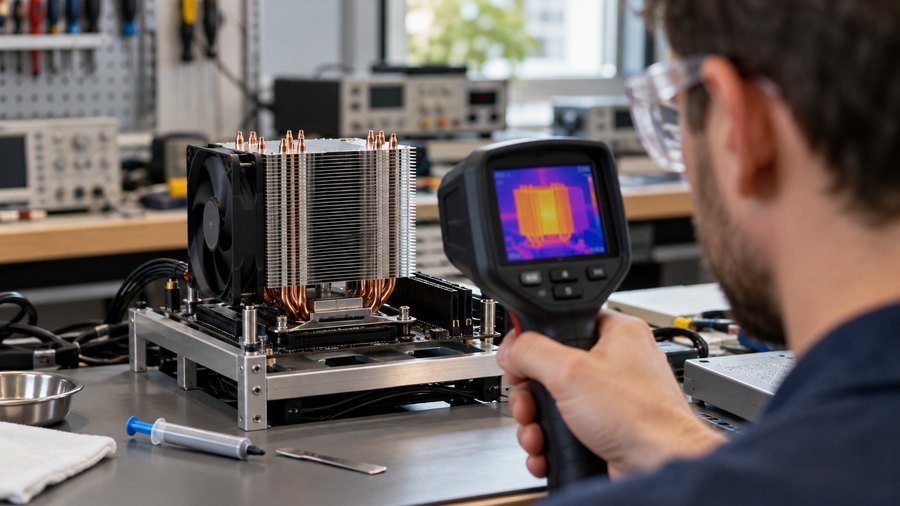
If temperatures rise, record the workload and ambient temperature first. Inspect fan speed and heat sink seating. Only then decide whether to open the joint. When you do open it, photograph the coverage pattern. That messy imprint can tell you more than a fresh tube’s marketing sheet.
Standards and Checks for an Honest Comparison
One commonly cited laboratory method is ASTM D5470-17(2024), a test method for thermal transmission properties of thermally conductive electrical insulation materials. Its scope and reported conditions matter. A test-method reference is non a blanket safety certificate or proof that a grease will perform the same way in every finished product.
Compare supplier measurements made with documented thickness and pressure. Ask whether interface contact resistance is included, and check that units match. Then verify the candidate in your own mounted stack. For electrically sensitive or regulated assemblies, the applicable dielectric, flammability and environmental requirements come from the finished product’s design and market, not from a generic promise that “thermal grease meets the standard.”
Conclusion
Thermal grease has a modest job with a big effect: it replaces trapped air at a thin, clamped contact between a hot component and its cooling hardware. It does not replace a good heat sink, sound mounting, electrical insulation where needed, or a sensible airflow path.
So start with the assembly. Measure the gap. Check the pressure. Compare the installed interface rather than one W/m·K number. If the surfaces sit too far apart, reach for a material built for that gap. If the cooler cannot shed the heat, fix the cooler. Simple enough, though the details under the screws still count.
Foire aux questions
Est-ce que le graisse thermique est la même chose que la pâte thermique ?
Usually, yes. Thermal grease, thermal paste, heat sink compound and thermal compound are common names for spreadable thermal interface materials. Product chemistry varies, and some suppliers use “gel” for quite different gap fillers. Check the specific data sheet when choosing a material.
Can a CPU or power device run without thermal grease?
A cooling assembly still needs a reliable path across the interface. Some coolers already have a factory-applied TIM, so adding grease would be unnecessary. Bare metal faces may trap air and perform poorly. Follow the device and cooler maker’s instructions rather than assuming “no visible paste” means “no interface material.”
Does grease cool a component by itself?
No. It helps heat move into a heat sink, cold plate or housing. That cooling structure must move the heat onward. A great interface under a blocked fan still ends in a hot device.
La graisse thermique est-elle conductrice de l’électricité ?
It depends on the formulation. Many ceramic filled greases are designed to be electrically insulating, while other compounds and liquid-metal products create different risks. Never infer electrical safety from color or the word “paste.” Check the supplier’s electrical specifications and your board clearances.
How much thermal grease should I apply?
Enough to cover the intended contact area once clamped, without building a thick layer or spilling onto sensitive parts. The amount depends on surface area, viscosity, dispense pattern and pressure. A desktop CPU instruction does not directly translate to a power module.
Does a higher W/m·K rating always mean lower temperatures?
No. Conductivity describes the material under test conditions. Final temperatures depend on thickness, contact, pressure, heat sink capacity and the rest of the thermal path. Compare mounted interface resistance under the same conditions when possible.
À quelle fréquence faut-il remplacer la pâte thermique ?
There is no useful universal calendar rule. Look for a change in operating temperature under comparable load and ambient conditions, physical evidence of degradation, or a need to remove the cooler for service. Some assemblies remain stable for years; others face tougher cycling and need qualification accordingly.
Can I reuse grease after lifting the heat sink?
Fresh material on properly cleaned surfaces is usually the more reliable way to restore even coverage. Lifting and reseating can trap air or disturb the old layer. Follow the component maker’s handling instructions, especially for delicate or insulated power devices.
Should I use grease or a thermal pad for a large gap?
For a defined larger gap, a pad or suitable gap filler is often a better starting point. Grease is aimed at a thin joint. Compare the gap’s minimum and maximum dimensions, pad compression force, thermal resistance and service requirements in the real assembly.
Why is my device still hot after repasting?
Check mounting pressure, cooler seating, workload, ambient temperature, fan or pump operation, heat sink dust and enclosure airflow. Also check whether the gap is too large for grease. Repasting changes one section of the path; it cannot repair a bottleneck somewhere else.