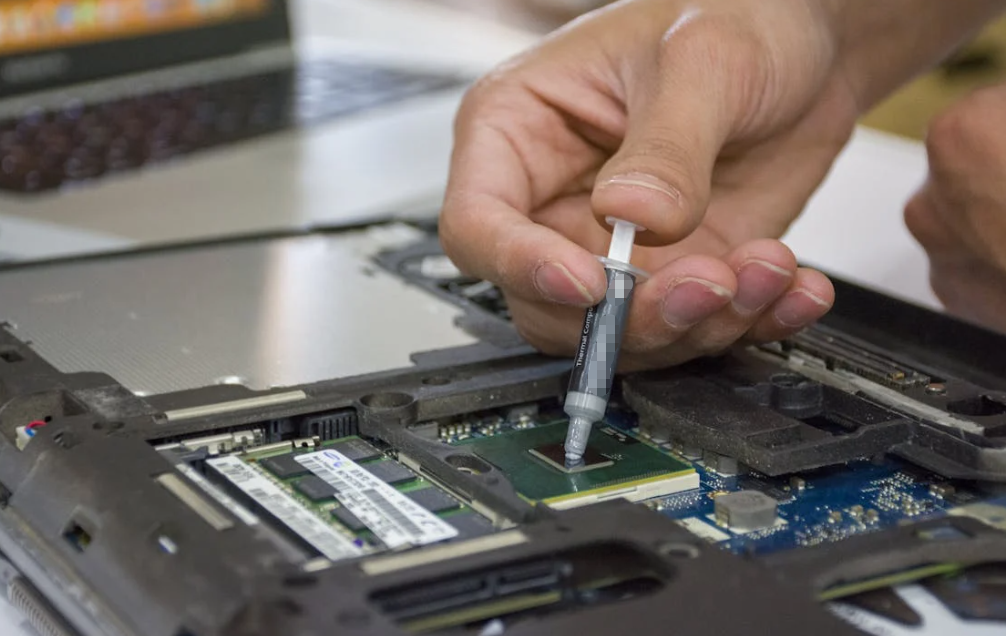
When people talk about PC cooling, the spotlight usually lands on bigger hardware: larger heatsinks, faster fans, thicker radiators, or advanced liquid cooling systems. Yet one of the smallest components in the entire thermal chain often decides whether a processor runs comfortably at 72°C or constantly hovers near thermal throttling.

That component is thermal grease.
Also called thermal paste or thermal interface material (TIM), thermal grease sits between a processor and its cooler. It looks insignificant. A pea-sized drop. Sometimes less. But the physics happening inside that thin layer directly influence heat transfer efficiency, system stability, fan noise, and even long-term hardware reliability.
For gaming PCs, industrial control systems, AI workstations, servers, LED modules, automotive electronics, and power devices, the quality of thermal grease can reshape the thermal behavior of the entire system.
At HakTak, thermal management materials are designed around one practical goal: improving thermal conductivity while maintaining long-term stability under real operating conditions. To understand why this matters, it helps to start with a simple question.
Why Thermal Grease Exists in the First Place
A CPU heat spreader and a heatsink may appear perfectly flat to the naked eye. Under magnification, however, both surfaces are filled with microscopic imperfections, grooves, and air pockets.
Air is a terrible conductor of heat.
When a heatsink is mounted directly onto a processor without thermal grease, these tiny air gaps trap heat and dramatically reduce thermal transfer efficiency. Research comparing systems with and without thermal grease showed CPU temperatures climbing to 100°C within a short period under load conditions.
Thermal grease solves this problem by filling microscopic voids and creating a more continuous thermal pathway between the heat source and the cooling solution.
In simple terms:
- The CPU generates heat
- Thermal grease transfers heat efficiently
- The heatsink disperses the heat
- Fans or liquid cooling remove it from the system
Break any link in that chain, and temperatures rise fast.
The Relationship Between Thermal Conductivity and Temperature

Not all thermal grease performs the same way.
The most important specification is usually thermal conductivity, commonly measured in W/mK (watts per meter-kelvin). Higher conductivity generally means better heat transfer capability.
A low-grade silicone compound may offer conductivity around 1–3 W/mK. High-performance formulations used in demanding applications can exceed 12 W/mK or more.
But raw numbers alone do not tell the full story.
Real-world thermal performance depends on several interacting variables:
- Contact pressure
- Surface flatness
- Paste viscosity
- Pump-out resistance
- Operating temperature cycles
- Application thickness
- Material aging behavior
In controlled CPU testing, researchers observed that systems using higher thermal conductivity grease maintained noticeably lower operating temperatures than systems using lower-grade compounds.
That reduction may sound small on paper — perhaps 3°C, 5°C, or 8°C depending on the setup — but in thermal engineering, even a few degrees matter.
A lower junction temperature can:
- Reduce thermal throttling
- Extend component lifespan
- Lower fan RPM
- Improve boost clock stability
- Enhance long-duration performance consistency
For industrial electronics operating 24/7, those temperature differences accumulate into meaningful reliability improvements over years of operation.
How Poor Thermal Grease Raises System Temperature
A cooling system is only as strong as its weakest thermal interface.
Even expensive cooling hardware can underperform if paired with low-quality or degraded thermal grease.
Several failure modes are common.
Dry-Out Over Time
Some lower-grade compounds gradually lose carrier oils after repeated thermal cycling. The paste hardens, cracks, or shrinks, reducing surface contact.
As this happens, temperatures slowly increase.
Users often notice:
- Louder fans
- Higher idle temperatures
- Sudden thermal spikes
- Reduced gaming or rendering performance
Community reports from long-term laptop use frequently describe systems running well after repasting, only for temperatures to worsen months later due to pump-out or drying effects.
Poor Thermal Conductivity
Basic compounds may work adequately for office PCs but struggle under heavy workloads such as:
- AI processing
- 3D rendering
- Cryptocurrency computation
- Industrial automation
- High-frequency server tasks
As power density increases, inefficient TIM layers become bottlenecks.
Modern CPUs and GPUs generate concentrated heat loads far beyond what older thermal compounds were originally designed to handle.
Improper Viscosity
Thermal grease must remain stable between mechanical pressure and temperature fluctuation.
If viscosity is too low:
- Paste may migrate away from hot zones
If viscosity is too high:
- Surface spreading becomes uneven
- Air gaps may remain trapped
Advanced thermal grease formulations balance spreadability with long-term stability.
Excessive Thickness
More thermal grease does not mean better cooling.
Thermal grease is meant to fill microscopic imperfections, not create a thick insulation layer. Excess application increases thermal resistance and can actually worsen temperatures.
A thin, controlled layer is usually optimal.
Thermal Grease and CPU Thermal Throttling

Modern processors aggressively manage temperature.
When temperatures approach thermal limits — often around 95°C to 100°C for consumer CPUs — processors reduce clock speed automatically to prevent damage.
This behavior is called thermal throttling.
According to performance testing from TechSpot, CPUs can sustain near-maximum turbo frequencies until temperatures approach critical thresholds, after which performance begins to decline.
This is where thermal grease becomes more important than many users realize.
If a better thermal interface lowers peak temperatures by even several degrees:
- The processor may maintain higher boost clocks longer
- Rendering jobs finish faster
- Gaming frame rates stabilize
- Performance drops become less frequent
In heavily loaded environments, thermal grease affects not only cooling, but computational consistency itself.
Why Industrial Systems Depend on Stable Thermal Interfaces
Consumer PCs are only one piece of the thermal management landscape.
Thermal grease is widely used across:
- EV battery systems
- Power modules
- LED lighting
- Telecommunications hardware
- Medical equipment
- Solar inverters
- Industrial robotics
- 5G infrastructure
In these environments, the challenge is not short benchmark bursts. It is continuous thermal stress over thousands of operating hours.
A thermal interface material must survive:
- Constant vibration
- Temperature cycling
- Humidity exposure
- Mechanical stress
- Long operational lifespans
Failure of the thermal pathway can increase internal temperatures enough to shorten electronic lifespan dramatically.
Studies on CPU thermal behavior show that elevated temperatures accelerate aging mechanisms inside semiconductor devices.
That principle applies broadly across electronics.
Every degree matters.
Different Types of Thermal Grease
Not all thermal compounds are built for the same purpose.
Silicone-Based Thermal Grease
Common and cost-effective.
Typically used in:
- Consumer electronics
- Entry-level systems
- General industrial applications
Advantages:
- Affordable
- Electrically non-conductive
- Easy application
Limitations:
- Moderate conductivity
- Potential aging over time
Ceramic Thermal Grease
Uses ceramic particles for thermal transfer.
Advantages:
- Electrically insulating
- Stable performance
- Safer around sensitive electronics
Widely used in:
- CPUs
- GPUs
- Embedded systems
Metal-Based Thermal Grease
Contains conductive metal particles such as silver or aluminum.
Advantages:
- High thermal conductivity
Risks:
- Possible electrical conductivity
- Requires careful application
Liquid Metal TIMs
Extremely high thermal conductivity.
Mostly used by enthusiasts and specialized systems.
Advantages:
- Exceptional thermal transfer
Challenges:
- Electrically conductive
- Can corrode aluminum
- Difficult handling requirements
For many industrial and commercial applications, balanced ceramic or hybrid formulations remain the preferred solution because they combine conductivity, stability, and safety.
Application Technique Also Changes Temperature
Even premium thermal grease performs poorly if applied incorrectly.
There is ongoing debate about:
- Pea method
- X-pattern
- Spread method
- Line method
In reality, proper mounting pressure matters more than the exact shape used during application.
The goal is consistent surface coverage without trapped air.
Testing from cooling-focused publications has repeatedly shown that uneven application can create hot spots and temperature inconsistencies.
Good application practices include:
- Cleaning surfaces thoroughly
- Applying appropriate quantity
- Ensuring even mounting pressure
- Avoiding contamination
- Replacing aged compounds periodically
Thermal Grease and Fan Noise
Lower temperatures influence more than just silicon safety.
Modern cooling systems dynamically adjust fan speed based on thermal readings.
If thermal grease improves heat transfer:
- CPU temperatures stay lower
- Cooling fans ramp less aggressively
- Acoustic noise decreases
Research comparing thermal grease and heatsink combinations found that improved thermal conductivity allowed reduced cooler RPM while maintaining stable temperatures.
This matters significantly in:
- Office workstations
- Medical devices
- Broadcast equipment
- Studio environments
- Edge computing systems
Quiet thermal performance has become a competitive advantage in many electronics categories.
The Hidden Role of Thermal Cycling
One of the biggest long-term challenges in thermal interface engineering is thermal cycling.
Electronics repeatedly heat up and cool down during normal operation:
- Startup
- Heavy workload
- Idle periods
- Shutdown
These expansion and contraction cycles stress the thermal interface layer.
Poor-quality compounds may:
- Pump out from the contact area
- Separate internally
- Dry unevenly
- Lose consistency
Higher-grade thermal grease formulations are engineered to resist these effects over extended operational periods.
Interestingly, some advanced phase-change materials slightly improve after several thermal cycles as interface contact stabilizes. Researchers discussing long-duration CPU thermal testing observed this behavior during sustained workload experiments.
Why High-Power Electronics Need Better TIM Solutions
Power density in electronics continues rising.
Modern AI accelerators, GPUs, and industrial processors generate far more heat per square centimeter than hardware from a decade ago.
As transistor density increases:
- Heat concentration increases
- Cooling margins shrink
- TIM quality becomes more critical
In data centers and industrial systems, inefficient thermal transfer directly affects:
- Power consumption
- Rack density
- Cooling costs
- Reliability
- Operational uptime
Thermal grease is no longer a secondary accessory. It has become part of system-level thermal engineering.
Environmental and Reliability Considerations
Thermal materials must also remain chemically stable.
Poorly formulated compounds can:
- Release vapors
- Cause corrosion
- Damage metal surfaces
Recent industry investigations revealed cases where unstable thermal paste formulations corroded copper cooling surfaces and created long-term reliability concerns.
For manufacturers and engineers, this highlights an important point:
Thermal grease selection should consider:
- Chemical stability
- Material compatibility
- Long-term aging behavior
- Environmental resistance
Not just peak conductivity numbers.
Choosing the Right Thermal Grease
The best thermal grease depends on the application.
For Consumer PCs
Focus on:
- Easy application
- Stable long-term performance
- Reliable conductivity
For Gaming and Overclocking
Prioritize:
- High thermal conductivity
- Pump-out resistance
- Consistent thermal performance under load
For Industrial Equipment
Look for:
- Long lifespan
- Thermal cycling stability
- Vibration resistance
- Wide operating temperature range
For LED and Power Electronics
Consider:
- Gap-filling ability
- Electrical insulation
- Material compatibility
Manufacturers increasingly evaluate TIM materials not only through benchmark testing, but also through accelerated aging, vibration simulation, and long-term thermal reliability studies.
How HakTak Thermal Materials Support Thermal Stability
As electronic systems become smaller and more powerful, thermal management materials must evolve alongside them.
HakTak develops thermally conductive materials designed for modern electronic applications requiring:
- Efficient heat transfer
- Long-term operational stability
- Reliable thermal cycling performance
- Industrial-grade consistency
Applications include:
- CPUs and GPUs
- Power electronics
- Automotive systems
- LED modules
- Telecommunications equipment
- Industrial control devices
Thermal grease may appear simple from the outside, but its influence on system temperature, reliability, and performance is substantial.
In many systems, the difference between stable operation and recurring thermal issues is measured in microns.
Conclusion
Thermal grease is one of the smallest components inside an electronic system, yet it plays a disproportionately large role in thermal management.
A high-quality thermal interface improves heat transfer efficiency, lowers operating temperatures, reduces thermal throttling, stabilizes performance, and supports long-term hardware reliability. Meanwhile, poor or degraded thermal grease can quietly undermine even expensive cooling hardware.
As processors, GPUs, and industrial electronics continue pushing higher power densities, thermal interface materials are becoming increasingly critical to system design.
Good cooling starts where surfaces meet.
FAQs
Does thermal grease really lower CPU temperature?
Yes. Thermal grease fills microscopic air gaps between the CPU and heatsink, improving heat transfer efficiency and lowering operating temperature.
How often should thermal grease be replaced?
For most systems, every 2–5 years is common, depending on workload, operating temperature, and grease quality.
Can too much thermal grease increase temperature?
Yes. Excess grease can create additional thermal resistance and reduce cooling efficiency.
Is expensive thermal grease always better?
Not always. Real performance depends on formulation quality, stability, and correct application — not just price or advertised conductivity.
What happens if thermal grease dries out?
Dried thermal grease loses effective surface contact, causing higher temperatures, louder fans, and possible thermal throttling.