
Dispense first · stabilize after assembly
Post-Curing Thermal Gel for Electronics Assembly
Form a low-stress heat path across uneven electronics gaps, then develop the specified final gel state after placement. Select the material and cure schedule together—against the real gap, line timing and finished-joint thermal result.
Define the material state
What Is Post-Curing Thermal Gel?
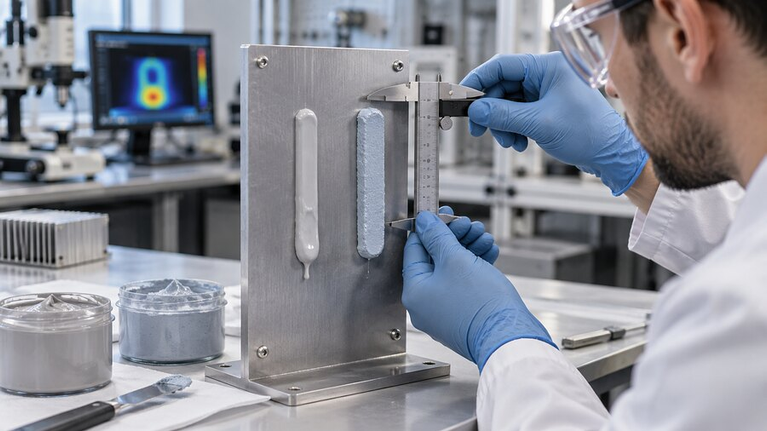
Post-curing thermal gel is a dispensable thermal interface material that is placed into an electronics gap before it reaches its specified final state. The bead wets the heat source and cooling surface as the assembly closes; a defined room-temperature, heat-assisted or other grade-specific process then stabilizes the interface.
The name does not identify a universal chemistry or component count. Confirm whether the proposed grade is supplied as one part or two, what triggers its cure, and whether “post-cure” means cure after dispensing or an additional step after an initial cure. A pre-cured, ready-to-dispense gel can be a different route entirely.
For the broader material family, see Haktak’s liquid gap filler category.
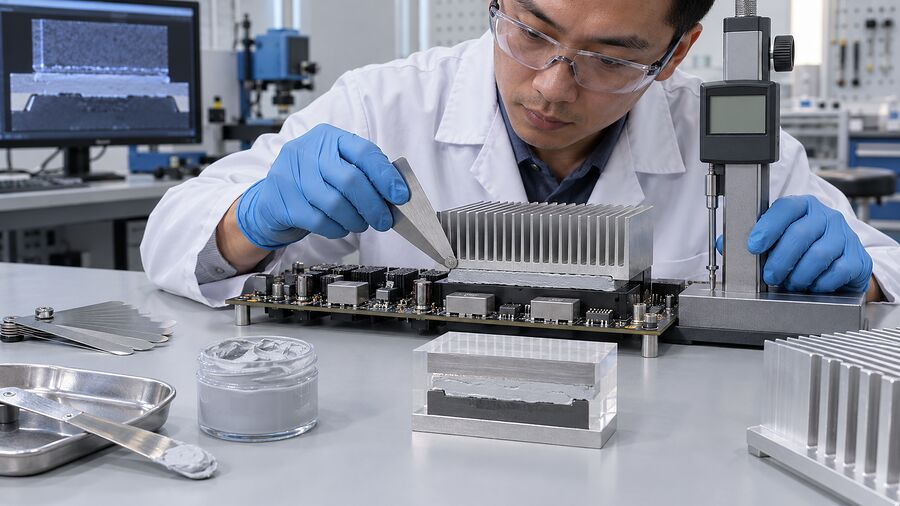
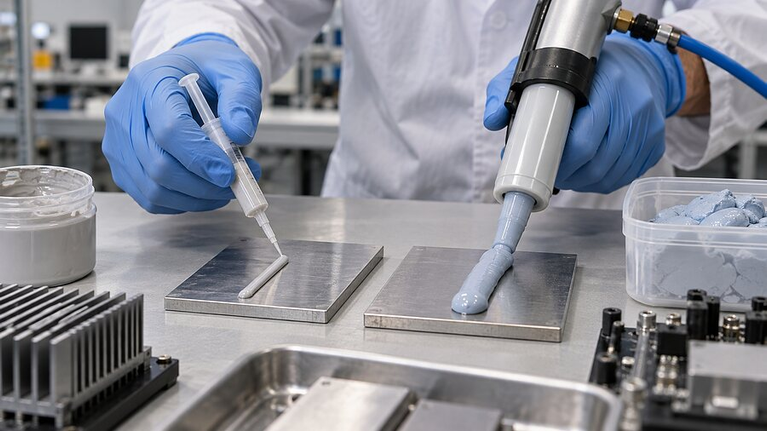 Compare the material at the thickness and pressure of the finished joint.
One connected material journey
From Dispensable Gel to Cured Thermal Interface
Each stage can change the next. Specify the supplied material, open time, closure and cure as one process rather than treating cure as a separate data-sheet line.
Know the incoming state
Record storage, conditioning, package, component count and any on-line mixing or activation requirement.
Make a repeatable bead
Set shot mass, nozzle, pattern and dwell so the gel keeps its intended shape before the mating surface arrives.
Build the real bond line
Control closure delay and pressure, then verify the actual material temperature and cure reached inside the joint.
Test after stabilization
Measure thermal, mechanical and electrical function after cure and again after representative service exposure.
A clear selection gate
When Does Post-Curing Thermal Gel Fit?
It is a strong candidate when a gap needs liquid placement and low assembly load, but a more stable final interface is required after the material has wetted both surfaces.
Complex or changing gaps
Dispenser placement can reach mixed component heights and local topography. Measure minimum, nominal and maximum finished gap—not just a CAD nominal.
A cure step fits the line
Check package handling, mix ratio if applicable, open time, closure delay, fixture condition and actual part temperature against takt time.
Contact must stay put
Qualify cured softness, shape retention and thermal contact after vibration, cycling and orientation changes. Confirm removal and residue if rework is planned.
The production window
Control Post-Curing Thermal Gel From Package to Release
A sample that cures on a bench may behave differently in a cold housing, on a long idle cycle or under real clamp load. Run trials at the edges of the intended operating window.
Prepare supply
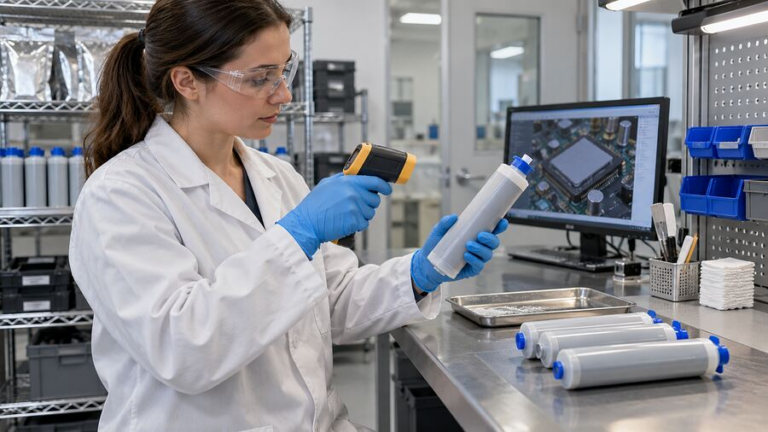
Confirm shelf life, storage and material temperature.
Control the dose
For 2K, verify ratio and mix; for every route, record mass and air.

Hold the bead
Check width, height, edge clearance and maximum wait time.

Set the bond line
Measure spread, contact, final thickness and clamp force.

Release by evidence
Check cure, thermal result and stability after aging.
Evidence under stated conditions
Post-Curing Thermal Gel Specifications That Predict Assembly Performance
A bulk W/m·K number screens candidates; the final heat path also depends on bond-line thickness, contact, cure state and aging. Request the specimen and test method with every value.

| Specify | Why it matters | What to record |
|---|---|---|
| Supplied and mixed state | Determines storage, metering, activation and process controls. | 1K/2K, mix ratio if applicable, conditioning and shelf life. |
| Open and working time | Sets the safe interval from dispense to final closure. | Temperature, bead size, orientation and maximum delay. |
| Cure schedule and final state | Changes stiffness, shape retention and possible component stress. | Actual material temperature, time, fixture, cure test and modulus/hardness. |
| Thermal conductivity | Useful for material screening, not a whole-joint prediction. | Method, specimen, direction, temperature and cure state. |
| Assembled thermal impedance | Includes final thickness and surface contact. | Bond line, area, pressure, fixture, before/after aging. |
| Mechanical and dielectric margin | Protects sensitive components and electrical boundaries. | Closure force, compression, voltage, insulation test and clearance. |
| Reliability and rework | Shows whether contact survives service and replacement. | Thermal cycling, vibration, displacement, residue and repeat assembly. |
On a narrow screen, swipe horizontally to view every table column.
For the distinction between material conductivity and assembled interface performance, read Haktak’s conductivity vs thermal impedance guide.
Application-led screening
Where Post-Curing Thermal Gel Can Be Evaluated
These are candidate use cases, not automatic qualifications. Confirm thermal, electrical, mechanical and curing limits in representative hardware.
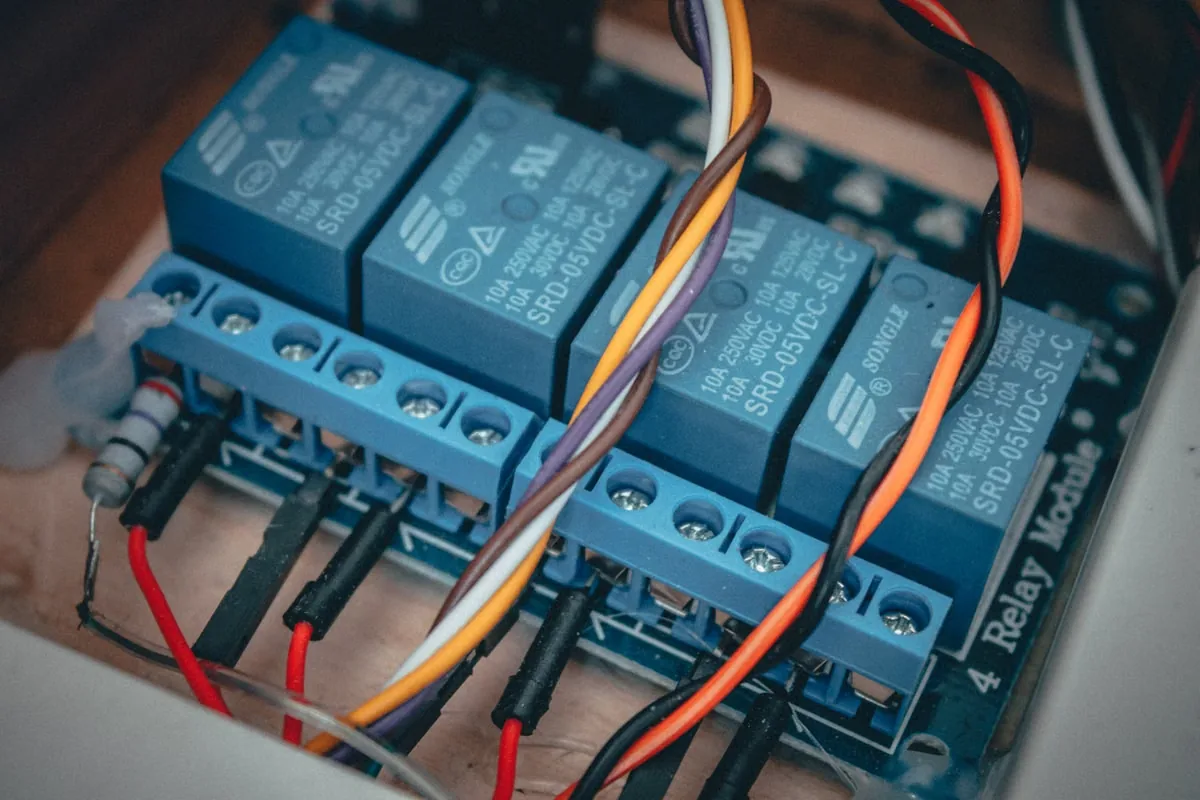
 01 / energy storage
Battery modules and cold plates
Bridge variable surfaces while checking the cell’s allowed cure temperature, pressure and electrical spacing.
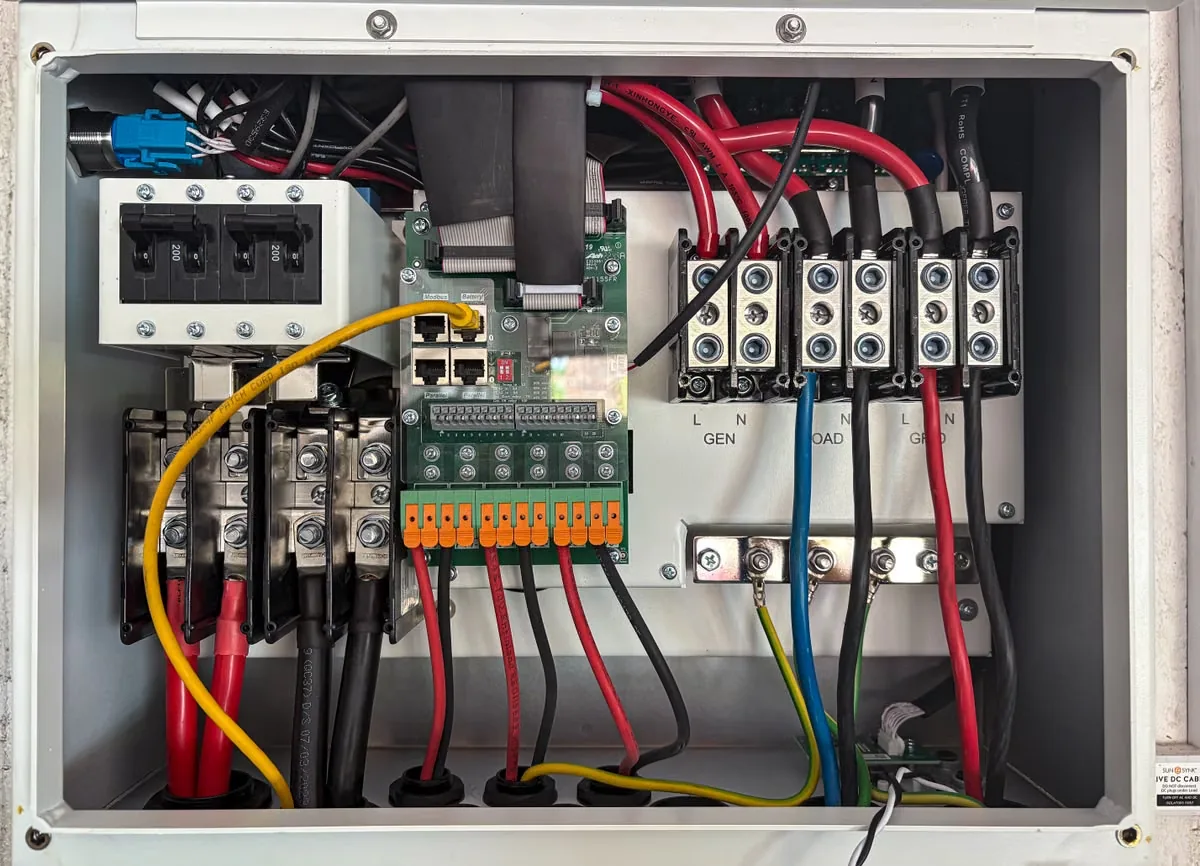
 02 / power conversion
Inverters and power modules
Qualify wetting and cured contact under load, vibration and repeated heating.
 03 / rugged electronics
Controllers and enclosures
Review vertical stability, housing tolerances and repair access after the final cure.
Test the finished joint
Validate Post-Curing Thermal Gel After Assembly and Aging
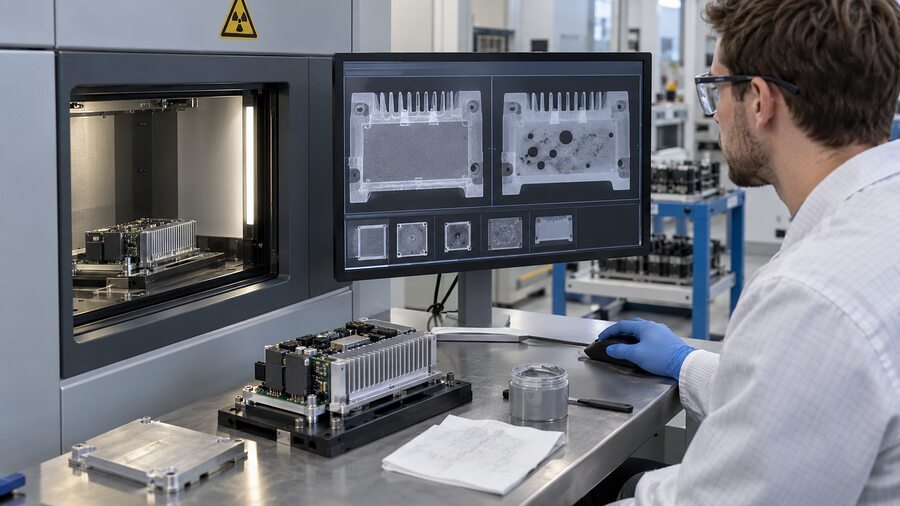
Use the same hardware and acceptance limits before and after exposure. A bead that looks correct can still hide a void, cure unevenly or transfer too much load after hardening.
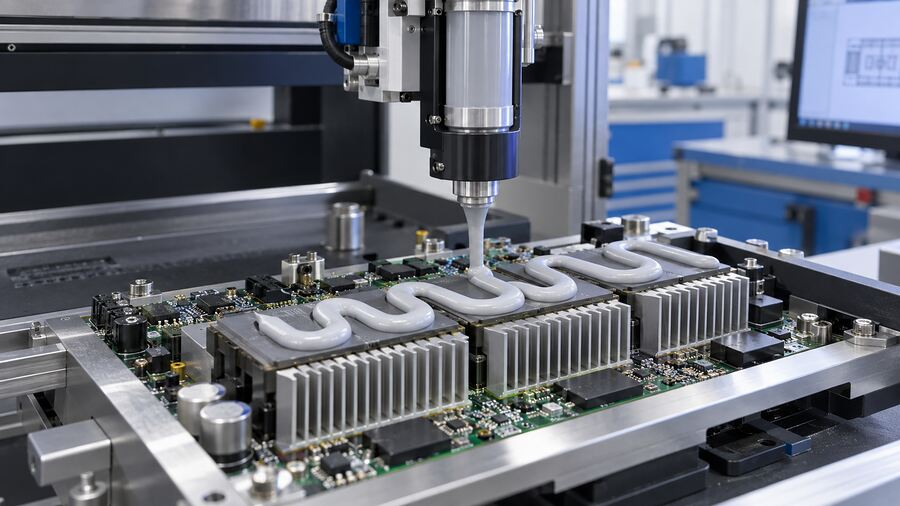 01 / before cure
Establish the baseline
Record dose, gap, coverage, closure force, component temperature and open time at worst-case line conditions.
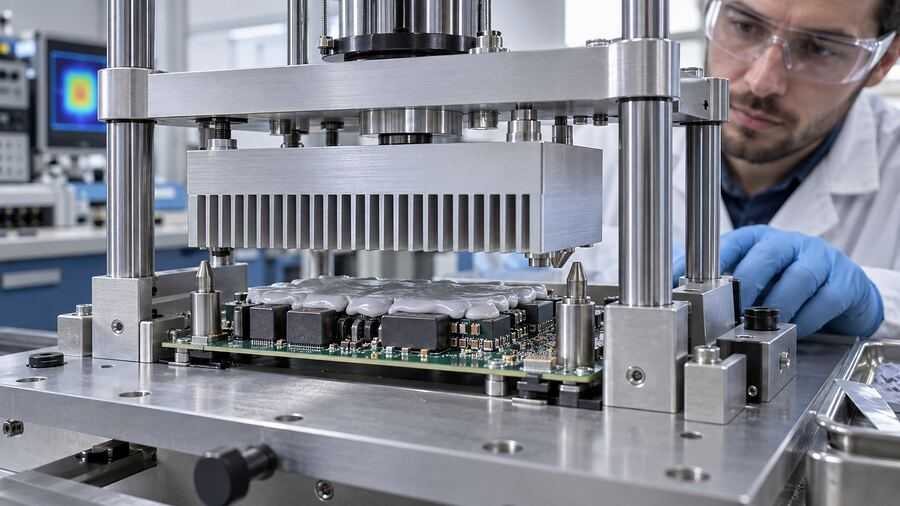 02 / after cure
Prove the final state
Measure cure at the material—not only oven set point—then test bond line, thermal impedance, dielectric margin and stress.
 03 / after exposure
Retest the function
Apply thermal cycling, vibration and relevant storage or humidity. Inspect voids, pump-out, adhesion, residue and rework performance.
Choose by material state
Post-Curing Thermal Gel vs 1K Gel, Putty and Pads
Similar names and W/m·K values do not make these routes interchangeable. The decisive differences are what arrives at the line, what happens after placement and how the part is serviced.
| Format | Best fit | Production route | Main qualification |
|---|---|---|---|
| Post-curing thermal gel | Dispensed contact followed by a specified final stabilization. | Condition / mix if required → dispense → close → cure. | Cure window, final modulus and retained contact. |
| Single component thermal gel | Ready-to-dispense supply without on-line two-part mixing. | Confirm the exact grade’s pre-cured, non-curing or other final state. | Shot repeatability, slump, thermal result and rework. |
| Thermal putty | Soft, formable placement for uneven and potentially serviceable joints. | Place or dispense; verify whether the selected grade cures. | Placement mass, shape retention and replacement. |
| Thermal pad | Defined footprint and preformed thickness. | Die cut → place → compress. | Contact at largest gap; load at smallest gap. |
| Silicone-free thermal gel | Contamination-sensitive optics, contacts or bonding processes. | Depends on exact chemistry and cure state. | Cleanliness, compatibility and aging evidence. |
On a narrow screen, swipe horizontally to view every table column.
From sample to production
Match Post-Curing Thermal Gel to Your Actual Joint
Send your drawing, minimum/nominal/maximum gap, heat load, cooling boundary, dispense equipment, closure delay, cure limits and service test plan. Haktak can review a suitable material route and the evidence required before release.
Practical engineering answers
Post-Curing Thermal Gel FAQ
What does “post-curing thermal gel” mean?
On this page it means a dispensable thermal material placed in the joint before a specified later cure or stabilization step. The exact chemical mechanism and final state depend on the grade.
Is every thermal gel designed to cure after dispensing?
No. Some gels are pre-cured and need no subsequent cure. Check the supplier’s description of the delivered state, any activation step and the final service state.
Does post-curing thermal gel have to be two-component?
No universal rule applies. Many cure-in-place gap fillers are 2K, but some 1K systems can cure under a specified trigger. Verify the actual formulation instead of assuming from the category name.
When should curing gel be chosen over a 1K pre-cured gel?
Consider it when post-placement shape retention or service stability is important and the assembly can support the required cure window. Compare both routes in the same finished hardware.
Can it be used on a battery module?
It is a candidate only after checking cell and housing temperature limits, electrical spacing, gap variation, closure load and actual cure reached inside the pack.
What determines the safe dispense-to-close interval?
Open time depends on the grade, material temperature, bead geometry, orientation and ambient conditions. Test the longest expected production delay, not only an ideal cycle.
Is higher thermal conductivity always better?
No. Device temperature also depends on final bond-line thickness, contact area, trapped air and whether the interface remains stable after cure and aging.
How should cure be verified in production?
Use a grade-specific acceptance method and measure representative material or part temperature. Oven set point alone does not prove that a cold metal housing or thick bead has reached the required cure.
Will a cured thermal gel always resist pump-out?
Do not assume it. Confirm contact and material position after the relevant thermal cycling, vibration, orientation and clamping conditions in the actual assembly.
Can post-curing thermal gel be reworked?
That depends on the final material and surfaces. Validate disassembly force, residue removal, replacement mass and thermal performance after the next closure.