
Two suppliers send you quotes for “high-performance CPU/GPU thermal paste.” One offers a small syringe. The other offers a kilogram tub at a tempting price. Both print a large conductivity number on the label. Which one belongs on your purchasing shortlist?
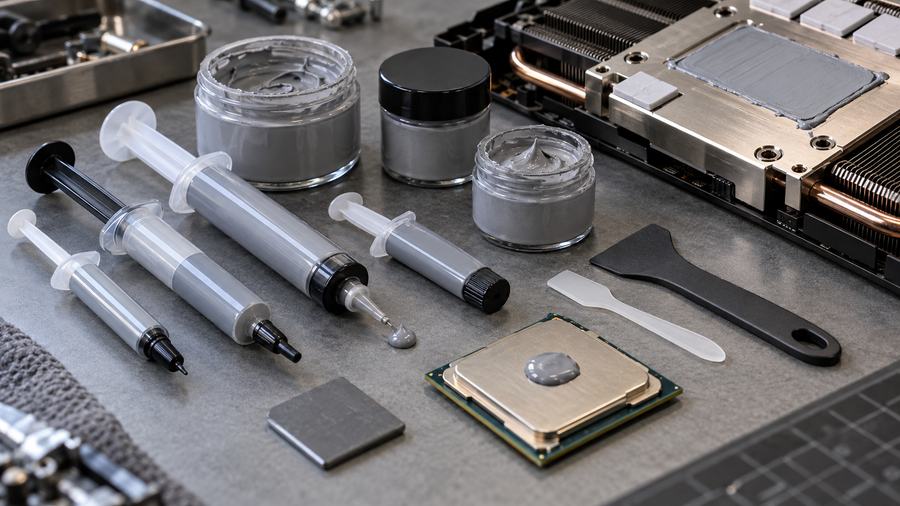
You cannot tell from those details alone. A repair shop, a PC assembly line, and a server hardware team need different packaging, documentation, support, and evidence. Even the phrase “CPU/GPU application” leaves plenty unanswered.
The useful sourcing process starts with the interface, then moves through supplier identity, sample testing, and repeat-order control. Here is how to build a shortlist you can actually compare—and turn a promising sample into dependable supply.
Start with the CPU or GPU interface you need to cool
Thermal grease is a thermal interface material, or TIM. It fills small surface irregularities between a heat source and a cooling surface. In normal use, it works as a thin layer under controlled contact pressure. It does not replace the cooler, its mounting hardware, or a designed electrical-insulation barrier.
“Thermal paste,” “heat sink compound,” and “thermal grease” often describe the same general material family. Those names tell you less than the actual grade and application instructions. A syringe labeled “thermal compound” might contain something quite different from the material your assembly was qualified to use.
CPU heat spreaders, exposed dies, and component gaps
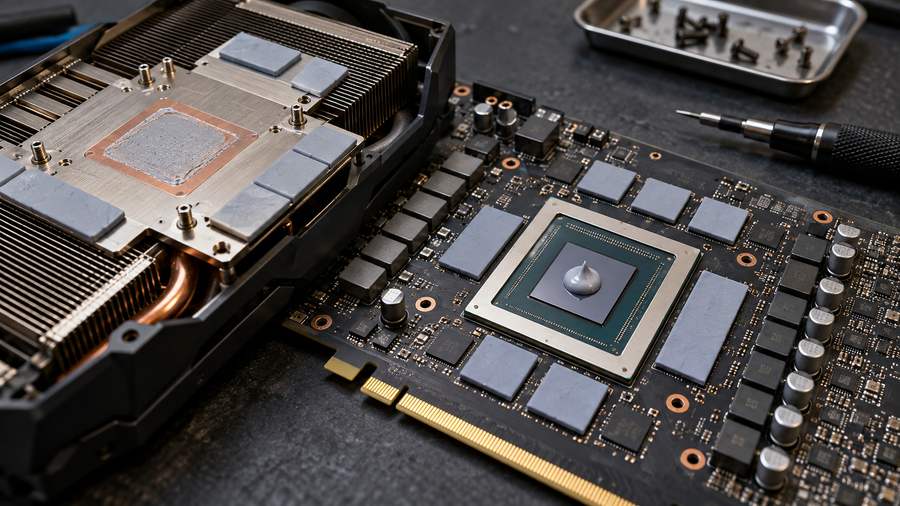
Many desktop CPUs transfer heat through an integrated heat spreader, or IHS. Some processors and many GPUs expose a die to the cooling assembly. The contact geometry, pressure limits, surrounding components, and consequences of uneven coverage differ. Confirm the exact package instead of treating all CPUs or GPUs as interchangeable.
A graphics card adds another wrinkle. Its main processor interface and the gaps above memory or voltage-regulation components can require different materials. Replacing a specified pad with a puddle of grease can leave the gap inadequately bridged. Changing pad thickness can also disturb cooler seating over the GPU.
| Vật liệu | Typical job to investigate | What purchasing must confirm |
|---|---|---|
| Keo tản nhiệt | Thin interface under maintained contact pressure | Package compatibility, coverage, application process, aging behavior |
| TIM có tính chất biến đổi theo pha | Interface designed for a material that softens at operating temperature | Activation conditions, mounting requirements, removal and replacement instructions |
| Thermal pad or putty | Designed gaps around components of different heights | Gap range, compression or flow, component loading, retention |
| Kim loại lỏng | Specialized interface with suitable surfaces and containment | Electrical conductivity, substrate compatibility, approved assembly procedure |
These are candidate uses, not permission to substitute materials. Follow the equipment design and component limits. HAKTAK’s thermal grease options for thin interfaces provide a starting point for a grease shortlist once the application is defined.
Silicone-based and silicone-free formulations are both available. Fillers may include ceramics or other particles, and their electrical behavior varies. Do not assume that a gray paste is conductive—or that a white one is insulating. Color is packaging information, not a test report.

Where to find CPU/GPU thermal grease suppliers
Use several routes, but give each route a specific job. A directory helps you discover candidates. A manufacturer confirms what it makes. A distributor helps you obtain traceable stock in workable quantities. Mixing up those jobs is where sourcing gets messy.
Start with original manufacturers and their sales channels
Search for the material family and your production requirement together. Useful combinations include “CPU thermal grease manufacturer bulk packaging,” “GPU thermal paste technical data sheet,” and “thermal compound automated dispensing supplier.” Add your region when local stock or technical support matters.
Ví dụ, Shin-Etsu’s thermal grease information explains the material family, identifies CPU applications, and cautions that fillers can be electrically conductive or isolating. That is a useful model for your research: find the original technical explanation, identify a candidate grade, and ask how to obtain it through the appropriate channel.
An original manufacturer is a sensible route when you need detailed application support, a production formulation, or a discussion about process compatibility. It does not follow that direct purchasing will have the lowest minimum order or shortest lead time. Ask those questions separately.
Use authorized distributors for traceable supply
For a repair business or a pilot build, a distributor may be more practical than a factory account. Smaller packs, local inventory, and an established purchasing process can outweigh a slightly higher price per gram.
Check authorization with the brand or manufacturer for the relevant product line and territory. A distributor carrying one brand’s adhesives is not automatically authorized for every material that brand sells. Also ask about remaining shelf life, lot identification, storage, and whether the product stays in its original sealed package.
Be careful with repacked material. It may be legitimate, but someone must take responsibility for cleanliness, correct identification, packaging compatibility, and the original batch link. “Same material, different syringe” needs a paper trail.
Use directories and marketplaces to widen the shortlist
Thomasnet and Global Sources can help reveal manufacturers, distributors, trading companies, and private-label offers. Search within the thermal grease category rather than assuming every TIM supplier compounds paste. Some businesses mainly convert sheets or distribute finished products.
Treat marketplace specifications as leads to verify. Ask for the current technical data sheet, the exact manufacturer and grade, and a quotation bearing the seller’s legal name. A supplier badge or polished factory video is not a substitute for that work.
You do not need twenty nearly identical quotes. Start with a manageable set of candidates covering the channels that fit your order. Remove those that cannot identify the material, answer application questions, or provide traceable samples. Comparing fewer complete submissions beats chasing a long list of vague promises.

Ask who makes the grease—and who owns the quality problem
A supplier can be a formulator, manufacturer, brand owner, contract packer, distributor, or trading company. Some perform several roles. The issue is not whether a trader is automatically worse. The issue is whether the chain is visible and someone can resolve a problem when production depends on it.
Ask who controls the formulation, where it is produced, where it is packed, and whose quality system covers each step. For substantial recurring orders, consider a proportionate factory or quality audit. A small repair shop may reasonably rely on a confirmed authorized source and intact manufacturer packaging instead.
For branded paste, check the current authentication guidance provided by the brand. Packaging designs change, so an old online photograph is weak evidence of a counterfeit. A working QR code alone is not conclusive either. Combine purchase-channel verification, lot information, invoices, and the manufacturer’s response where needed.
For private-label sourcing, clarify whether the offer is a standard formulation in your packaging, a modified existing grade, or a genuinely custom development. Those are different projects. Agree on the technical specification, label claims, retained samples, ownership or use rights where relevant, and what happens if a raw material changes.
A useful question is: “If our next batch behaves differently, which records can you investigate?” A supplier that can discuss retained lots, production records, and corrective action gives you something concrete to evaluate. “Our quality is very good” does not get you very far.

Send one RFQ that makes the quotations comparable
An RFQ is a request for quotation. Give each supplier the same version. Otherwise one quotes retail syringes, another quotes a bulk cartridge, and a third quietly selects a cheaper grade. The price spreadsheet looks precise while comparing three different purchases.
Describe the assembly in enough detail for the supplier to reject an unsuitable product. Include a drawing or photograph when you can share it. Sensitive dimensions can be discussed under an appropriate confidentiality agreement.
| RFQ field | Information to include |
|---|---|
| Ứng dụng | Processor/package, heat spreader or exposed die, cooler contact materials |
| Giao diện | Intended bond line, surface condition, mounting method and allowable pressure |
| Operating conditions | Heat load, temperature limits, orientation, duty cycle, required service life |
| Quy trình sản xuất | Manual spread, syringe dispense, automated dispense, stencil or other approved method |
| Order profile | Sample quantity, pilot quantity, expected recurring demand, destination |
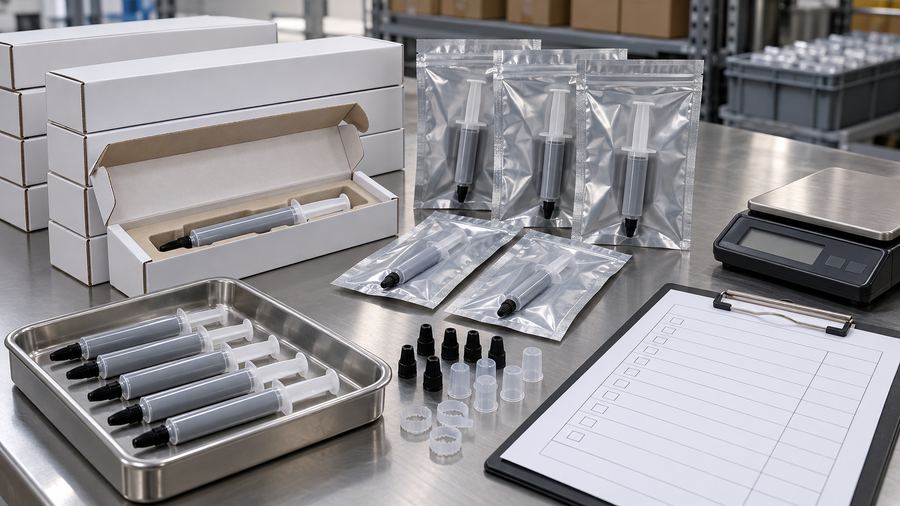
| Packaging | Net fill mass or volume, syringe/cartridge/tub format, equipment connection, label needs |
| Bằng chứng | Current TDS and SDS, test conditions, traceability, relevant compliance documents |
| Commercial terms | MOQ by grade and pack, lead time, freight basis, payment, defects and returns |
| Continuity | Shelf life at delivery, storage, change notification, discontinuation notice |
Ask for packaging quantities in unambiguous units. A 10 mL syringe does not necessarily contain 10 g; density matters. Also distinguish container capacity from actual net fill. Small misunderstandings become large purchasing errors when copied into repeat orders.

TDS, SDS, and quality documents answer different questions
The technical data sheet describes the product and its properties under stated conditions. Typical values may not be guaranteed shipment limits. Ask which values are controlled specifications and which are informative.
The safety data sheet covers hazard communication and handling information. It is not a thermal-performance certificate. A certificate of analysis, when available, should identify a batch and report the agreed tests. Not every property on a marketing sheet is measured on every batch; agree on what the supplier actually checks.
ISO 9001 certification concerns a quality management system within a defined scope. It does not certify a particular paste for your GPU. Likewise, RoHS or REACH statements address applicable substance obligations; they do not establish cooling performance. Check the product identity, document date, issuer, and applicable scope rather than collecting logos.
Test supplier samples before placing the production order
A sample has two jobs: show that the material suits the hardware and show that your process can apply it consistently. A good temperature on one carefully assembled unit answers only part of the question.
Request samples with grade and lot identification. Record receipt date and storage. If possible, include more than one production lot during qualification, especially where recurring volume justifies it. Keep a reference sample or reference assembly so later comparisons have a stable starting point.
Compare thermal performance under the same conditions
Use the same hardware, cooler, load, ambient conditions, fan or pump settings, mounting procedure, and temperature-measurement method. Modern CPUs and GPUs can change clock speed and power automatically. A lower temperature caused by reduced power is not evidence of a better interface.
Log actual power and relevant operating settings. Compare repeated assemblies, not just repeated readings of one installation. Remounting variation may be larger than the difference between two pastes. If the spread in results overlaps heavily, do not manufacture a winner from a tiny average difference.
Ask how the supplier measured conductivity or thermal impedance. ASTM D5470 covers measurement of thermal impedance and calculation of apparent thermal conductivity for thermally conductive electrical-insulation materials. It is a test method, not a product approval. Temperature, pressure, specimen thickness, and contact effects still matter when interpreting results.
A high W/m·K number is useful only with context. It does not tell you how thin the material spreads in your mounting system, how much contact resistance remains, or how the joint changes in service. Require the test conditions before comparing figures from different suppliers.
Check dispensing, coverage, and rework
Try the intended production package and tool. Material that spreads nicely with a laboratory spatula may dispense poorly through your chosen nozzle. Check dose repeatability, stringing, trapped air, settling or separation, and cleanup around nearby components.
Inspect contact coverage on trial assemblies using an appropriate method. Opening the joint changes it, so keep thermal-test samples intact where needed and use separate specimens for destructive inspection. Avoid applying a universal pea-sized quantity to every package. Coverage and dose should follow the validated hardware and process.
Make one technician perform the planned service procedure too. Can the cooler be removed without damaging the package? Can the old material be cleaned with a compatible method? If a maintenance team will use the product, the removal process is part of qualification.
Repeat the checks after aging and cycling
Initial cooling is only the starting point. Depending on the formulation and assembly, temperature cycling and mechanical movement can contribute to pump-out, migration, oil bleed, drying, or changes in contact. The relevant test profile comes from the product’s use, not a universal number of cycles copied from another application.
HAKTAK’s guide to thermal grease performance after high-temperature exposure provides additional context for checking the interface after stress. The aim is to understand whether the candidate maintains acceptable performance under your requirements.
Write acceptance limits before looking at the winner
Define the permitted temperatures or interface performance, assembly variation, coverage, migration, electrical requirements, and changes after aging. Record failure rules and the measurement uncertainty that matters to the decision.
A supplier should understand why a sample passed or failed. “It ran hot” is not much feedback. The package, load, ambient, mounting, measured result, and agreed limit make that observation actionable.
Compare cost per good assembly, not just the tub price
Bulk material can save money, but only if it remains usable and your process wastes little. Include material left in the package, purge shots, handling, rework, freight, and inventory that expires before use. Keep commercial comparisons on the same delivery and currency basis.
Here is a hypothetical example, not a supplier quotation. A 1,000 g pack costs $100. Your validated application uses 0.2 g per assembly, and 10% of the purchased material is lost through residual material and process waste. That leaves 900 g, enough for 4,500 applications. The material cost is about $0.022 per application, before labor, freight, tax, and rejects.
Now compare a smaller pack with a higher price per gram but less leftover material and lower expiration risk. It might cost less in actual use for a low-volume repair operation. For a busy production line, cartridge compatibility and dosing consistency may matter more.
Do not assume a fresh-looking tub has a full shelf life remaining. Ask for manufacture or expiry information, minimum remaining shelf life at delivery, and storage instructions. Get opened-container guidance separately. A published unopened shelf life does not automatically apply after repeated exposure during use.

Turn the first order into repeatable supply
Approve the exact grade and packaging, not merely the supplier’s company name. Keep the approved technical specification, process settings, acceptance plan, and sample records together. Confirm that the first production shipment matches the qualified supply route.
At receiving, check identity, lot, seals, net quantity, dates, and any agreed documents. Use risk-based incoming checks suited to your volume and application. A small controlled dispense or inspection may detect a problem that an invoice cannot.
Agree on notification before relevant formulation, filler, production-site, or packaging changes. Define how complaints, retained samples, replacement stock, and corrective action will be handled. Ask about discontinuation notice and realistic replenishment lead time as well.
A second source can reduce supply risk, but it needs its own qualification. Two products with the same advertised conductivity are not automatically drop-in substitutes. Keep that distinction visible in the purchasing system so a stock shortage does not become an unplanned engineering change.
Kết luận
Finding CPU/GPU thermal grease suppliers is straightforward. Finding a source that fits your hardware, process, and repeat orders takes a little more work. Define the interface, research several appropriate supply channels, verify who makes and handles the material, and compare samples under controlled conditions. Then lock down packaging, traceability, acceptance criteria, and change control.
For a material discussion with HAKTAK or another supplier, send the interface details and purchasing brief first. A useful recommendation starts with the actual assembly. The quote comes after that.
Câu hỏi thường gặp
1. Where can I buy thermal grease in bulk?
Start with original manufacturers, their authorized distributors, and relevant industrial directories. B2B marketplaces can widen the search. Confirm the exact grade, source, packaging, and traceability before treating a listing as an approved supply option.
2. Should I buy directly from a manufacturer or use a distributor?
A manufacturer may suit recurring production and detailed application work. A distributor may offer smaller packs or convenient local stock. Compare authorization, remaining shelf life, support, and delivered cost for your order profile.
3. How can I tell whether thermal paste is genuine?
Use the brand’s current authentication instructions and verify the seller’s relationship with the brand. Keep invoices and batch details. Packaging appearance or a QR code alone may be insufficient; ask the manufacturer when the evidence is unclear.
4. Can one thermal grease work on both CPUs and GPUs?
Possibly, if it is suitable for both actual interfaces. Check heat spreader versus exposed-die contact, mounting, coverage, electrical behavior, and aging. A CPU/GPU label does not establish compatibility with every package or cooler.
5. What documents should I request from the supplier?
Request the current TDS, SDS, grade and lot identification, relevant compliance statements, and agreed quality records. Ask which specifications are guaranteed and whether batch test results are available. Match the paperwork to the precise product being purchased.
6. Is higher thermal conductivity always worth paying for?
No. Actual performance also depends on contact, bond line, mounting, and stability over time. Compare data obtained under compatible test conditions, then validate the candidate in your assembly. The largest catalog number may not produce the best result.
7. What MOQ should I expect for OEM or private-label paste?
There is no dependable universal MOQ. It depends on formulation, packaging, printing, filling equipment, and the supplier’s production model. Request separate minimums for standard packaging, your own label, and any custom formulation.
8. How should I compare supplier samples?
Use controlled hardware and operating conditions, repeat assemblies, and record actual power and ambient temperature. Test application consistency and the relevant aging profile too. Define acceptance criteria before comparing results.
9. Can I keep an opened bulk container until its printed expiry date?
Do not assume so. Printed shelf life may apply only to unopened material stored under specified conditions. Ask for guidance on opened containers, contamination control, resealing, and any required inspection before reuse.
10. What should I agree before ordering again?
Lock down grade, packaging, traceability, remaining shelf life, delivery terms, defect handling, and change notification. Requalify changes when appropriate. Repeat purchasing should reproduce the approved material and process, not simply repeat a familiar product name.