
Phase change material usually performs better than thermal paste in applications that need clean assembly, repeatable thickness, long-term stability, and controlled production quality. Thermal paste often performs better when the interface is very thin, flat, and carefully assembled, especially where the lowest possible bond line thickness is required.
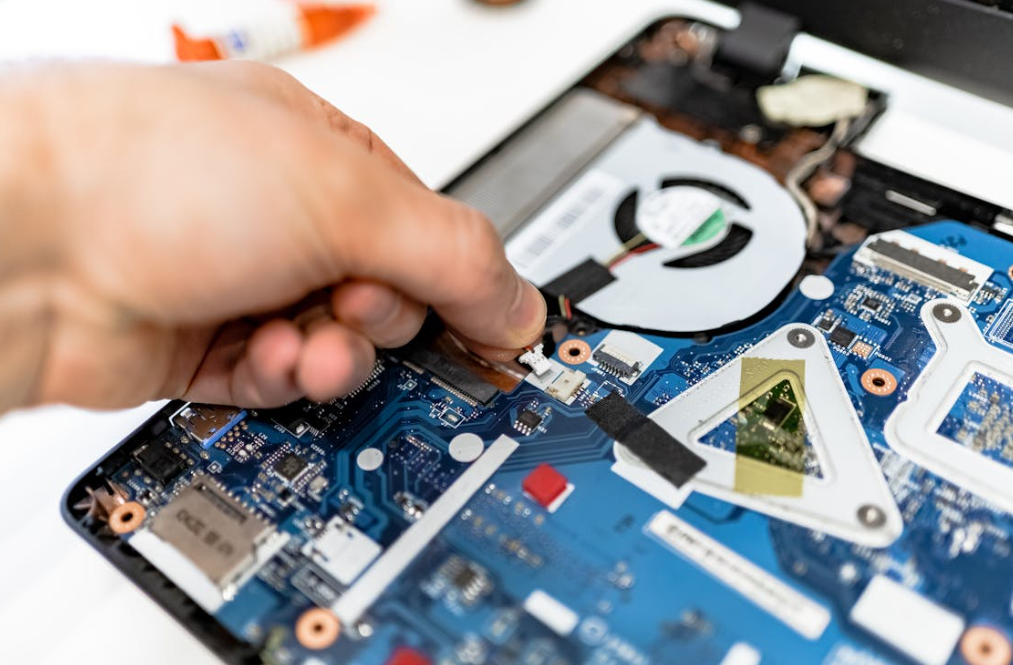
In simple terms: choose phase change material when you want paste-like thermal contact with pad-like handling. Choose thermal paste when you have a flat surface, strong assembly control, and need a very thin interface.
Both materials are thermal interface materials, but they solve different engineering problems. The best choice depends on surface flatness, operating temperature, pressure, rework needs, production method, and long-term reliability.
For a deeper explanation of how PCM pads work, you can also read HakTak’s guide: PCM Thermal Pads Explained: How Phase-Change Materials Improve Heat Management.
What Is a Thermal Interface Material?
A thermal interface material, or TIM, is placed between a heat-generating component and a heat sink, metal housing, cold plate, or chassis. Its job is to fill microscopic air gaps between two surfaces.
Even polished metal surfaces are not perfectly smooth. Under magnification, they contain peaks, valleys, and small voids. When two solid surfaces touch, only the high points make contact. The remaining space is filled with air, which has very poor thermal conductivity.
A TIM replaces air with a more thermally conductive material. This reduces thermal resistance and helps heat move more efficiently away from chips, power modules, LEDs, batteries, and other electronic components.
Common thermal interface materials include:
- Pâte thermique
- Pâte thermique
- Pads thermiques
- Phase change materials
- Pâte thermique
- Thermal gels
- Mots de remplissage
- Thermally conductive adhesives
Among these options, phase change materials and thermal paste are often compared because both can create intimate surface contact and reduce interface resistance. But they do it in different ways.
What Is Phase Change Material?

In electronics cooling, phase change material usually refers to a thermal interface material that is solid or semi-solid at room temperature but softens when the device reaches its operating temperature.
A PCM thermal pad is typically easy to handle during assembly. It can be cut, placed, and aligned like a pad. Once the device heats up, the material softens and flows slightly into microscopic surface irregularities. This helps it create better contact with the heat source and heat sink.
The phase change behavior does not always mean the material becomes a free-flowing liquid. In many electronics applications, the material simply softens enough to wet the surface and reduce contact resistance.
This gives PCM materials a useful balance:
- Cleaner than paste
- Easier to place than grease
- More conformable than a standard pad
- More stable in production than manual paste application
- Better contact than many dry pads at operating temperature
PCM materials are often used in CPUs, GPUs, power modules, LED systems, automotive electronics, telecom equipment, and industrial control systems.
What Is Thermal Paste?
Thermal paste, also called thermal grease or thermal compound, is a soft, spreadable material made from a base fluid and thermally conductive fillers. The base fluid may be silicone oil, synthetic oil, or another polymer system. The fillers may include ceramic particles, metal oxides, carbon-based materials, or other thermally conductive powders.
Thermal paste is designed to fill very small surface imperfections. When applied properly, it creates a thin interface between the heat source and the heat sink.
Thermal paste is widely used in:
- CPUs et GPUs
- Électronique de puissance
- Modules LED
- Électronique grand public
- Industrial equipment
- Repair and maintenance operations
- Prototyping and lab testing
Thermal paste can deliver excellent performance when the bond line is thin and the surfaces are flat. However, its performance depends heavily on correct application. Too much paste increases thermal resistance. Too little paste leaves air gaps. Uneven spreading can create hot spots.
For application guidance, HakTak has a related article here: Conseils pour appliquer la pâte thermique et fonctionnement.
Phase Change Material vs Thermal Paste: Core Difference
The main difference is the balance between performance, handling, and repeatability.
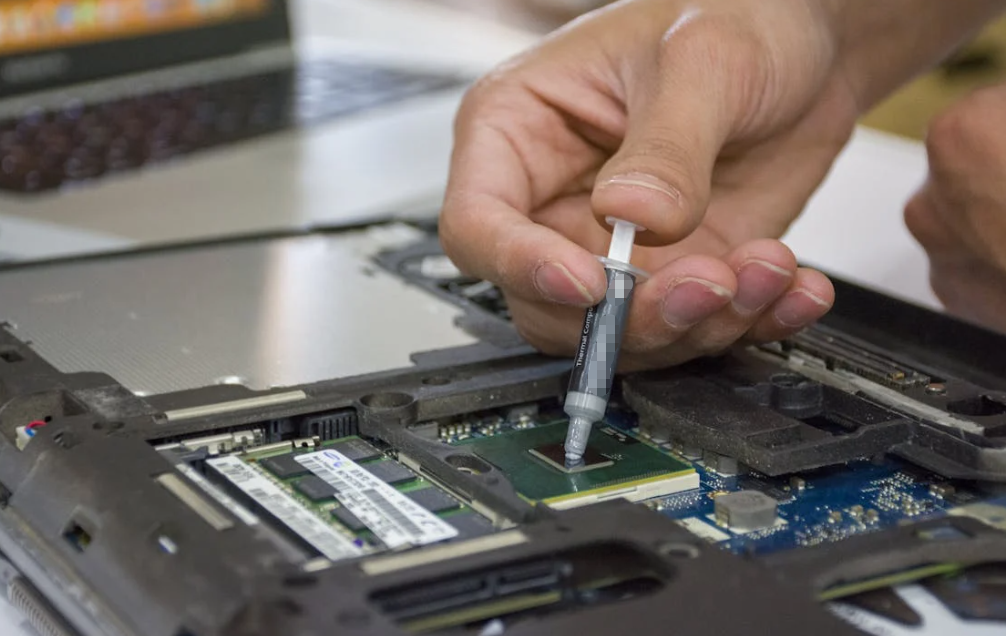
Thermal paste is already soft at room temperature. It spreads into surface imperfections during assembly. This can create a very thin bond line, which is good for thermal performance. But it can be messy, difficult to control, and sensitive to operator technique.
Phase change material is more stable during assembly. It behaves more like a pad at room temperature, then softens during operation. This allows it to combine cleaner handling with improved surface wetting after the device heats up.
| Facteur | Phase Change Material | Pâte thermique |
| Form at room temperature | Solid or semi-solid pad/film | Soft paste or grease |
| Behavior during operation | Softens and wets surface | Remains paste-like |
| Manutention | Clean and repeatable | Messier, more operator-dependent |
| Contrôle de la ligne de liaison | More controlled | Depends on application amount |
| Retravailler | Usually cleaner | May require more cleaning |
| Idéal pour | Production consistency | Thin, flat interfaces |
| Risque | Needs correct activation temperature | Pump-out, drying, over-application |
| Utilisation typique | CPUs, GPUs, power modules, telecom, automotive | CPUs, GPUs, repairs, prototyping, flat interfaces |
Which Performs Better Thermally?
The honest answer is: it depends on the real interface.
If two surfaces are flat, smooth, and clamped with proper pressure, thermal paste can perform extremely well because it can create a very thin bond line. A thinner bond line usually means lower thermal resistance.
However, in real production environments, thermal paste performance can vary because application thickness is hard to control. One operator may apply too much. Another may apply too little. A dispenser may create bubbles or uneven coverage. Over time, paste may also migrate, pump out, dry, or separate depending on the formulation and operating conditions.
Phase change material may not always have the lowest theoretical bond line thickness, but it often delivers more consistent performance across many units. Once heated, it softens and improves surface contact. This can reduce thermal resistance while keeping assembly cleaner and more repeatable.
So the better question is not only “Which has higher thermal conductivity?” The better question is:
Which material delivers lower thermal resistance in the actual assembly over the full product lifetime?
For a deeper discussion of thermal conductivity and testing, see HakTak’s guide: Comment choisir et tester la conductivité thermique de la graisse thermique.
Thermal Conductivity Is Not the Whole Story

Many buyers compare phase change material and thermal paste by looking only at W/m·K. This is understandable, but incomplete.
Thermal conductivity tells you how well the bulk material conducts heat. But real-world cooling also depends on:
- Épaisseur des traits de liaison
- Rugosité de surface
- Clamping pressure
- Wetting ability
- Distribution de charges
- Résistance à l'exsudation
- Dry-out resistance
- Thermal cycling stability
- Contact thermal resistance
- Reproductibilité de l'assemblage
A thermal paste with a high W/m·K value may perform poorly if applied too thickly. A PCM with a lower listed conductivity may perform better if it creates more consistent contact and maintains a thinner effective interface after softening.
This is why engineering teams should evaluate thermal resistance or thermal impedance, not only thermal conductivity.
In electronics cooling, the interface is often the weak point. A small air gap can cancel out the advantage of a high-conductivity material. PCM materials are designed to reduce this risk by improving wetting at operating temperature while maintaining controlled placement during assembly.
Bond Line Thickness and Contact Resistance
Bond line thickness is the thickness of the TIM layer between the heat source and heat sink.
A thinner bond line usually improves heat transfer, assuming the material fully fills surface imperfections and does not leave voids. This is one reason thermal paste can perform well. It can be spread very thin when surfaces are flat and pressure is sufficient.
However, very thin does not automatically mean better. If the paste is squeezed out too much, dry contact areas may appear. If it is applied unevenly, some areas may have too much paste while others have too little.
Phase change material usually provides more controlled thickness. During operation, it softens and conforms to the surfaces. This helps reduce contact resistance without the same level of manual application variability.
For mass production, this consistency matters. A material that performs slightly better in a lab but varies widely in production may be less useful than a material with stable, repeatable performance.
Application and Assembly
Thermal paste can be applied by dot, line, screen printing, stencil printing, or dispensing. It can work very well when the process is tightly controlled. But it is still easy to make mistakes.
Common thermal paste application problems include:
- Applying too much material
- Applying too little material
- Uneven spreading
- Trapped air bubbles
- Contaminated surfaces
- Oil separation before use
- Inconsistent pressure during assembly
Phase change material is generally easier to handle. It can be supplied as a pad, film, or pre-cut shape. Operators place it onto the component or heat sink, then assemble the system. The material activates when the device reaches the required temperature range.
This makes PCM attractive for manufacturers that need repeatable assembly quality and lower mess.
Thermal paste remains useful for repair, testing, small-batch builds, and applications where surfaces are flat and controlled. But in high-volume production, PCM often simplifies process control.
Reliability Over Time
Long-term reliability is one of the most important differences between phase change materials and thermal paste.
Thermal paste can degrade over time depending on formulation, operating temperature, pressure, vibration, and thermal cycling. Some pastes may dry out, harden, separate, or pump out from the interface. When this happens, thermal resistance increases and component temperatures rise.
HakTak discusses storage and degradation factors in this related article: How to Properly Store Unused Thermal Paste.
Phase change materials are often selected when engineers want more stable long-term interface behavior. Because the material begins as a controlled film or pad, it is less likely to be over-applied. After activation, it wets the interface and can maintain more consistent contact through repeated thermal cycles, depending on the specific formulation.
That said, not all PCM materials are the same. Engineers should still evaluate:
- Phase change temperature
- Thermal cycling performance
- Résistance à l'exsudation
- Plage de températures de fonctionnement
- Surface compatibility
- Rework behavior
- Exigences d'isolation électrique
A good PCM material should soften at the right temperature, maintain contact during operation, and remain stable over the expected product life.
Pump-Out and Dry-Out Risk
Pump-out happens when a thermal interface material gradually moves away from the interface due to repeated heating, cooling, pressure changes, and mechanical movement. It is a common concern for thermal paste, especially in systems exposed to vibration or frequent thermal cycling.
Dry-out happens when the base fluid in a paste evaporates, migrates, or separates, leaving behind a drier, less effective material. This can increase thermal resistance and reduce cooling performance.
PCM materials are designed to reduce some of these risks by remaining more controlled in the interface. Because they soften during operation rather than starting as a fully fluid paste, they may be less prone to uncontrolled spreading. However, formulation quality still matters. A poorly designed PCM can still suffer from migration or stability issues.
For demanding applications such as aerospace, vacuum equipment, and sealed systems, outgassing also becomes important. HakTak has covered this topic in detail here: La graisse thermique se volatilise-t-elle dans le vide ? Comprendre le dégagement gazeux et les performances dans les environnements à basse pression.
Rework and Cleaning
Rework is another practical factor.
Thermal paste usually requires cleaning after disassembly. Old paste must be removed from both surfaces before fresh material is applied. If residue remains, it can affect the next interface and reduce performance.
Phase change material can be cleaner to handle, especially when supplied as a pad or film. Depending on the formulation, it may leave less residue than paste and may be easier to remove as part of a controlled service process.
However, PCM materials may also adhere after activation, so rework behavior should be tested before final selection. Some applications prioritize easy repair, while others prioritize stable long-term contact.
In consumer electronics repair, thermal paste is still common because it is familiar, flexible, and easy to apply manually. In factory assembly, PCM may be preferred because it reduces variation and cleanup.
Electrical Insulation and Safety
Both phase change materials and thermal pastes can be formulated to be electrically insulating or electrically conductive.
For most electronics applications, electrically insulating TIMs are preferred because they reduce the risk of short circuits. Many PCM thermal pads are designed with insulating properties, which makes them useful between active components and metal heat sinks.
Thermal pastes vary widely. Some are ceramic-filled and electrically insulating. Others may contain metal fillers and require more careful handling. If paste spreads beyond the target area, it may create electrical risk depending on formulation.
When selecting either material, engineers should check:
- Résistivité transversale
- Rigidité diélectrique
- Type de remplissage
- Application area
- Risk of overflow or migration
- Clearance between conductive traces
For high-density electronics, a cleaner and more controlled TIM can reduce assembly risk.
When to Choose Phase Change Material
Choose phase change material when you need a balance of strong thermal performance and clean production handling.
PCM is often a good fit when:
- Assembly repeatability matters
- Manual paste variation is a concern
- The product will be produced at scale
- A clean process is required
- The interface reaches the PCM activation temperature
- Rework should be cleaner than paste
- Thermal cycling stability is important
- The surface is reasonably flat but needs better wetting than a standard pad
Common PCM applications include:
- CPUs et GPUs
- Power modules
- LED assemblies
- Telecom equipment
- Électronique automobile
- Électronique industrielle
- High-performance computing systems
PCM is especially useful when engineers want the contact benefits of paste but the handling benefits of a pad.
When to Choose Thermal Paste
Choose thermal paste when the interface is very flat, thin, and controlled, or when flexibility in manual application is important.
Thermal paste is often a good fit when:
- The bond line must be extremely thin
- Assembly is low-volume or manual
- The heat sink and component are flat
- Rework is frequent
- Cost sensitivity is high
- Operators are trained to apply paste correctly
- The product is in testing, repair, or prototyping
Thermal paste remains one of the most widely used TIMs because it is versatile and effective. But it requires process discipline. For best results, surfaces must be clean, the correct amount must be used, and assembly pressure must be consistent.
Selection Checklist
Use this checklist when comparing phase change material vs thermal paste:
- Is the surface flat and smooth? If yes, thermal paste may work well. If not, PCM or another conformable TIM may be better.
- Is production consistency important? For high-volume production, PCM often provides better repeatability.
- Will the interface reach the PCM activation temperature? If the device operates below the phase change temperature, the PCM may not fully activate.
- Is rework required? Thermal paste is familiar but messy. PCM may be cleaner, depending on formulation.
- Is long-term pump-out a concern? PCM may offer better stability in thermal cycling applications.
- Is electrical insulation needed? Check dielectric strength and volume resistivity for both materials.
- Is the application sensitive to contamination? PCM can reduce mess and overflow risk compared with paste.
- Are you comparing real thermal resistance or only W/m·K? Always test under real assembly conditions.
Common Mistakes
The first mistake is assuming higher thermal conductivity always means better performance. Real cooling depends on the full interface, not only the material datasheet.
The second mistake is applying too much thermal paste. A thick paste layer can increase thermal resistance and reduce performance.
The third mistake is using PCM in a system that never reaches its phase change temperature. If the material does not soften, it may not deliver the expected contact improvement.
The fourth mistake is ignoring reliability testing. Thermal cycling, vibration, storage, and aging can change TIM performance over time.
The fifth mistake is comparing materials without testing the actual assembly. Lab data is useful, but final selection should reflect real pressure, surface roughness, operating temperature, and mechanical design.
HakTak Perspective
À HakTak, phase change materials and thermal pastes are not treated as simple substitutes. They are different tools for different thermal design problems.
Thermal paste is useful when engineers need a very thin interface and can control the application process. Phase change material is valuable when production consistency, clean handling, and long-term contact stability matter.
For many electronics manufacturers, PCM thermal pads provide a practical middle ground: they are cleaner than grease, easier to place than paste, and more conformable than conventional pads after heating.
The right material should be selected based on:
- Heat source power
- Contact surface condition
- Épaisseur des traits de liaison
- Operating temperature
- Assembly pressure
- Thermal cycling requirements
- Electrical insulation needs
- Rework expectations
- Processus de production
Instead of choosing only by W/m·K, engineers should evaluate complete interface performance. The best TIM is the one that delivers stable thermal resistance in the final product.
Conclusion
Phase change material and thermal paste can both deliver strong thermal performance, but they perform best in different situations.
Thermal paste can provide excellent results in thin, flat, well-controlled interfaces. It is flexible, widely used, and effective when applied correctly. But it can be messy, variable, and more sensitive to pump-out or dry-out over time.
Phase change material offers cleaner handling, more repeatable assembly, and improved surface wetting at operating temperature. It is often the better choice for production environments where consistency and long-term reliability matter.
If the goal is the lowest possible interface resistance in a controlled lab setup, thermal paste may perform very well. If the goal is stable performance across many units in real production, phase change material often has the advantage.
The best choice should always be verified through application-specific testing, including thermal resistance, pressure, temperature cycling, rework, and reliability evaluation.
Foire aux questions
Is phase change material better than thermal paste?
Phase change material is often better for clean assembly, repeatable production, and long-term stability. Thermal paste may perform better in very thin, flat interfaces when applied correctly.
Does PCM replace thermal paste?
PCM can replace thermal paste in many applications, especially where manufacturers want cleaner handling and more consistent assembly. However, thermal paste is still useful for repairs, prototyping, and very thin interfaces.
What temperature does phase change material activate?
Many PCM thermal interface materials soften around typical electronics operating temperatures, often in the range of 40°C to 65°C. The exact activation temperature depends on the formulation.
Is thermal paste more conductive than PCM?
Not always. Both materials are available in different thermal conductivity grades. Real performance depends on bond line thickness, contact resistance, pressure, and surface wetting.
Is PCM easier to apply than thermal paste?
Yes. PCM is usually supplied as a pad or film, making it cleaner and easier to place. Thermal paste requires more careful control of amount, spreading, and surface preparation.
Does thermal paste dry out?
Some thermal pastes can dry out, separate, or harden over time depending on temperature, formulation, and environment. Proper storage and correct application help reduce this risk.
Can PCM be used for CPUs and GPUs?
Yes. PCM thermal materials are commonly used for CPUs, GPUs, and other high-power chips, especially where clean handling and repeatable thermal performance are important.
Which is better for mass production?
Phase change material is often better for mass production because it offers cleaner handling, controlled thickness, and more repeatable assembly than manually applied thermal paste.