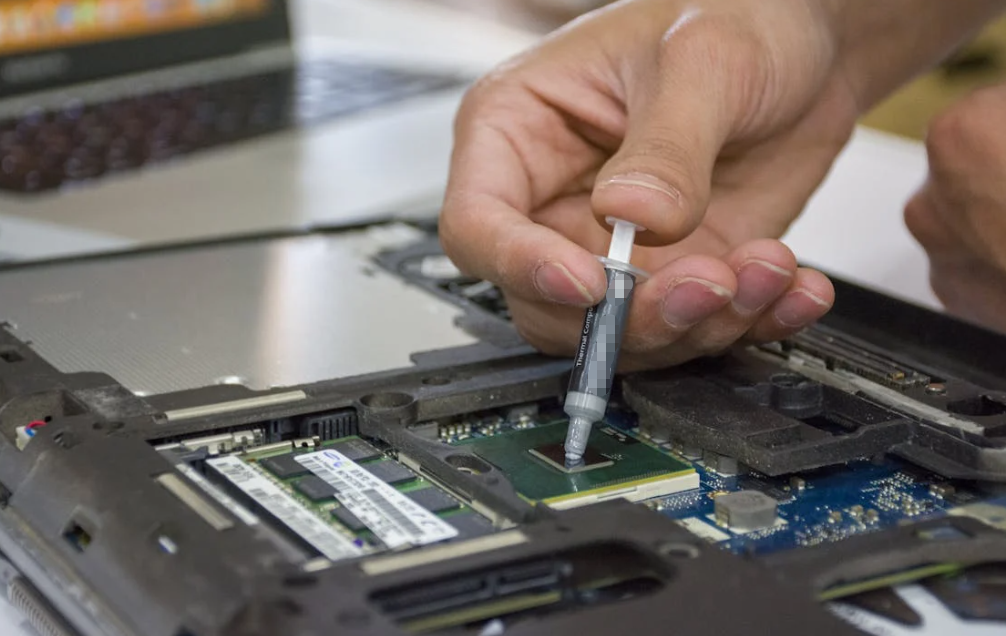
Thermal grease conducts heat. Whether it also conducts electricity depends on the exact formula. Many conventional thermal pastes are electrically non-conductive. Some specialty greases conduct both heat and electricity, while liquid-metal thermal interface materials require their own handling precautions.
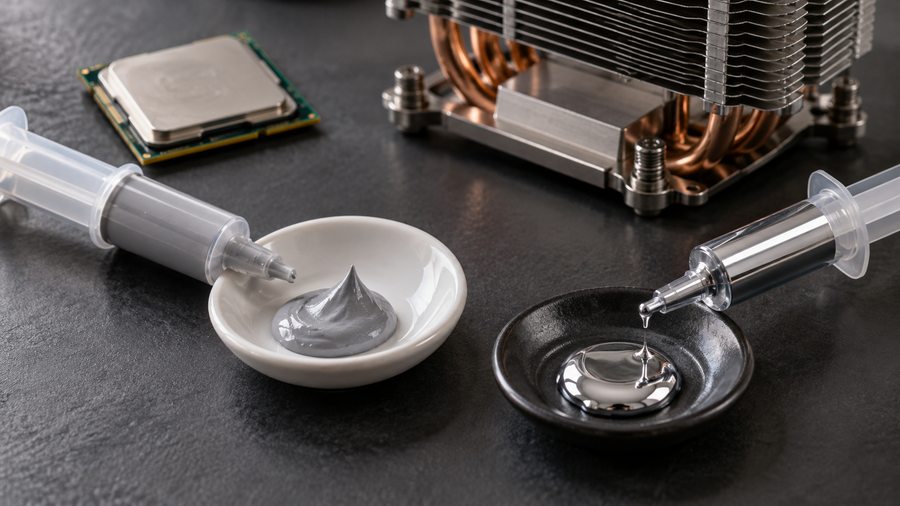
That distinction matters when a little paste ends up somewhere unexpected. A tube labeled “highly conductive” may be talking about heat transfer, not electrical current. The color of the paste will not settle the question, either.
Before using it near exposed circuitry, check the manufacturer’s electrical specifications for that exact product. And keep one point in mind: a grease described as non-conductive is not automatically a suitable electrical insulation barrier.
Let’s separate those ideas and look at what they mean for your assembly.
Thermal Conductivity and Electrical Conductivity Are Different
What W/m·K tells you—and what it does not
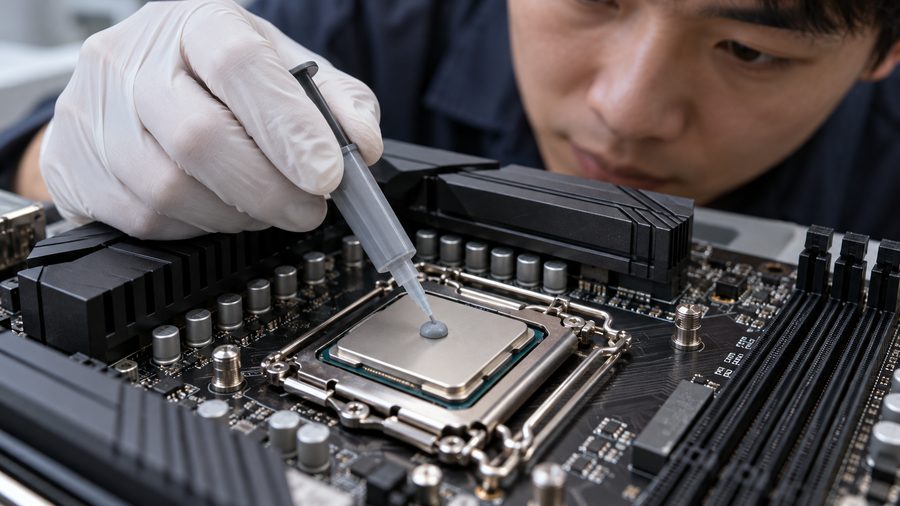
Thermal conductivity describes how readily heat moves through a material. Its common unit is watts per meter-kelvin, written W/m·K. Thermal grease helps heat cross the microscopic spaces between a component and its heat sink by replacing trapped air.
Electrical conductivity describes how readily electrical current flows. A material can transfer heat while strongly resisting electrical current. Think of a ceramic mug: heat reaches your hand through the wall, but that does not make the mug an electrical wire.
So a high W/m·K figure does not tell you whether a paste could electrically bridge two pins. It also does not guarantee the lowest processor temperature. Contact quality, grease thickness, mounting pressure and the rest of the cooling system still matter.
Resistance, resistivity and dielectric strength
These terms answer different questions. Electrical resistance applies to a particular path or test specimen. Volume resistivity accounts for specimen geometry and helps describe the material itself. Dielectric strength concerns electrical breakdown under specified test conditions.
| 財産 | 共通単位 | What it helps you judge |
|---|---|---|
| 熱伝導率 | W/m·K | How readily heat travels through the material |
| Electrical resistance | Ω | Opposition to current along a particular path |
| 体積抵抗率 | Ω·cm or Ω·m | Resistance to current through the material, accounting for geometry |
| 絶縁耐力 | kV/mm | Breakdown field under the stated test conditions |
| 絶縁破壊電圧 | V or kV | Voltage at which the tested specimen breaks down |
A data sheet can list excellent thermal conductivity and high electrical resistivity together. That is not a contradiction. They describe different jobs.
Which Thermal Grease Formulations Conduct Electricity?
Ceramic-filled and silicone-based greases
A typical grease combines a carrier with particles that improve heat transfer. The carrier helps the compound spread and wet the contact surfaces. The fillers contribute to its thermal behavior.
Many electrically insulating formulations use ceramic fillers, such as aluminum oxide or boron nitride. Aluminum oxide is not the same material as aluminum metal. Seeing “aluminum” in a chemical name does not prove that a compound conducts electricity.
Silicone describes a carrier family, not the electrical specification of the finished grease. Silicone-free greases also vary. Neither label removes the need to check the exact formulation.
White or gray color is just as unreliable. Different recipes can look almost identical on a spatula. Appearance helps identify a spill; it does not qualify the material.
Silver and carbon fillers: check the finished formula
It is tempting to sort every paste into two boxes: ceramic means insulating, metal means conductive. Real formulations are less tidy.
Arctic Silver’s official description of Arctic Silver 5 provides a useful counterexample. The product contains silver, yet the manufacturer identifies it as electrically non-conductive. It also warns that the compound is slightly capacitive and should stay away from traces, pins and leads.
Capacitive behavior is different from a direct conductive bridge. Material between nearby conductors can affect how electrical signals interact, even without acting like a wire. That warning is specific to the product; it should not be copied onto every non-conductive grease.
Carbon-based is also a broad description. The form of carbon, particle loading and distribution all matter. Check the finished compound rather than inferring its behavior from one ingredient.
Electrically conductive specialty greases
Some greases deliberately support electrical conduction. They may serve engineered contact, grounding or shielding applications where that property is useful.
その FUCHS thermal interface materials directory shows why thermal and electrical specifications need separate columns:
| 製品 | 熱伝導率 | 体積抵抗率 |
|---|---|---|
| FUCHS TIM GREASE 618 | 1.2 W/m·K | 10¹⁴ Ω·cm |
| FUCHS TIM GREASE 710NS | 7 W/m·K | 10² Ω·cm |
These are manufacturer-published values, not HAKTAK test results. FUCHS describes 710NS as a compound for both thermal and electrical conduction, including contact and grounding uses.
The figures illustrate different formulations. They do not establish a rule that increasing thermal conductivity must reduce electrical resistivity. Nor does a conductive grease automatically make a suitable replacement for a specified electrical connection. Contact design and product qualification still apply.
Liquid metal belongs in a separate category
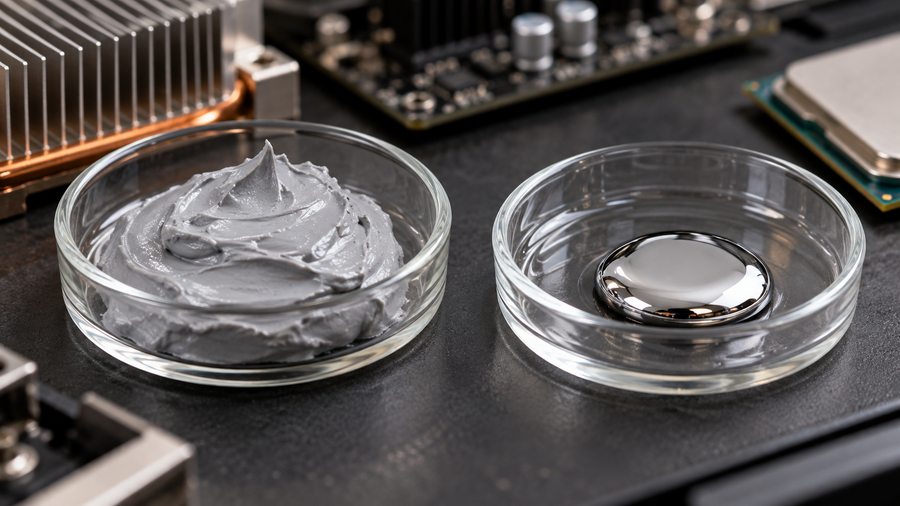
Liquid-metal TIMs are metallic materials used at thermal interfaces. They should not be treated as ordinary grease with a higher performance rating.
For example, Thermal Grizzly identifies Conductonaut as electrically conductive, while identifying its named conventional pastes as non-conductive. Its instructions also distinguish Conductonaut’s aluminum-contact restriction from those conventional products.
Electrical containment and surface compatibility are separate checks. A material may transfer heat effectively yet be unsuitable for the cooler surface or surrounding circuitry. Follow the exact product and equipment instructions. Do not assume every metal-filled paste is liquid metal, or that a familiar application method transfers safely between them.
If Thermal Grease Gets on a PCB or CPU Socket
Identify the material and where it went
First, identify the exact product. Keep the tube or packaging and find its manufacturer information. An unmarked syringe leaves a real information gap. It is better to resolve that gap than guess from the color.
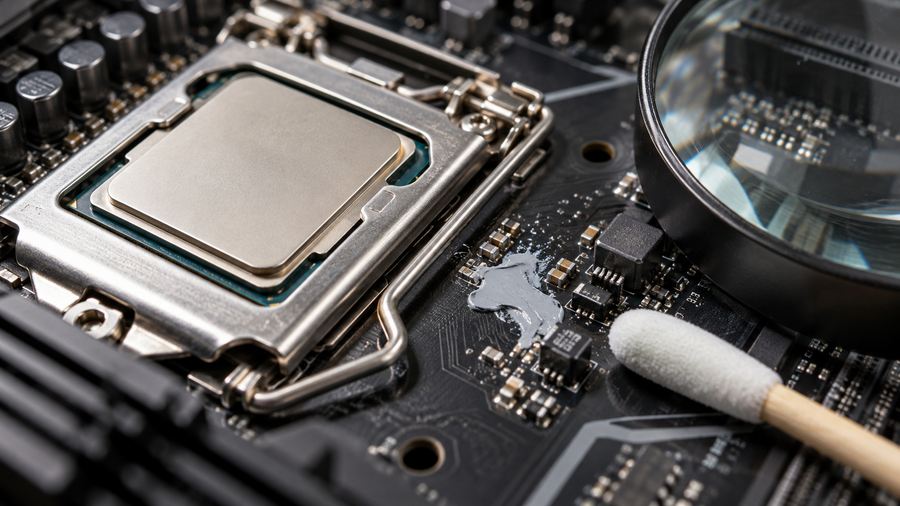
Next, inspect the location. A small amount squeezed onto the outside edge of a heat sink is different from residue inside a CPU socket. Paste between fine contacts can interfere with their connection even when the material does not readily conduct electricity.
Location also changes the cleanup difficulty. A flat metal heat spreader is accessible. Socket contacts and closely spaced components are delicate, and residue can hide underneath them.
| Where the material is | Main concern | Practical next step |
|---|---|---|
| Accessible cooler surface | Excess material or poor seating | Clean using the approved procedure and remount correctly |
| PCB near exposed connections | Conductive bridging or contamination | Identify the compound and inspect before power is restored |
| Socket or fine-pitch contacts | Contact interference and cleaning damage | Use appropriate service guidance or qualified repair |
| Unknown liquid-metal spill | Conductive material may have spread | Keep the equipment off and seek suitable inspection |
Clean and inspect before powering up
Power down and disconnect the equipment as its service instructions require. Industrial power equipment may retain hazardous energy after disconnection and belongs with qualified personnel.
Use a cleaning method compatible with the compound, board materials and surrounding parts. Avoid scraping contacts with metal tools or flooding a socket with an unapproved solvent. Let approved cleaning agents dry fully and inspect for residue before reassembly.
If material has entered inaccessible contacts, get help rather than pushing it deeper while trying to wipe it away. The aim is a clean, undamaged connection.
There is no useful “safe spill size” that applies to every board. Product identity, location and the condition of the contacts matter more than how small the smear looks. Turning it on to see what happens is not a cleaning check.
Why Non-Conductive Grease Is Not an Insulation Barrier
CPU and GPU cooling joints
In an ordinary processor cooling joint, grease improves contact between the designated thermal surfaces. It is not there to insulate arbitrary electrical connections around the processor.
The mounting system controls pressure and position. Nearby GPU memory or power components may use pads because the cooler leaves different gaps above them. Replacing those pads with grease changes the mechanical arrangement, regardless of whether both materials are electrically non-conductive.
This is where a narrow product claim can become misleading in practice. “Does not conduct electricity” answers a material question. It does not approve every location, thickness or replacement.
Power modules, LED drivers and industrial controls
A transistor tab or another exposed cooling surface may be electrically connected to an internal terminal. If its heat sink must remain isolated, the assembly needs an appropriate insulation system.
That might include a specified insulating sheet or ceramic component, suitable mounting hardware, and an approved thermal interface treatment. The required construction depends on the device and its electrical conditions.
Grease can be displaced during tightening. Its thickness can vary across a rough surface, and temperature cycling may move material out of parts of a joint. A high resistivity value alone does not prove that a continuous insulating layer will remain in place.
比較する場合 thermal materials for power electronics, start with the isolation requirement. Then evaluate heat transfer. This order matters in motor drives, industrial power supplies, LED drivers and automotive power electronics.
Telecom and dense electronics
Compact electronics bring thermal interfaces close to connectors, exposed pads and sensitive circuits. Even where a direct short is unlikely, unwanted residue can affect contacts or complicate cleaning and inspection.
High-frequency designs may also need to consider dielectric properties and coupling, depending on where the material sits. A resistance measurement alone does not describe all electrical behavior.
The practical goal is controlled placement. Keep the material inside its intended interface and evaluate the assembled design over its expected temperature, vibration and service conditions.
How to Check a Thermal Grease Data Sheet

Look beyond the thermal conductivity headline
Start with the exact grade and document revision. Similar product names can refer to different formulations, and a distributor’s short listing may omit important restrictions.
Look for an explicit statement about electrical behavior, supported where appropriate by volume resistivity and dielectric test data. Check the units carefully. Resistance in ohms is not the same quantity as volume resistivity in ohm-centimeters.
Ask how the specimen was prepared and tested. Thickness, electrode geometry, applied voltage, temperature, humidity and measurement time can affect interpretation. A useful number needs enough context to connect it to your assembly.
A technical data sheet, or TDS, describes performance properties. A safety data sheet, or SDS, focuses on hazards, handling and related safety information. An SDS may not provide the electrical data needed for selection. Likewise, RoHS compliance does not establish electrical insulation performance.
What the test standards actually establish
ASTM D257 covers DC resistance or conductance testing of insulating materials. Its measurements can be used to determine resistivity with the appropriate specimen and electrode geometry. Ask the supplier how the method was applied to its material.
ASTM D149 addresses dielectric breakdown voltage and dielectric strength of solid electrical insulating materials at commercial power frequencies. When a grease data sheet cites this method, request details of specimen preparation, thickness and any adaptations. A paste is not automatically equivalent to a solid insulation sheet.
ASTM D5470 concerns thermal transmission properties. It helps interpret thermal impedance and apparent conductivity under test conditions. It does not establish electrical isolation.
None of these references, by itself, certifies the complete product. Also, do not multiply a dielectric-strength number by an assumed grease thickness and treat the result as an allowable working voltage. Actual insulation design needs suitable margins, construction details and validation.
Can a multimeter prove that grease is non-conductive?
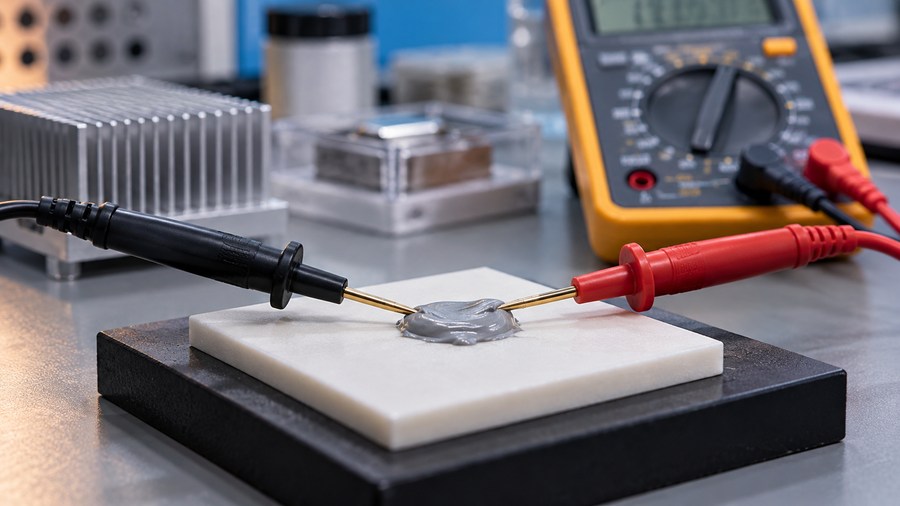
A basic continuity test cannot do that. No beep means the measured path did not meet that meter’s continuity threshold under those conditions. It does not establish a high resistivity value, dielectric strength or behavior at another voltage.
Probe spacing, contact pressure and the amount of material also change the result. Grease is particularly awkward because the specimen can move during measurement.
Use manufacturer data and properly specified laboratory testing for qualification. A homemade test on a blob of paste should not become the basis for approving electrical isolation. Do not apply improvised high-voltage tests to a populated board.
Choosing a Compound for the Actual Assembly
A workable selection process starts with the electrical job, then the thermal and mechanical conditions.
- Define the isolation requirement. Does the joint need to separate a live surface from a heat sink, or is electrical conduction intentional?
- Check the gap and mounting. Thin, closely clamped surfaces may suit grease. Larger gaps may need a pad, putty or gap filler with its own electrical specifications.
- Compare installed thermal performance. Consider contact resistance, final thickness and mounting pressure alongside conductivity.
- Check stability and compatibility. Evaluate migration, pump-out, temperature cycling and interaction with nearby materials.
- Validate the assembled product. Agree on relevant electrical and thermal acceptance criteria, including aged conditions where required.
Consider a hypothetical motor-controller repair. The original transistor uses an insulating sheet between its tab and the heat sink. Someone proposes removing it and using a “non-conductive” paste to improve cooling. The first question is whether the replacement preserves the required isolation. A lower temperature cannot compensate for losing that function.
For a new design, share the contact geometry, temperature range and electrical requirements when reviewing HAKTAK’s thermal grease options for electronics. Those details make the product discussion more useful than asking for the highest W/m·K number.
For production, document the approved grade and dispensing method. Control where the material goes and how the joint is fastened. If a supplier changes the formulation or a line changes the process, review whether existing validation still applies. A good compound still needs a repeatable assembly process.
結論
Thermal grease is made to transfer heat, but its electrical behavior varies by formulation. Many conventional pastes are non-conductive; specialist greases and liquid-metal TIMs can behave very differently.
Check the exact product rather than its color, filler name or thermal conductivity headline. Keep paste away from unintended contacts, and treat socket contamination as a separate problem from electrical conduction.
For engineering applications, distinguish a material’s resistivity from a qualified insulation system. The right choice must suit the contact surfaces, electrical requirements and service conditions together. That is what turns a promising data sheet into a reliable joint.
よくある質問
Does thermal grease conduct electricity?
Some formulations do, while many conventional thermal pastes are electrically non-conductive. The product name alone does not tell you which type you have. Look for an explicit manufacturer statement and relevant electrical data for the exact grade. If the compound is unidentified, do not assume it is suitable near exposed electrical connections.
Does a higher W/m·K rating mean a paste is electrically conductive?
No. W/m·K describes thermal conductivity, not electrical conductivity. Materials can transfer heat while resisting current. Compare electrical specifications separately, and remember that cooling performance also depends on contact quality and layer thickness. A higher thermal rating does not answer whether the material can safely contact a particular circuit or replace an insulating part.
Is white or gray thermal grease non-conductive?
Color is not reliable evidence. White and gray compounds can use different carriers, fillers and additives. Even two products that look identical may have different electrical properties. Find the manufacturer and product grade, then read its technical information. Treat an unmarked or poorly documented compound as unknown rather than trying to identify it by appearance.
Is silver thermal paste always electrically conductive?
No. Arctic Silver 5 is an example of a silver-containing compound whose manufacturer describes it as non-conductive, while also noting slight capacitive behavior. Other silver-containing greases are intentionally conductive. The finished formulation matters. Do not generalize one product’s electrical properties to another because they share a filler name or metallic appearance.
Is liquid metal electrically conductive?
Liquid-metal thermal interface materials conduct electricity and require suitable containment and handling. They are not ordinary grease substitutes. Check the exact product’s instructions for surface compatibility and the device manufacturer’s service requirements. Conductive material reaching unintended electrical connections can cause damage, and good heat-transfer performance does not remove that risk or make every cooling surface compatible.
Can non-conductive thermal paste cause problems in a CPU socket?
Yes. It can interfere with contact between mating surfaces, trap contamination or complicate inspection. The problem need not be a direct electrical short. Keep the system off until the affected area has been appropriately cleaned and checked. Delicate socket contacts can be damaged by cleaning, so use the relevant service procedure or qualified repair assistance.
Can I test thermal grease with a multimeter?
A multimeter may detect a conductive path within its measurement range, but a high reading or lack of a continuity beep does not prove insulation performance. The test voltage, geometry and instrument limits matter. Use suitable manufacturer specifications or controlled testing for engineering decisions. Do not turn a casual probe test into approval for a high-voltage application.
Can thermal grease replace an electrical insulation pad?
Not automatically. The pad may provide a controlled separation and a qualified electrical barrier, as well as thermal contact. Grease can shift or become very thin under pressure. Any replacement must preserve the assembly’s electrical and mechanical requirements through service. Keep the specified insulation structure unless a properly evaluated design change supports another solution.
Is dielectric grease the same as thermal grease?
No. Dielectric grease may be intended to protect or lubricate specified electrical connections, while thermal grease is formulated for heat transfer at a thermal interface. Some properties may overlap, but the names do not establish interchangeability. Use a product only where its thermal performance, electrical behavior and material compatibility support the intended application.
Can I use conductive thermal grease on a CPU or GPU?
Only where the exact material and device arrangement support that use. A purpose-designed system may accommodate a conductive TIM, but that does not make it a routine replacement for conventional paste. Consider nearby components, retention and surface compatibility. For servicing, follow the equipment maker’s approved material and procedure rather than choosing solely by a thermal-performance claim.