
ディスペンス可能な熱伝導ギャップ充填
シリコーンフリー熱伝導性ゲルによる汚染に敏感な電子機器のギャップ充填
シリコーン系材料の使用が制限される場合に、軟質でディスペンス可能な熱伝導インターフェース材で、部品とハウジング間の不均一なギャップを橋渡しします。シリコーンフリーという表示やW/m·Kだけでなく、汚染要件、実際のボンドライン、ディスペンス工程、長期信頼性に基づいてシリコーンフリー熱伝導性ゲルを選定してください。.
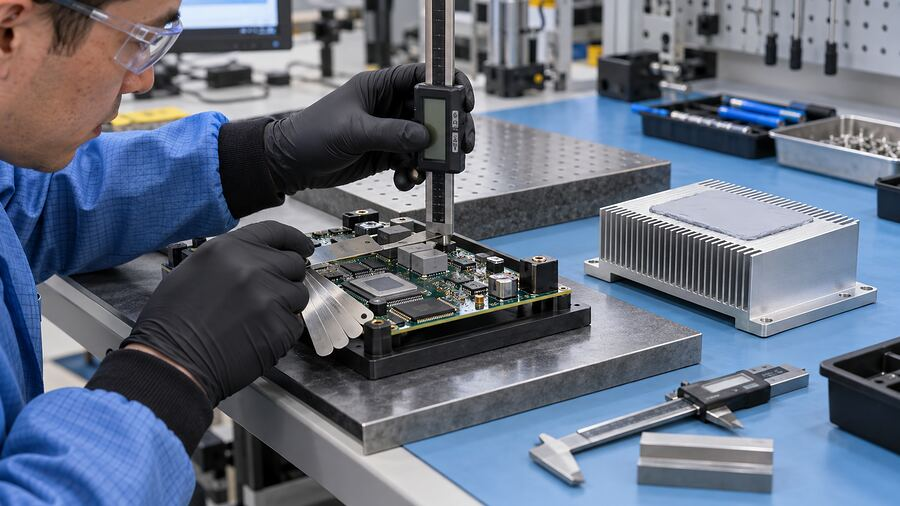
Define the material, not just the label
What Is Silicone-Free Thermal Gel?
Silicone-free thermal gel is a dispensable thermal interface material formulated without a silicone binder, used to replace air between uneven heat-generating components and a heat sink, cold plate or enclosure.
Thermally conductive fillers provide the heat path; the non-silicone carrier and delivered material state determine flow, softness, wetting and service behavior. The gel conforms as the assembly closes, so controlled dose and final thickness remain essential.
The category name does not establish a universal formulation or cure mechanism. A ready-to-dispense, one-part material may be non-curing or pre-cured; other silicone-free liquid gap fillers require mixing and a subsequent cure. Specify the exact grade rather than treating these routes as interchangeable.
For the wider family, explore the liquid gap filler category. For basic formats and use cases, read what a thermal gap filler does.
Silicone-free is not silicon-free
Silicone describes a polymer chemistry; silicon is an element that may appear in ceramic fillers or other compounds. Define the prohibited substances, allowed limits and analytical method in the purchasing specification.
A silicone-free declaration also does not establish zero outgassing, zero oil bleed or universal surface compatibility. Those require separate evidence.
Start with the restriction reason
When Should You Choose Silicone-Free Thermal Gel?
Consider this route when soft gap filling is needed and silicone use conflicts with the product environment or manufacturing specification. Identify the exposed surface and failure mechanism first.
Protect the optical path
For cameras, sensors and optical modules, define acceptable deposition, haze or transmission change. Test the material at the real distance, temperature and enclosure ventilation—not only as an isolated sample.
Preserve coating and bonding
Painting, conformal coating and adhesive bonding may require controlled surface chemistry. Evaluate wetting, adhesion and contamination after the full production sequence, including handling and thermal exposure.
Respect sensitive zones
Contact-sensitive hardware or a silicone-restricted factory may have specific acceptance limits. Include connectors, relays, residue transfer and equipment cleanliness in qualification; a clean material alone does not make a clean process.
Separate chemistry from supplied state
Silicone-Free Thermal Gel Types and Material States
Select the operating state and production route together. The following are screening routes, not a claim that every grade is available with the same properties.
One-part soft gel
A supplied compound can avoid on-line two-part mixing. Confirm whether it is pre-cured, non-curing or activated by another mechanism, and whether it holds shape through the longest dispense-to-close delay.
Best fit: lines seeking simpler dispensing and service-aware assembly, where storage stability, slump and final thermal contact can be validated.
Silicone-free curing gap filler
A liquid system can wet the interface before reaching a specified final state. Mixing, open time, fixture conditions and actual material temperature become part of the controlled process.
Best fit: assemblies needing post-placement stabilization, where the equipment, components and takt time can support the qualified cure window.
Evidence under stated conditions
Silicone-Free Thermal Gel Specifications That Matter in Assembly
Compare the delivered material and assembled interface. Every reported value needs its specimen, method and operating condition; a competitor’s data is not a specification for a Haktak grade.
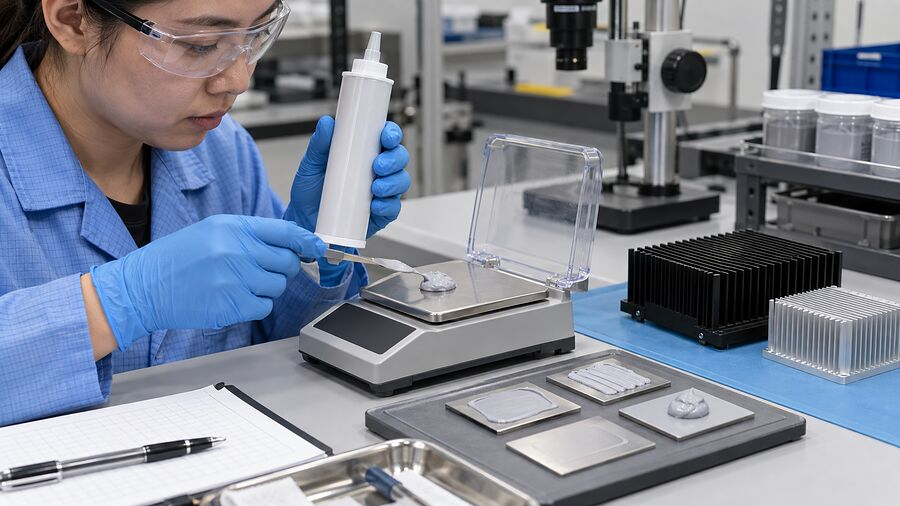
| 仕様書 | その重要性 | 何を記録するか |
|---|---|---|
| Silicone restriction and composition | Connects the declaration to the actual prohibited chemistry. | Substances, limits, supplier declaration and analytical scope. |
| Thermal conductivity and impedance | Bulk conductivity screens materials; impedance includes thickness and contact. | Method, temperature, pressure, contact area and final bond line. |
| Gap and closure load | Determines coverage and load on components, boards and solder joints. | Minimum/nominal/maximum gap, dose, strain and compression force. |
| Viscosity and shape retention | Controls pump pressure, nozzle selection, wetting and slump. | Temperature, shear rate, dwell, bead geometry and orientation. |
| Supply and final state | Determines mixing, activation, cure and handling requirements. | 1K/2K, ratio if relevant, open time, storage and actual cure reached. |
| Bleed, outgassing and compatibility | Checks contamination of nearby surfaces and subsequent processes. | Exposure conditions, deposition/residue criteria and representative substrates. |
| 電気的挙動 | Separates thermal transfer from electrical conduction or insulation. | Dielectric/resistivity evidence, voltage, thickness, edges and clearance. |
| 信頼性と手直し | Checks retained contact and serviceability over the intended lifetime. | Cycling, humidity, vibration, displacement, removal and replacement results. |
On a narrow screen, swipe within the table to view all columns.
Learn why assembled performance needs more than a bulk number in the 熱伝導率と熱インピーダンスのガイド.
つながる1つの製造窓口
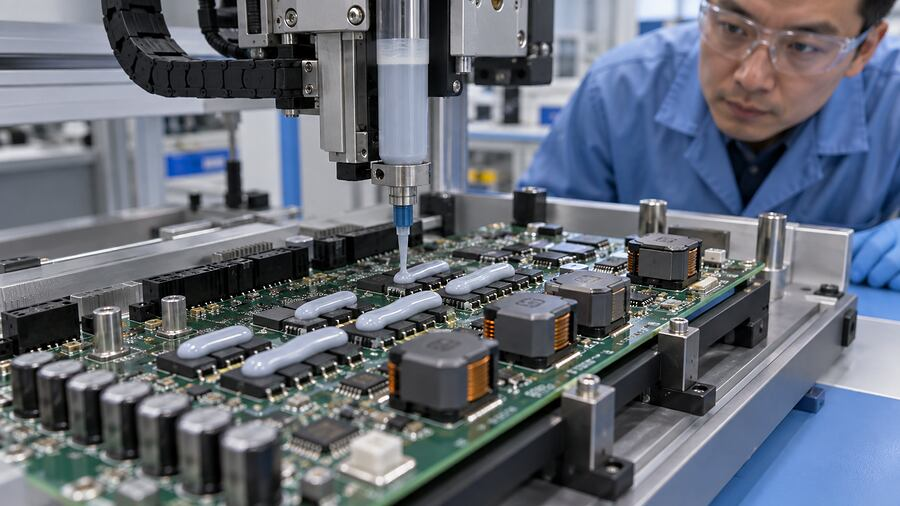
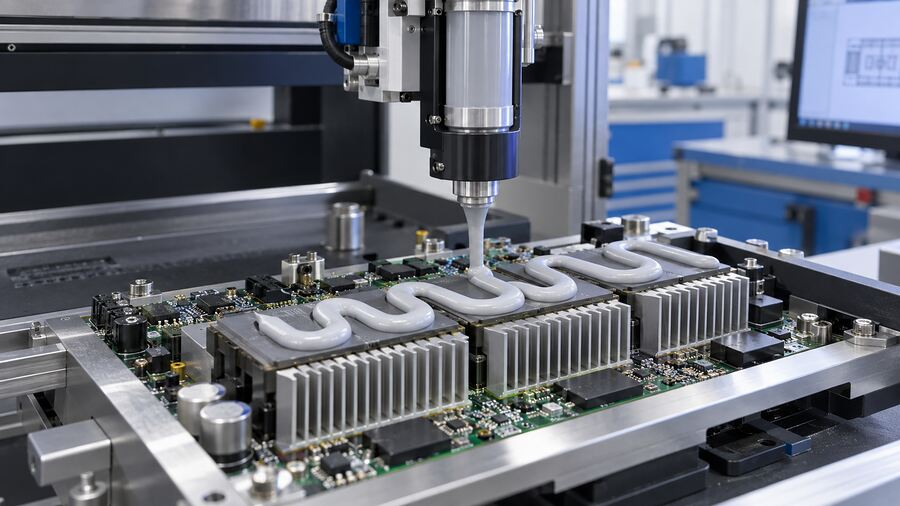
Dispensing Silicone-Free Thermal Gel as a Controlled Process
Qualify the material from storage through closure. Temperature, settling, air intake, mixer shear and nozzle restriction can change the delivered bead even when the nominal formulation is unchanged.
Condition and meter
Confirm package handling, material temperature, shelf life and shot mass. For two-part grades, record ratio tolerance and mixing quality.
排出して閉じる
Use a bead pattern that wets both surfaces and lets air escape. Test starts, stops, corners, the smallest shot and longest idle or assembly delay.
Stabilize and inspect
Verify any required cure at the material, then inspect coverage, overflow, final thickness and functional performance. Separate handling readiness from full functional cure.
Test the real assembly
Validate Silicone-Free Thermal Gel for Contamination-Sensitive Assemblies
Use the same surfaces and acceptance limits before and after service exposure. Check both the heat path and the sensitive zone: a good thermal result alone does not prove contamination compatibility.
Record the starting interface
Measure dose, gap, contact, thermal impedance and electrical behavior. Record optical, coating, bonding or contact performance before introducing the candidate.
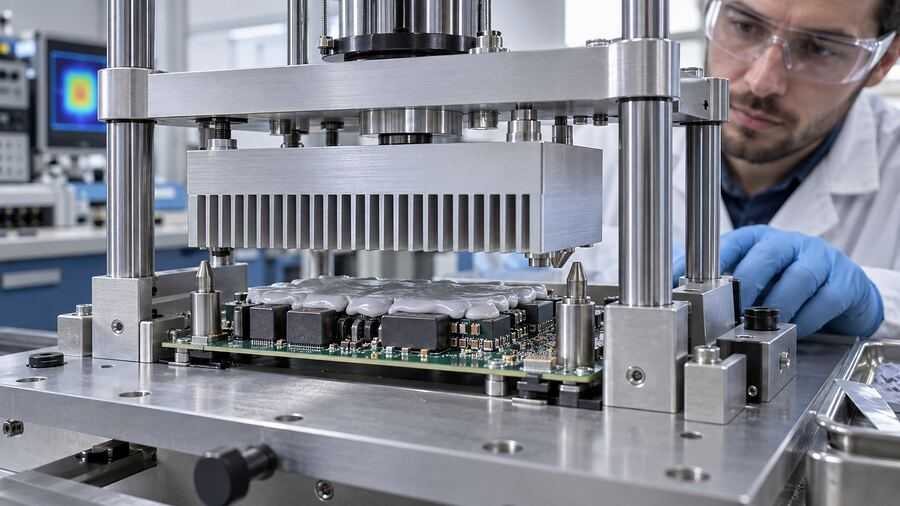
Reproduce the duty
Apply relevant heat, humidity, vibration and orientation. Include nearby witness surfaces or actual sensitive substrates; define residue and deposition acceptance limits in advance.
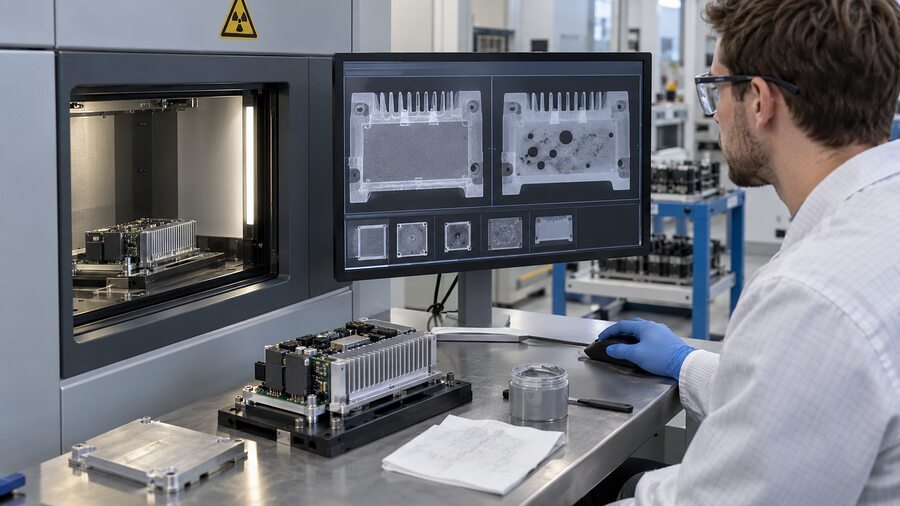
Retest the functions
Repeat thermal, electrical and surface checks. Inspect migration, bleed, adhesion and contact loss; validate disassembly, cleaning and the thermal result after replacement.
アプリケーション主導型スクリーニング
Silicone-Free Thermal Gel Applications
These are candidate applications, not automatic qualifications. The restriction reason and complete service conditions determine whether this material route is appropriate.
Cameras and optical electronics
Connect sensors and processors to housings while checking optical deposition, alignment loads and nearby surface contamination.
Coated and bonded assemblies
Evaluate heat transfer together with paint wetting, conformal coating adhesion and adhesive bond quality after handling and aging.
Controls, compute and power
Bridge mixed component heights where silicone restrictions apply, while retaining dielectric margins, mechanical reliability and an acceptable repair route.
Choose by interface and service strategy
Silicone-Free Thermal Gel vs Silicone Gel, Putty and Pads
A similar conductivity number does not make different chemistries or formats interchangeable. Compare them at the same gap, pressure, temperature and contamination criteria.
| Route | 最適 | Main qualification |
|---|---|---|
| ノンシリコーンサーマルゲル | Soft dispensed contact where a defined silicone restriction applies. | Composition declaration, surface compatibility, process window and aging. |
| 1液性サーマルゲル | Ready-to-dispense supply without two-part metering. | Binder chemistry, delivered state, slump and rework; 1K is not synonymous with silicone-free. |
| 後硬化サーマルゲル | Placement followed by a qualified final stabilization. | Cure window, final softness and retained contact; confirm chemistry separately. |
| サーマルパティ | Formable contact across local height variation. | Actual material state, mass, migration and service procedure. |
| サーマルパッド | Defined footprint, controlled thickness and clean part placement. | Binder compatibility, contact at the largest gap and load at the smallest gap. |
| 熱伝導グリス | Very thin, tightly controlled interfaces rather than large stand-offs. | Binder chemistry, pump-out, application amount and long-term contact. |
Swipe within the table on mobile to compare every column.
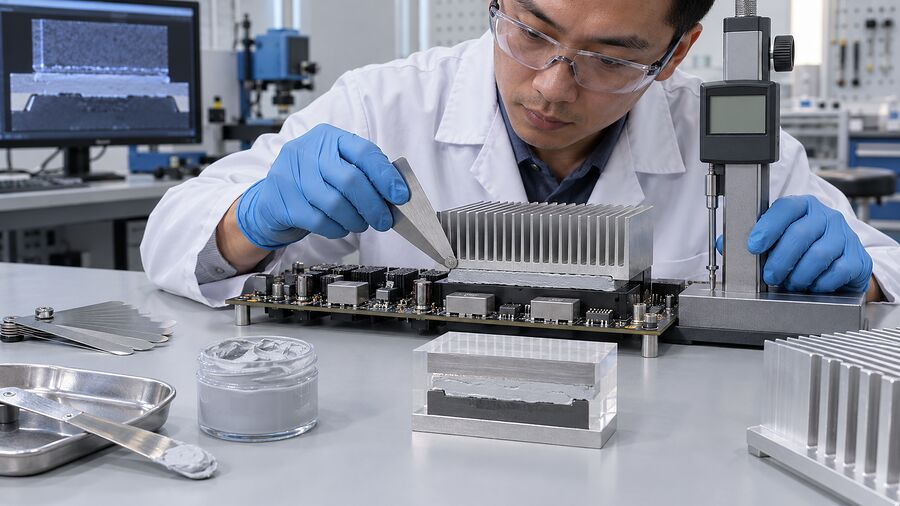
From screening to production
Match Silicone-Free Thermal Gel to Your Actual Interface
Send the silicone restriction, sensitive surfaces, minimum/nominal/maximum gap, heat load, voltage, equipment, any cure limits and reliability plan. はくたく can review the material route and comparison evidence needed for your assembly.
Practical engineering answers
Silicone-Free Thermal Gel FAQ
What is silicone-free thermal gel?
It is a dispensable thermal interface material made with a non-silicone binder, used to fill uneven electronic heat-source-to-cooling-surface gaps. The exact composition and final state depend on the grade.
Is silicone-free the same as silicon-free?
No. Silicone is a polymer chemistry and silicon is an element. State the substances and limits that your specification prohibits; fillers may contain silicon without being silicone polymers.
Is every silicone-free thermal gel single component?
No. Silicone-free describes chemistry, not component count. Both ready-to-dispense one-part materials and mixed liquid gap-filling systems exist.
Does silicone-free thermal gel require curing?
Some grades are pre-cured or non-curing; others need a defined cure or activation step. Confirm the delivered state and functional cure requirements from the selected grade’s documentation.
Does silicone-free mean zero bleed or outgassing?
No. A non-silicone carrier can still release volatile compounds or leave residue. Define relevant conditions and acceptance limits, then test the candidate with the actual sensitive surfaces.
Can it be used near optical components?
It can be screened for that application, but optical compatibility is not automatic. Evaluate deposition, haze or transmission changes at representative temperature, distance, ventilation and exposure time.
Is silicone-free thermal gel electrically insulating?
Many formulations target insulation, but the category name does not guarantee it. Check grade-specific dielectric strength, resistivity, voltage, bond-line thickness and edge clearance.
How is thermal gel different from silicone-free grease?
Gel is typically selected for conformable gap filling and shape retention. Grease is generally used in much thinner interfaces. The actual rheology and qualified thickness—not the name alone—determine fit.
Will it remain stable in vertical or vibrating assemblies?
That requires testing. Confirm pre-closure slump and post-assembly migration, contact and thermal performance through the intended temperature, orientation and vibration duty.
Can silicone-free thermal gel be reworked?
It depends on the grade and final state. Validate removal force, residue cleanup, replacement volume and thermal, electrical and surface performance after the next closure.