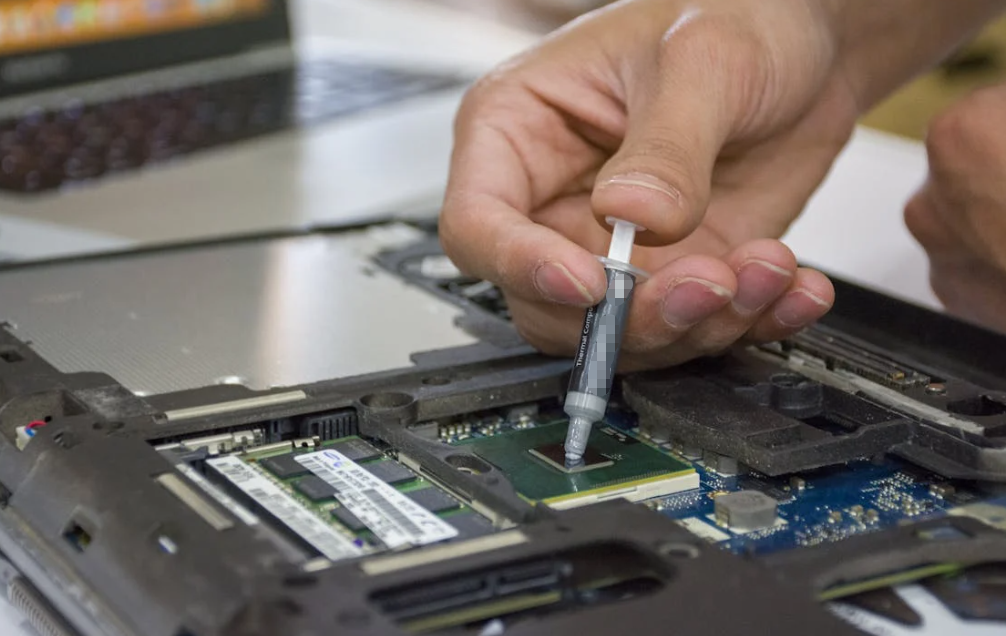
The service manual calls for thermal paste. The tube on your bench says thermal grease. Are you holding the right thing?
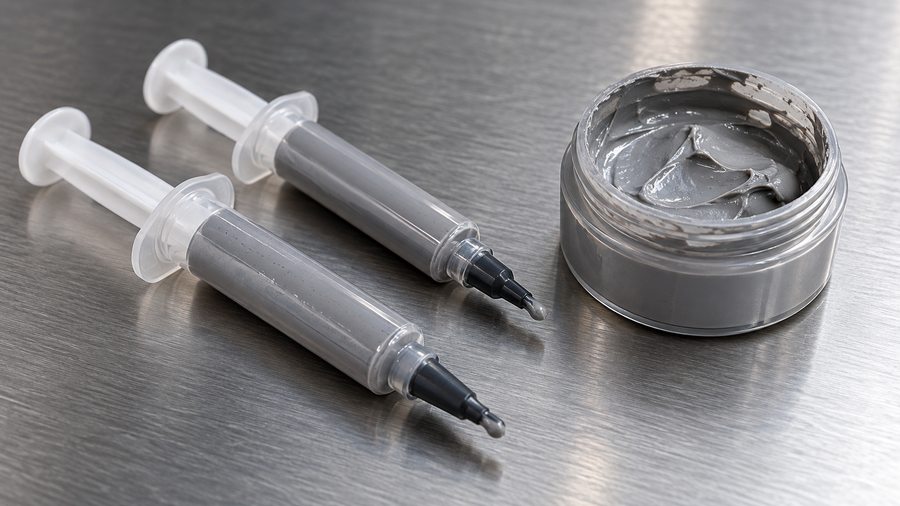
Usually, yes: in electronics cooling, those two names commonly describe the same family of spreadable thermal interface materials. Both fill tiny air spaces between a hot component and a cooling surface. The name alone, though, does not tell you whether that particular tube fits this particular joint.
A laptop CPU, a bolted power module and a hotend can all need a heat-transfer compound. They do not necessarily need the same formula. So let’s settle the wording, then make the substitution decision that actually matters.
Thermal Grease and Thermal Paste Usually Mean the Same Kind of TIM
Manufacturers, repair guides and hobbyists use overlapping names. You will see 熱伝導グリス, 熱伝導グリース, ヒートシンクコンパウンド, CPU paste and sometimes just 熱伝導グリス. Intel’s processor application guide, for example, lists grease among the names used for paste. The shared purpose is to improve contact where two solid surfaces meet.
Those surfaces look flat until you magnify them. Tiny ridges touch; tiny valleys hold air. The compound moves into the valleys as the cooler is clamped down. Heat then has a more continuous route from the component into the heat sink, cold plate or metal housing. The cooling hardware still has to carry that heat away.
Here’s the naming map you can keep in your head:
| Label you see | What it usually means | What the label cannot prove |
|---|---|---|
| Thermal grease / thermal paste | A spreadable material for a thin thermal interface | Exact formula, electrical properties or service temperature |
| Heat sink compound / CPU paste | Often the same broad product family | Suitability for a different component or mounting method |
| 熱伝導性化合物 | A loose umbrella term in some catalogs | That it is non-curing grease rather than another compound |
| Thermal interface material (TIM) | The whole family of materials used at thermal joints | That it is paste at all; pads and PCM are TIMs too |
Yes, the wording is messy. A product data sheet clears up more than a product title ever will. Even the current ASTM D5470-17(2024) test-method description groups greases and pastes together as examples of viscous liquid interface materials. That is useful evidence about terminology. It does not make every grade interchangeable.
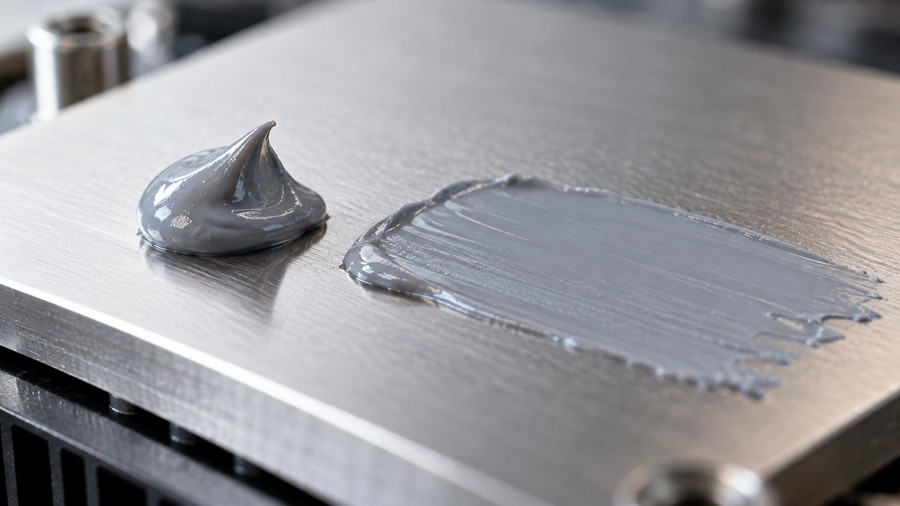
Same Category Does Not Mean Identical Product
Think of “thermal paste” the way you think of “engine oil.” The category tells you the job. It does not say which bottle is suitable for your machine.
Most familiar grease or paste formulas combine a spreadable carrier with thermally conductive フィラー. A carrier may be silicone based or silicone free. Fillers can include metal oxides, other ceramics, carbon-based particles or metals. The type and amount of filler affect how the compound flows, how thin it can settle, and its measured thermal properties. The carrier affects handling and stability too.
Two tubes can share a name and behave differently
Imagine two products labeled “thermal paste.” One spreads easily under a small CPU cooler. The other is formulated to stay put when screen printed onto a power module baseplate. Both can belong to the same family. Swap them without checking the joint and you may change coverage, final thickness or aging behavior.
Now imagine one tube says “grease” and the other says “paste.” Their data sheets may show nearly identical applications and test results. The labels did not tell you that either. You had to compare the grades.
Color is another tempting shortcut. White, gray and dark pastes may use different ingredients, but color is not a measured thermal or electrical specification. HAKTAK’s discussion of 白色とグレーのサーマルグリースの比較 explores that trap in more detail.
One more important wrinkle: don’t assume a metallic-looking paste is electrically conductive, or that every ceramic-sounding product is automatically safe near exposed circuitry. Get the actual resistivity or dielectric information for the chosen grade. Liquid-metal TIMs are a separate case and can introduce serious electrical and metal-compatibility risks.
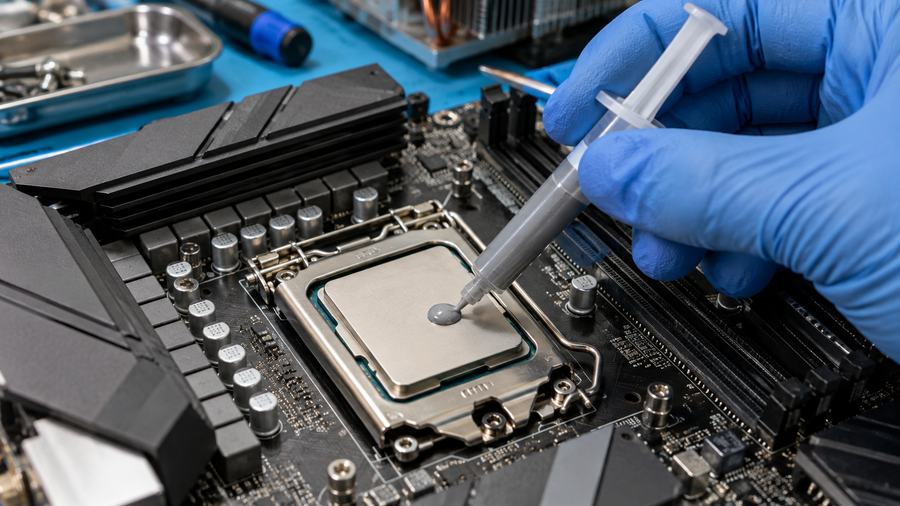
Five Checks Before Replacing Grease With Paste, or Paste With Grease
The substitution decision gets much easier when you stop comparing names and start comparing requirements. Put the specified product and the proposed replacement data sheets side by side. Then work through these five questions.
1. Will the joint close to the intended thickness?
Grease and paste are usually best at a thin, clamped interface. Measure or estimate the gap after assembly, not just the distance between parts lying loose on a bench. Check flatness, tolerances, fastener locations and mounting pressure.
If a chip sits well below a shared metal lid, extra paste is a poor way to build a bridge. The material may squeeze away or leave an unreliable thick layer. This is a job to reassess with the mechanical design or a proper gap material.
Ask the supplier what bond-line thickness, or BLT, its thermal figures assume. A number measured at one thickness may say little about a joint that finishes much thicker.
2. Does it perform under your pressure and heat load?
Thermal conductivity, usually given in W/m·K, describes heat traveling through the bulk material under specified conditions. Thermal impedance or resistance describes how the installed interface resists heat flow. Both matter, but they are not the same number.
Pressure changes how a paste wets the two surfaces. Too little can leave air pockets; a material that resists spreading may stay thick. A paper comparison based on W/m·K alone can therefore pick the wrong winner. HAKTAK’s guide to サーマルグリスの熱伝導率の選択とテスト is the place to go deeper on measurement conditions.
If you have two candidates, test them in the actual stack under the same power, ambient temperature, mounting method and workload. Record the difference after the system stabilizes. That is more useful than comparing two isolated marketing numbers measured in different ways.
3. Is it electrically and chemically compatible?
Read the electrical section of the data sheet. Does the assembly rely on a separate insulating pad or sheet? Is the compound near exposed traces or contacts? Grease is not a substitute for an electrical insulation barrier simply because a supplier calls it “non-conductive.” Check clearances and the finished joint.
Also consider adjacent materials. A formulation may contact aluminum, copper, coatings, plastics or an optical surface. Silicone migration or oil bleed can matter where contamination is unacceptable. Liquid metal is particularly unsuitable for certain metal surfaces, including aluminum, and needs its own handling rules.
This is not a reason to fear every paste. It is a reason to qualify the specific paste, not guess from the word on the label.
4. Can it survive the real operating environment?
Check the supplier’s continuous-use temperature range, not just a short peak. Then look at storage life, thermal cycling, vibration, pump-out and oil separation evidence. Ask what happens after repeated startup and shutdown, not only on the first day.
A desktop PC and an outdoor power converter live different lives. Both may use a compound that is called grease, but the converter’s environment can place tougher demands on the material. Service plans differ too. Is the joint expected to be opened for repair, or left closed for years?
5. Can your team apply it consistently?
A material might perform well in a lab and still be awkward on a production line. Check viscosity, dispense equipment, recommended bead or print pattern, package size, storage instructions and inspection method. Does the product spread with the allowed clamp load? Does it contaminate neighboring parts if the operator uses a little too much?
For a repair, follow the device manufacturer’s steps. For production, qualify a repeatable volume and inspect the final contact pattern. A neat bead before assembly is nice. A reliable, well-covered interface after assembly is the goal.
| Check | Compare on both grades | What can go wrong if you skip it |
|---|---|---|
| Joint fit | Final gap, BLT, pressure, surface geometry | Thick layer or uncovered regions |
| 熱解析結果 | Test method, impedance, pressure, temperature | A higher W/m·K grade runs hotter in the real joint |
| Electrical/chemical fit | Insulation data, substrate compatibility, bleed | Clearance or contamination problem |
| Service conditions | Continuous temperature, cycling, storage life | Early drying, movement or separation |
| アプリケーション | Viscosity, dispense pattern, mounting instructions | Good samples but inconsistent production |
When Can You Swap? Three Assemblies, Three Decisions
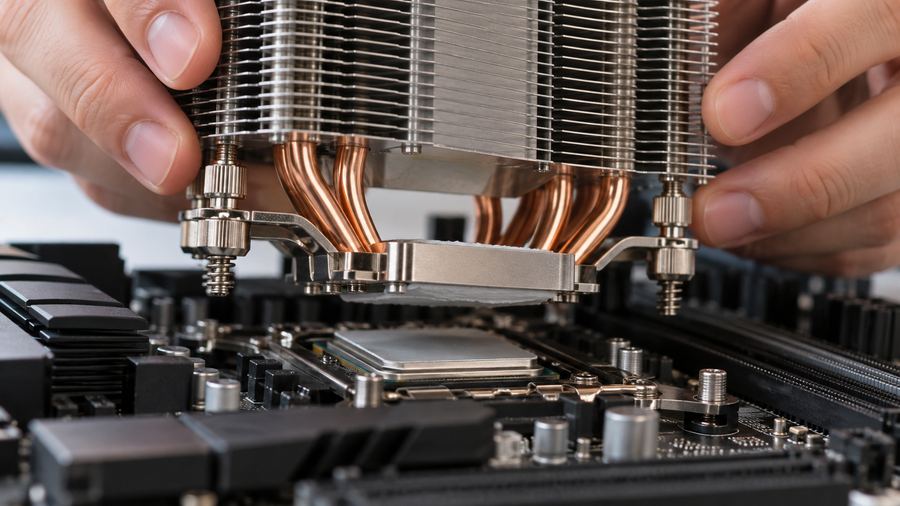
A desktop CPU cooler
If a PC build guide asks for thermal paste and you have an ordinary CPU-grade thermal grease, the names themselves are not an obstacle. Check that the cooler does not already have a pre-applied TIM. Then follow the maker’s cleaning and mounting instructions and verify that the product is suitable for that CPU-cooler interface.
The key is a thin, covered joint under the designed mounting pressure. Neither a giant blob nor a dry corner helps. When the cooler comes off, a fresh application on clean surfaces is usually a safer route than hoping the disturbed old layer will spread evenly again.
A bolted power module or an LED assembly
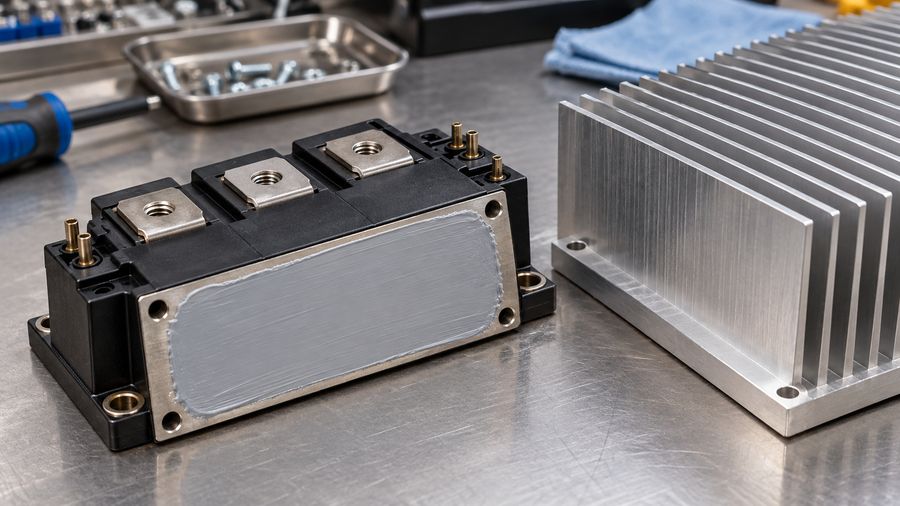
Here the question expands. The baseplate or board must transfer heat to a sink or chassis, but fastener torque, electrical isolation and operating environment can be just as important as the grease. If a specification names one grade, treat another grade as a proposed engineering change. Compare the test conditions, electrical data, temperature range and aging evidence. Then mount and test it in a representative assembly.
Do not copy the familiar CPU “pea-sized dot” onto a wide power-module base. Its shape and pressure distribution call for their own application method. Small shortcut, big consequences.
A hotend or another unusually hot assembly
Someone buying replacement compound for a 3D printer may see “thermal grease” in the parts list and assume CPU paste is an easy stand-in. Maybe it is; maybe it is not. A repair question about that exact swap appeared in the research for this article, but a forum answer is not a qualification test.
The sensible check is the equipment maker’s specification and the candidate’s documented continuous operating range, substrate compatibility and service-life evidence. Avoid a universal claim that all CPU pastes stop working at one temperature. Grades differ, and the actual joint temperature matters.
Materials That Look Like Paste but Do a Different Job
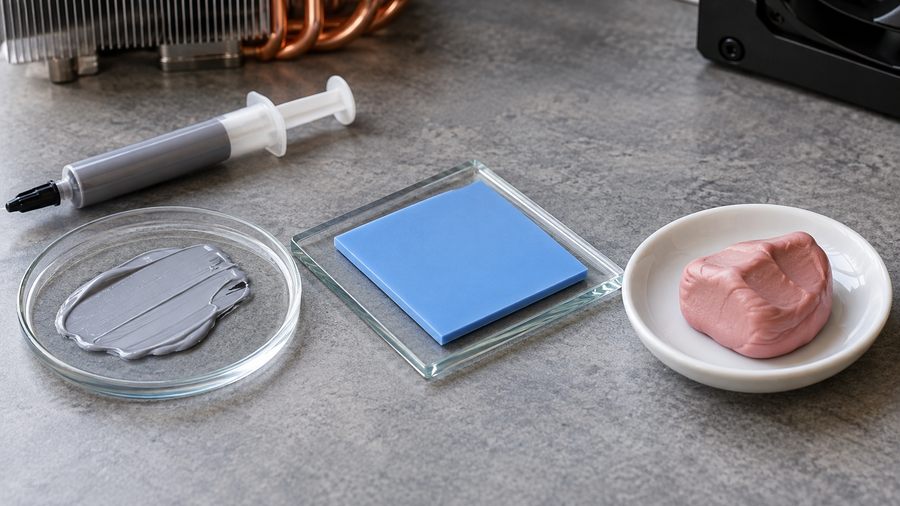
“Spreadable” is not a complete TIM specification. Several materials can come in syringes or feel soft to the touch while behaving differently after installation.
| 材料 | Typical role | Why it is not automatically a grease/paste substitute |
|---|---|---|
| Ordinary thermal grease or paste | Thin, clamped contact between fairly close surfaces | Needs suitable pressure and cannot hold parts together |
| 熱伝導性パテまたはディスペンス可能なギャップフィラー | Larger or uneven gaps, often across mixed component heights | Different placed volume, compression and movement behavior |
| 熱伝導パッド | Defined gap with a preformed part | Compression, thickness and contact differ from a wet thin joint |
| 相転移材料(PCM) | A preform that softens at a designed temperature | Requires the intended activation and mounting conditions |
| 熱伝導性接着剤 | Transfers heat while helping bond parts | Cure, bond strength and rework differ; grease does not glue |
| 液体金属 | Specialized thin thermal interface | Electrical and substrate compatibility require special care |
AMD’s TIM material guidance discusses unsolidified grease and paste alongside pads and PCM. Its guidance notes that pads can address greater height tolerances where devices share a heat sink. That is the practical distinction: choose by the assembled gap and contact, not by how many product labels mention “thermal.”
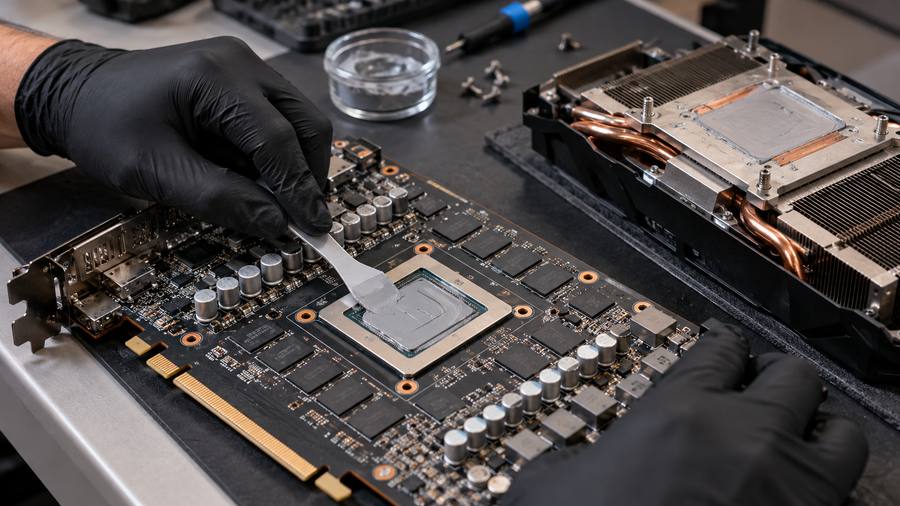
Want a familiar example? A GPU cooler may use paste on the main processor while thermal pads cover memory devices sitting at different heights. Replacing those pads with a thin smear of CPU paste can leave the memory without proper contact. HAKTAK’s thermal paste versus thermal pads comparison explores the two formats in more detail. Putty or a dispensable filler is another option to assess when the gap is uneven, subject to the exact device design.
And no, ordinary vacuum grease or generic silicone lubricant does not become a qualified electronics TIM merely because it looks similar. A thermal formulation needs evidence for heat transfer in its intended interface.
Data Sheets and Standards: Read the Conditions Under the Number
ASTM D5470-17(2024) covers a laboratory method for measuring thermal impedance and calculating apparent thermal conductivity for thermally conductive electrical insulation materials. It includes viscous liquids such as greases and pastes among its specimen types. The standard also explains that its idealized heat-flow conditions do not directly match most practical applications. That last part is the part to remember.
When comparing two products, ask: Was the value measured with the same method, temperature, pressure and thickness? Is it a bulk W/m·K value, an area-normalized impedance, or a thermal resistance in K/W for a specified sample? Do not put different units in a table and declare a winner.
Consider a deliberately simple calculation. If an interface’s measured resistance in one particular build is 0.10 K/W そして 50 W crosses it, the temperature difference across that interface is approximately 5 K. That is ΔT = Q × R, not a claimed result for either product. It also says nothing about the heat sink’s resistance to room air. HAKTAK’s article on 熱伝導率と熱抵抗の比較 explains why the material number and the assembled result answer different questions.
Standards and compliance labels need the same care. RoHS or REACH documentation, when relevant, concerns substances and regulatory obligations. It does not certify that a paste will cool your assembly or survive thermal cycling. Ask for test reports tied to the grade and the actual design requirements.
What to Ask a Supplier Before Approving a Substitute
If you’re replacing a specified grease with a different paste, send the supplier a short brief. It can be plain English:
“This compound sits between a bolted aluminum heat sink and a power-module baseplate. Here are our maximum and minimum gap, mounting pressure, temperature range, electrical isolation design and assembly method. Please recommend a grade and share comparable impedance, electrical and aging data, plus application instructions.”
Include the part drawing and the original compound’s grade if you have them. Ask whether the replacement is silicone based, whether there are oil-bleed or substrate-compatibility limits, and how to clean or rework it. Request samples for a side-by-side test using the same hardware, preload and thermal load. A supplier’s catalog is a starting place; the mounted device decides.
Once those requirements are clear, HAKTAK’s thermal grease materials provide a route to discuss a suitable product format. The useful purchasing question is specific: “Which grade maintains the required thermal contact in this assembly?” Asking simply for “the best paste” is like ordering “the best tire” without saying what vehicle it fits.
Mix-ups That Cause Real Problems
Naming confusion can lead to mistakes beyond grease versus paste. Keep these in view when a substitute looks plausible:
- Grease is not glue. A thermal adhesive may hold parts together after curing. Ordinary paste needs mechanical retention.
- A pad is not a thick paste. Pad thickness and compression can be part of the mechanical design. Removing it without replacing its gap-filling role may break thermal contact.
- Color does not certify insulation. Look for electrical specifications for the exact grade, especially near exposed circuitry.
- A printed temperature range is not the whole life story. Ask what happens through the expected heat cycles and service time.
- Fresh compound cannot fix a weak heat sink. Check airflow, fans, preload and downstream thermal resistance if temperatures remain high.
One last practical point: avoid mixing an unknown old compound with a new one and treating the blend as a tested formulation. Clean the surfaces using the equipment maker’s approved method and install the chosen product as directed. It is a small bit of housekeeping, but it keeps your comparison honest.
結論
Thermal grease and thermal paste generally name the same family of spreadable TIMs. The two labels are interchangeable in conversation; two specific products are not automatically interchangeable in hardware.
Check the joint’s gap and pressure, the installed thermal result, electrical and chemical compatibility, operating life, and application method. If those match and your assembly test agrees, a differently named grade may be a good substitute. If the gap or function is different, pick the material designed for that job.
よくある質問
Is thermal compound the same as thermal paste?
Often, yes, when “compound” means a spreadable material used between a hot part and heat sink. But “thermal compound” can be a broad catalog term. Check whether the actual product is non-curing paste, a curing gap filler or an adhesive before you order it.
Can I use thermal grease instead of thermal paste on a CPU?
Usually, if it is a CPU-suitable grade and the cooler calls for an applied compound. Check for a factory-applied TIM first, clean and mount as instructed, and keep electrically risky material away from the board. The word “grease” on the tube is not a problem by itself.
Can CPU paste replace the thermal grease specified for another machine?
Not without checking the grade. Compare sustained temperature, substrate compatibility, mounting gap, electrical requirements and expected life. An unusually hot machine may need a formulation unlike the paste you use on a desktop cooler.
Is white thermal grease different from gray thermal paste?
Their color may reflect filler or branding, but it does not prove thermal conductivity, electrical insulation or quality. A white product and a gray product could both be grease/paste. Read both data sheets rather than using color as the selection rule.
Are thermal grease and silicone grease always the same?
No. A thermally conductive grease may use a silicone carrier, but generic silicone grease can be formulated for lubrication or sealing rather than heat transfer. Look for a thermal-interface product and measurements relevant to your joint.
Does “grease” mean better heat transfer than “paste”?
No. Those words do not define a performance tier. Compare the exact formulations at the same bond-line thickness and mounting conditions. The product that performs better in one build may not be the better choice in another.
サーマルグリースは電気を通しますか?
Some formulations can create electrical risks; others are designed as insulators. Liquid metal is especially different from conventional ceramic-filled paste. Check the exact product’s electrical data, clearances and application instructions. Do not decide from the color or name.
サーマルパテはサーマルペーストと同じものですか?
Usually no. Putty is often chosen to conform to a larger or uneven gap, while ordinary paste/grease is commonly used as a thin layer between closely mounted surfaces. Names vary by supplier, so confirm the intended thickness and behavior after assembly.
Can thermal paste replace a thermal pad?
Only if the actual gap and mounting design support it. Pads often bridge a defined distance or accommodate component-height differences. A smear of paste may never reach the mating surface. Measure the assembled joint before changing formats.
Should I remove old compound before changing to another brand?
Yes, in most service work. Clean both mating surfaces by the equipment maker’s method, then apply the new product as directed. That avoids old residue, uneven coverage and an unqualified mixture at the interface.