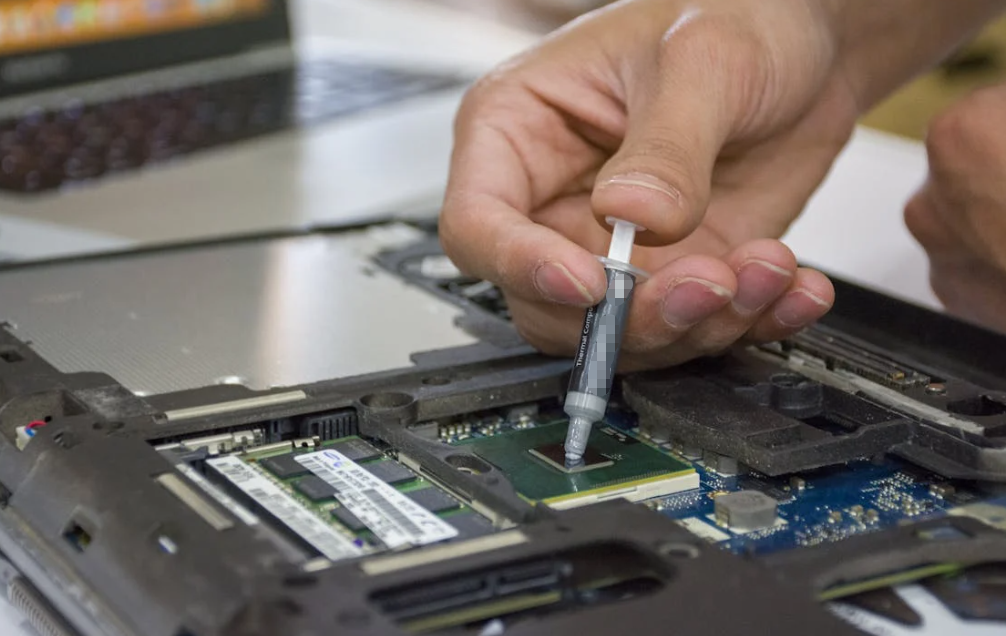
Ja, Wärmeleitpaste kann an geeigneten Kontaktstellen im Inneren mancher Smartphones verwendet werden. Ob sie für Ihr Smartphone geeignet ist, hängt vom ursprünglich verwendeten Material, dem Spalt zwischen den Bauteilen und davon ab, wie die Baugruppe den Kontakt aufrechterhält.
Ein Smartphone, das sich heiß anfühlt, benötigt nicht automatisch neue Wärmeleitpaste. Auch eine Paste, die bei einem Desktop-CPU gut funktioniert, ist nicht zwangsläufig mit dem internen Schichtaufbau eines Smartphones kompatibel. Bevor Sie etwas ändern, sollten Sie die Kontaktstelle bestimmen, die Sie verbessern möchten. Eine bei der Demontage beeinträchtigte werkseitige Wärmeleitverbindung zu erneuern, kann sinnvoll sein. Wärmeleitpaste überall dort einzubringen, wo freier Platz vorhanden ist, kann dagegen neue Probleme verursachen.
Kann Wärmeleitpaste in einem Smartphone verwendet werden?
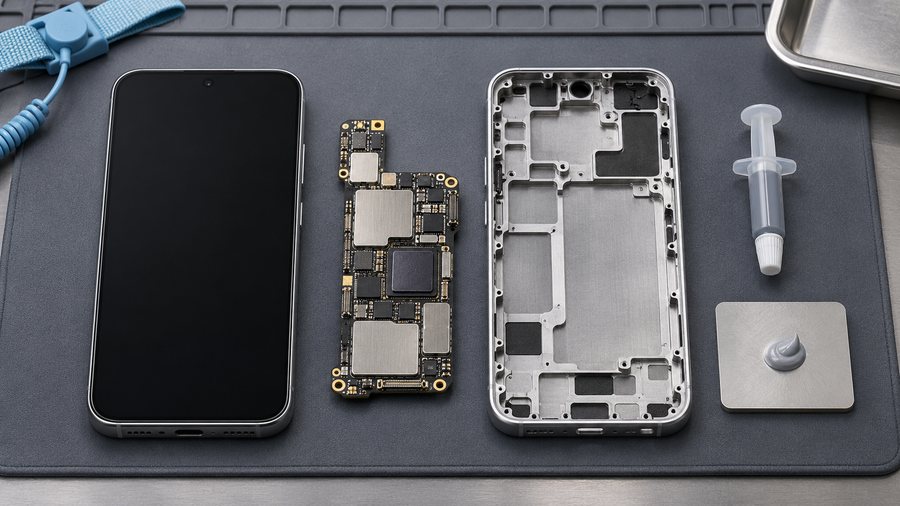
Eine vorgegebene Kontaktstelle bei der Reparatur wiederherstellen
Wärmeleitpaste füllt kleine Unebenheiten zwischen aufeinanderliegenden Kontaktflächen aus. Sie verdrängt eingeschlossene Luft und verringert den Wärmewiderstand an dieser Verbindungsstelle. Sie schafft jedoch keinen Wärmeableitungspfad zwischen Bauteilen, die durch einen ungeeigneten Spalt voneinander getrennt bleiben.
In a smartphone, the relevant joint might involve a package surface, shield, spreader or midframe. Its location varies by model. Follow the service information for the exact device and hardware revision before deciding where material belongs.
If a repair separates an interface that originally used paste, the reassembly procedure may require fresh compound. That is a different task from modifying a working phone in search of lower temperatures. The repair should restore the intended contact and fit.
Check whether PC thermal paste suits that joint
Some electronics compounds suit several device types. A CPU label alone gives you too little information to approve one for a phone.
Compare the finished formulation’s electrical behavior, spreadability and stability with the joint requirements. The installed layer must stay within its supported thickness range. It must also spread under the load the phone can safely provide.
Bei der Überprüfung Wärmeleitpastenformulierungen, ask for data at the intended bond line and pressure. A high conductivity number on the syringe cannot answer those questions. If the original material or clearance is unknown, identify it before choosing a substitute.
Follow the phone’s heat path before choosing a compound
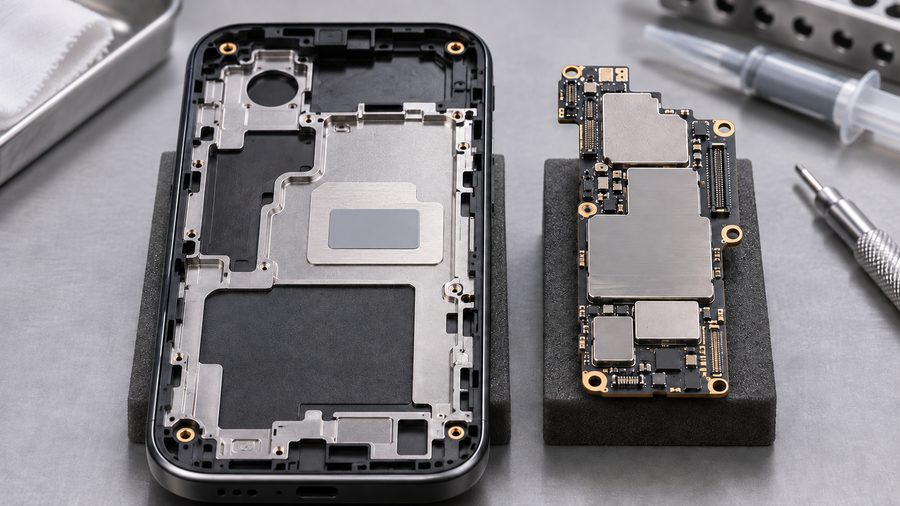
The SoC may not touch the frame directly
The system on chip, or SoC, combines processing functions in a compact package. Heat leaves it through paths determined by the package and phone construction. A shield, spreader or other intermediate layer may sit between the package and the midframe.
A metal cover near the processor is not automatically a surface intended for extra paste. Nor does its position prove that it is pressed against the next part. Check both mating surfaces and the service documentation.
Treating every phone like a small desktop computer overlooks this stack. A desktop cooler often has a defined clamp system above a metal processor lid. A phone may distribute load through a thin frame and several small fasteners, with other components sharing that space.
Graphite spreads heat; the interface transfers it into the spreader
A thin contact material and a broad graphite sheet can work together. The contact layer helps heat cross a joint. The sheet spreads it over a wider area.
Gore’s explanation of in-plane and through-plane heat transfer distinguishes these directions. In-plane means along the sheet; through-plane means across its thickness. Comparing a graphite sheet’s in-plane conductivity with a paste’s through-thickness value can therefore mislead.
Think of the contact layer as a short bridge into a wider road. The bridge gets heat across the joint; the spreader gives it room to move sideways.
A vapor chamber still needs suitable contact
A vapor chamber spreads heat through evaporation and condensation inside a sealed structure. The interface leading into it still matters. Replacing that interface cannot repair a damaged chamber or increase the phone’s external cooling area.
Samsung’s description of the Galaxy S25 Edge illustrates how a custom structure, vapor chamber and tailored TIM can form one design. The term “tailored TIM” alone does not identify its chemistry or authorize replacement with ordinary CPU paste.
Thermal paste, pads, putty and graphite do different jobs
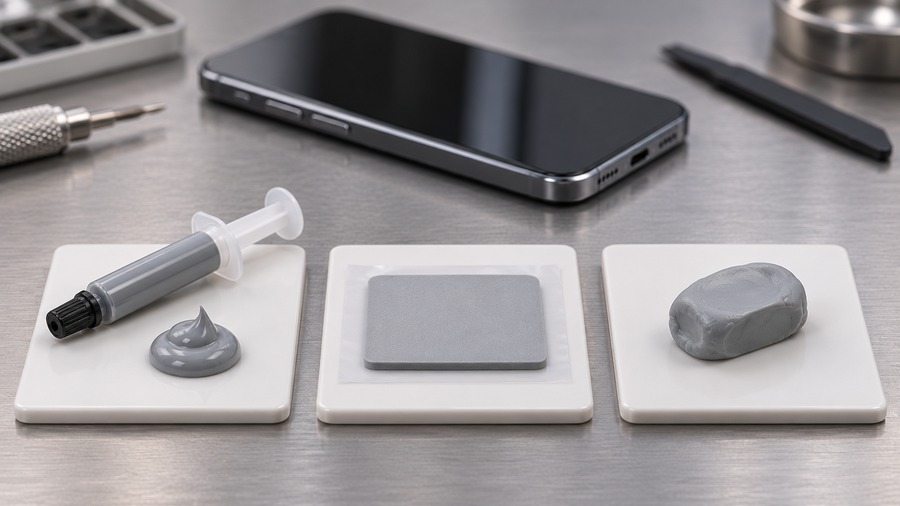
What is inside a thermal compound?
Conventional thermal grease commonly contains conductive filler particles dispersed in a carrier. Silicone-based and non-silicone formulations exist. Fillers may include ceramics such as alumina or boron nitride, depending on the product.
The carrier and filler structure influence how the compound spreads and stays in place. A material that feels thick during dispensing may behave differently under assembly pressure. Its color provides little useful evidence of suitability.
Thermal conductivity and electrical conductivity are separate properties. Check the finished product’s electrical data. A silicone carrier or ceramic filler does not, by itself, establish every electrical property of the complete formulation. Liquid metal also requires a separate compatibility assessment and is unsuitable as an improvised phone repair substitute.
Why a pad-to-paste swap can leave a gap
A preformed pad may occupy a deliberate clearance between two parts. Remove it and apply a thin smear of paste, and those parts may no longer make thermal contact.
Imagine a joint where a soft pad bridges a visible clearance. A smear of grease can leave air between the surfaces even if its conductivity rating is higher. That mismatch is easy to miss when both materials look grey. The replacement must fit the installed geometry without excessive load or movement.
Thermal pads for controlled gaps need their own thickness and compression checks. Likewise, dispensable gap-filling materials have grade-specific working ranges and handling requirements. Neither category is automatically interchangeable with grease.
Check installed clearance and closure force
The uncompressed thickness of an old pad may differ from its original specification. Compression history, damage and residue can affect the measurement. Use the specified replacement part when available.
Do not force a thicker material into place by tightening harder. The board, display or package may carry the extra load. A cover that closes is not proof that every internal interface is correct.
For more on the gap and fit, see Wärmeleitkitt und Wärmeleitpaste.
Graphite and phase change materials need their own specifications
Graphite heat-spreading materials differ in construction, orientation and protective layers. Graphite itself conducts electricity, so exposed edges and particles need control. Preserve the specified laminate and insulation arrangement.
A phase change material softens through a defined thermal transition. Its initial form may resemble a film, but its installed behavior differs from a conventional gap pad. Verify its activation conditions and application requirements before considering a replacement.
| Material | Typical job | Replacement question |
|---|---|---|
| Wärmeleitpaste oder Wärmeleitfett | Improve contact across a suitable thin joint | Can the assembly maintain the required layer and coverage? |
| Wärmeleitpad | Bridge a specified clearance with a preformed part | Are thickness and compression load correct? |
| Thermal putty or gel | Conform across supported gaps or uneven surfaces | What are the grade’s gap, flow and stability limits? |
| Graphitfolie | Spread heat, often along the sheet | Are direction, electrical protection and layer construction preserved? |
| Phasenwechsel-TIM | Bildung einer formschlüssigen Grenzfläche nach thermischer Aktivierung | Will it reach the required conditions and final bond line? |
When replacing thermal paste makes sense
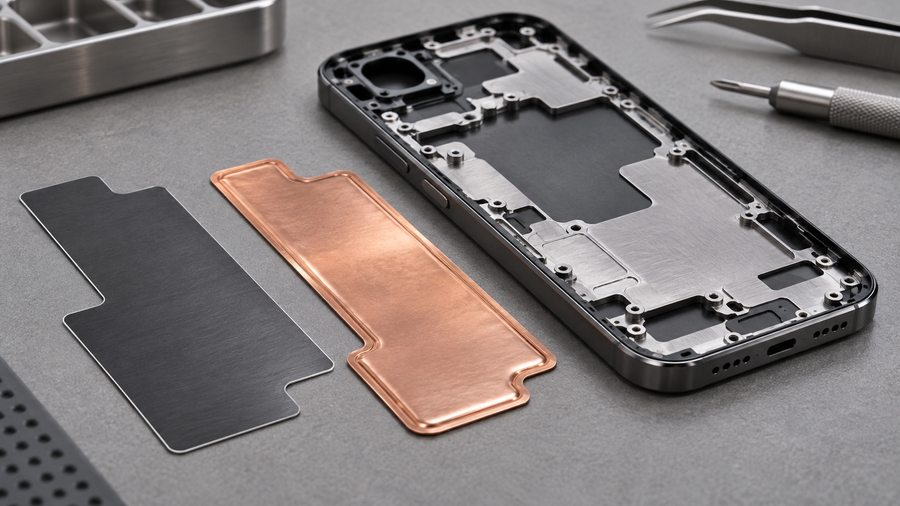
Check workload, charging and ambient conditions first
A phone can become warm during gaming, recording, data transfer or charging. Direct sunlight and a hot room also change the available cooling conditions. Google identifies several of these factors in its Pixel support guidance.
Before opening the device, note when the problem occurs. Is it limited to one app? Did it begin after an update, repair or change in charging equipment? Does it continue under a light workload in a cooler environment?
If the phone shows a temperature warning, stop the demanding activity and follow the manufacturer’s cooling guidance. Repeated shutdowns or signs of battery damage need diagnosis. Adding thermal paste is not a repair for a swollen or damaged battery.
Look for evidence that the original interface was disturbed
Replacement becomes more plausible when a repair has separated the original contact, damaged a specified material or left parts incorrectly seated. Confirm the diagnosis rather than assuming all older compounds have failed.
| What you find | Reasonable next step | What to avoid |
|---|---|---|
| A specified paste interface was separated | Follow the approved renewal procedure | Reusing a contaminated or disturbed layer by default |
| The original part was a pad or putty | Identify its replacement specification | Substituting a thin paste layer without checking the gap |
| A graphite sheet is torn | Restore the specified sheet or assembly | Treating paste as a replacement spreader |
| No intended contact path exists | Review the construction and diagnosis | Building a new bridge with a mound of grease |
| Material identity is unknown | Consult service information or the supplier | Choosing by color or touch alone |
What can go wrong when you add paste to a phone?
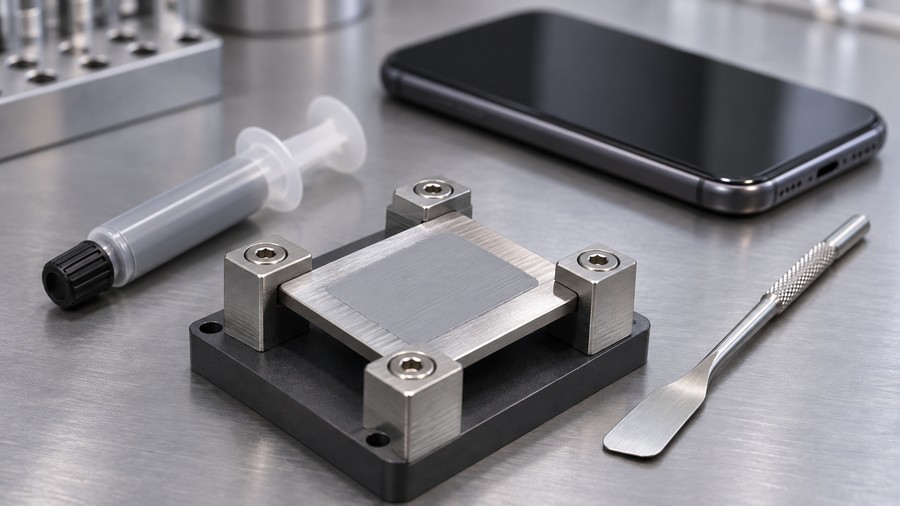
Electrical behavior and contamination
Electrically conductive material can bridge contacts if it escapes the intended area. Even a highly resistive compound can contaminate connectors or interfere with mechanisms. “Non-conductive” does not mean harmless everywhere.
Check compatibility with coatings, plastics and nearby materials. Migration, bleed or volatile constituents may matter near sensitive surfaces. Those requirements belong to the finished formulation and assembly, not a generic claim that all silicone is good or bad.
Keep compound away from camera optics, microphones, connector contacts and other unintended areas. More coverage is useful only within the specified contact region.
Excess material, movement and mechanical fit
An unnecessarily thick layer adds distance for heat to cross. Excess compound can also squeeze outward during closure. Its final distribution depends on the material and the pressure pattern.
Thermal cycling can move grease away from parts of the interface. This Wärmeleitpasten-Pumping-Out differs from carrier loss or separation, although several mechanisms may occur together. Initial cooling performance does not establish stability over the phone’s service life.
Mechanical changes can create another problem before aging begins. An added layer may load the board or prevent another part from seating. Do not compensate with extra screw torque, a shim or pressure on the battery.
Keep unintended heat away from sensitive areas
A smartphone’s thermal design also limits heat reaching certain surfaces and components. Some spaces or insulating layers may be deliberate. Filling them can redirect heat.
A cooler processor reading would not justify excessive battery temperature or an uncomfortable surface hotspot. Check the complete result. The same applies to sealing: thermal compound does not replace the adhesives or gaskets used during reassembly.
A repair process should preserve the original interface
Obtain the procedure for the exact model before opening it. Follow its power-down, battery isolation and handling instructions. A general thermal paste guide cannot supply the correct disassembly order for every phone.
Record where the original material sits and which surfaces it connects. Keep track of graphite films, protective layers and fastener positions. If a material is damaged, establish the correct replacement rather than removing it from the design.
Use the specified cleaning method and a compatible cleaner. Control residue and liquid near connectors, films and openings. Surfaces must be ready for reassembly before fresh material is applied.
The iFixit phone thermal paste repair guidance shows renewal at the original location and a return to the phone’s reassembly guide. It is useful process context, not a universal approval for any compound or quantity.
Apply the defined amount within the intended footprint. There is no phone-wide equivalent of a standard desktop “pea-sized dot.” The required amount depends on the joint area, final thickness and spreading behavior.
Reassemble with the correct hardware and sequence. If the fit changes or a part will not seat, inspect the cause before applying more force. Restore sealing components as required and complete the relevant functional checks.
For refurbishment batches, record the replacement material and lot. Repeatability across units matters as much as a satisfactory first repair.
How engineers should specify and test a smartphone TIM
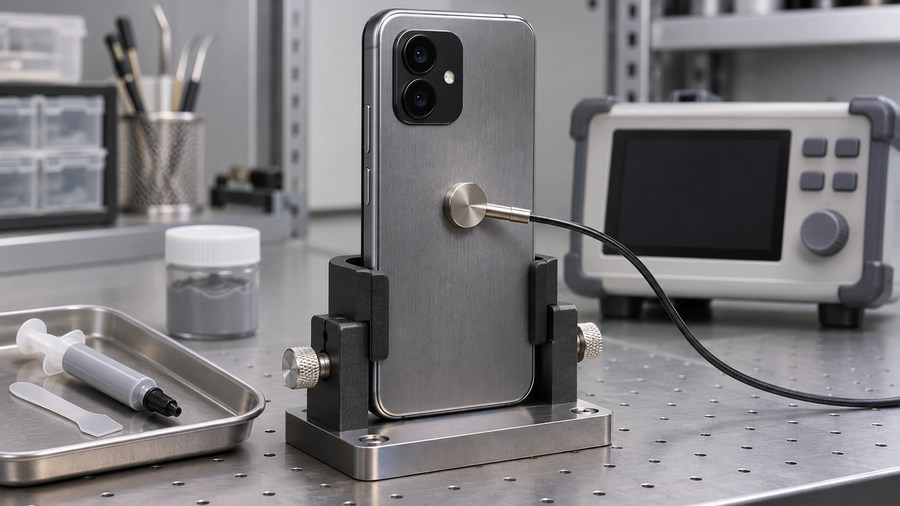
Compare interface performance at the actual bond line
Give the material supplier the contact geometry, gap tolerance, available load and operating conditions. Include electrical and contamination restrictions. Without them, the supplier has to guess at the interface.
Thermal conductivity describes conduction within a material. The resistance of the assembled joint also includes its thickness and contact boundaries. A simplified uniform-layer model is:
R_interface = R_contact,1 + t/(k × A) + R_contact,2
Dabei wird die Dicke t in Metern und die Wärmeleitfähigkeit k in W/(m·K), area A in m², and each resistance term in K/W. The model assumes a defined heat-transfer area and does not represent every spreading path inside a phone.
For a hypothetical layer with unchanged conductivity and area, doubling thickness doubles its bulk resistance term. Contact resistance can also change, so this does not predict a measured phone temperature. You still need to know how thick the material will be after assembly.
Request thermal impedance data with the test pressure, thickness and temperature. Confirm whether values include contact effects and check the units. Area-normalized impedance is not the same quantity as resistance in K/W. The distinction is covered in thermal conductivity versus interface impedance.
Check stability after temperature exposure and cycling
ASTM D5470 provides a relevant steady-state thermal transmission test method. Its controlled measurements support material comparisons; they do not establish the temperature or reliability of a complete smartphone.
IEC 60068-2-14 is a reference for temperature-change testing. Select exposure conditions through the product’s reliability plan. Neither standard creates one universal pass criterion for smartphone thermal paste.
Compare initial and aged interface performance under representative assembly conditions. Include orientation, mechanical movement and nearby-material compatibility where relevant. Ask for the exposure details behind a supplier’s stability claim.
For teams sourcing thermal materials for consumer electronics, a useful brief identifies the interface, required data and intended validation. It should also state whether the job is original design, repair or refurbishment.
Measure performance and temperatures under repeatable conditions
A lower temperature can result from lower processor power. A higher surface temperature can reflect improved outward heat transfer. Neither observation alone establishes success.
Record sustained performance alongside the temperatures you can interpret. Distinguish a battery sensor, package-related reading and exterior measurement. Do not label an app’s temperature display as SoC junction temperature without knowing its source.
| Test item | Keep consistent or record | Warum es wichtig ist |
|---|---|---|
| Umwelt | Ambient temperature and airflow | Changes the external cooling boundary |
| Workload | Same task, settings and duration | Changes heat generation and throttling |
| Phone state | Charge level, charging status and software settings | Affects power and thermal control |
| Leistung | Sustained frame rate, throughput or relevant task result | Reveals whether a cooler reading came with less work |
| Temperatur | Sensor identity, location and measurement method | Prevents comparison of different quantities |
| Montage | Material, lot and repair condition | Helps explain variation between builds |
Run repeated comparisons after the phone returns to a comparable starting condition. A brief benchmark immediately after a cold start can miss the behavior that appears during sustained use.
Fazit
Thermal paste belongs in a smartphone when the specified interface and formulation support it. Start with the original material, actual gap and assembly requirements. Pads, putty and graphite may be doing jobs that a thin paste layer cannot replace.
For overheating, diagnose the conditions before opening the phone. For repair, restore the intended stack. For a new design or material change, verify sustained performance, relevant temperatures and stability after representative aging.
Häufig gestellte Fragen
1. Can I use PC thermal paste in my phone?
Only if the exact formulation suits the phone’s intended interface. Check electrical behavior, installed thickness, spreading and stability. A desktop CPU application claim does not establish compatibility with every phone, and it does not justify replacing a pad or putty.
2. Do all smartphones use thermal paste?
No. Thermal construction varies by model and interface. A phone can use several materials together, including pads, gels and graphite spreaders. Confirm the original material from service information; a grey residue alone is not enough to identify it.
3. Can I replace a phone thermal pad with thermal paste?
Not without checking the geometry and requirements. The pad may bridge a clearance that a thin grease layer cannot occupy reliably. Use the specified replacement where available. A conductivity rating alone cannot establish that the substitute will maintain contact.
4. Is thermal putty the same as phone thermal paste?
They can look similar, but their supported gaps and flow behavior can differ. Putty commonly fills larger or uneven clearances. Product names overlap, so compare the grade specification and original assembly requirement instead of identifying the material by appearance.
5. Can replacing thermal paste stop thermal throttling?
It may help if a defective interface is limiting heat transfer. It will not remove the phone’s thermal controls or correct every overheating cause. Compare sustained performance under the same conditions, and check battery and surface temperatures as well.
6. Should I remove graphite sheets to add paste?
Preserve the specified thermal stack. A graphite sheet spreads heat and may include protective or insulating layers. Paste does not perform the same spreading job. Replace a damaged sheet through the model’s repair procedure rather than eliminating it.
7. Is non-conductive paste safe anywhere inside a phone?
No. Electrical resistivity is only one requirement. Compound can contaminate contacts, affect mechanisms or redirect heat into sensitive areas. Use it only within the intended interface and verify the finished formulation’s compatibility with nearby materials.
8. How much thermal paste should a phone use?
Use the amount specified for that interface. Area, gap and assembly pressure determine the required distribution. Avoid borrowing a desktop CPU dot size or adding extra material to fill an unknown space. Correct coverage must coexist with correct fit.
9. How often should smartphone thermal paste be replaced?
There is no universal interval. Follow the manufacturer’s maintenance and repair guidance. Replacement may be needed after an interface is disturbed or a fault is diagnosed. Phone age alone does not prove that the thermal compound has failed.
10. Why is my phone still hot after replacing the paste?
The cause may involve workload, charging, ambient conditions or another fault. The replacement may also have incorrect thickness or contact. Review the complete cooling path and compare equivalent operating conditions instead of treating every warm surface as evidence of failed paste.