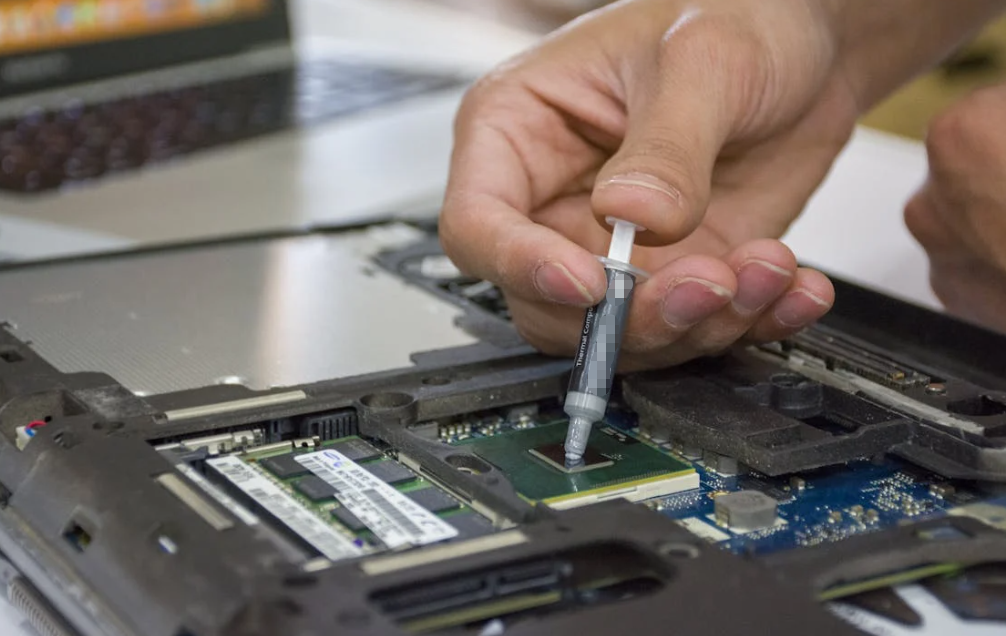
Thermal compound is a material placed between a heat-producing component and a cooling surface to improve heat transfer. In computer cooling, the term usually means thermal paste or thermal grease: a spreadable material that fills microscopic surface gaps.
You might find it between a CPU and its cooler, a GPU and a cold plate, or a power module and a heat sink. The job is similar in each case. Help heat cross a joint that would otherwise contain poorly conducting air.
The name can be confusing, though. Industrial suppliers sometimes use “compound” for a wider range of formulations. A product called thermal gel, for example, may behave quite differently from ordinary CPU grease.
So start with the interface. How closely do the parts fit? What holds them together? Does the assembly need electrical insulation? Those questions tell you more than the name on the syringe.
How Does Thermal Compound Work?
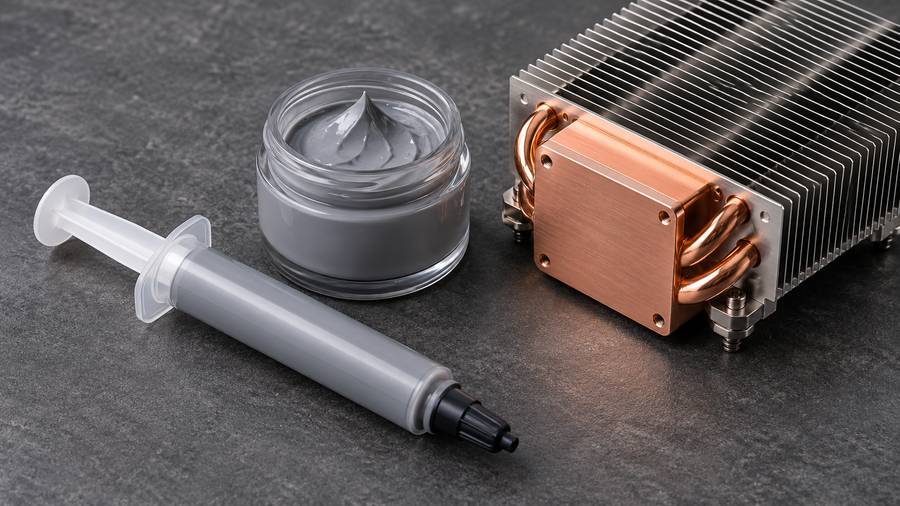
Smooth surfaces still leave microscopic air gaps
A polished heat spreader looks flat. Under magnification, its surface has small peaks and valleys. The cooler’s base has them too. Press the parts together and some points touch, while other areas retain air.
Think of placing two slightly uneven tiles face to face. They touch in places, but the contact is incomplete. Thermal compound conforms to those small irregularities, replacing much of the trapped air with a better heat-transfer path.
The surrounding cooling system still has work to do. Heat travels through the interface into a heat sink or cold plate, then eventually reaches the air or coolant. Compound cannot compensate for every restriction along that path.
Why the finished layer matters
Three terms help explain performance:
- Thermal conductivity: how readily heat travels through the material, expressed in W/(m·K).
- Bond line thickness: the thickness remaining after assembly.
- Contact resistance: resistance to heat flow where the material meets each solid surface.
For a simplified, uniform layer:
R_layer = t / (k × A)
Hier, t is thickness in meters, k ist die Wärmeleitfähigkeit und A is contact area in square meters. The result is thermal resistance in K/W.
Consider a hypothetical layer that is 50 μm thick, has a conductivity of 4 W/(m·K), and covers 20 × 20 mm. Its calculated layer resistance is 0.03125 K/W. With 80 W passing through it, the temperature difference across that layer is 2.5°C.
That calculation excludes contact resistance and heat spreading. It is not a prediction that changing paste will lower CPU temperature by 2.5°C.
It does show why thickness matters. A higher conductivity value may help, but actual performance also depends on coverage, pressure, and the surfaces themselves. A label cannot describe the entire joint.
What Is Thermal Compound Made Of?
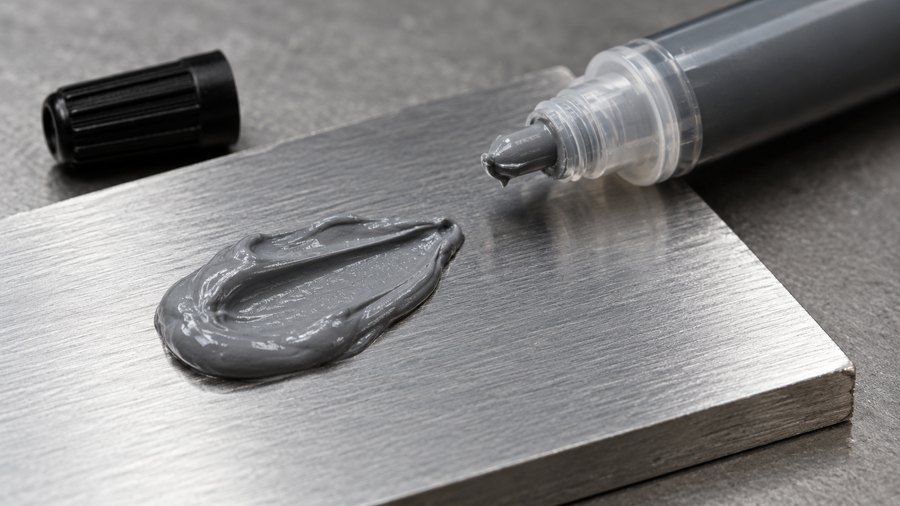
The carrier and the filler do different jobs
A conventional thermal grease combines a carrier with heat-conducting filler particles. The carrier gives it its spreadable consistency. The fillers improve heat transfer through the mixture.
Carriers may use silicone fluids or suitable non-silicone organic systems. Fillers can include zinc oxide, aluminum oxide, boron nitride, or other materials selected for the formulation.
“Silicone-based” and “ceramic-filled” can describe the same product. One describes the carrier; the other describes the particles. Treating them as competing material categories leads to muddled comparisons.
Particle loading, size distribution, and the carrier also affect spreading and handling. Two products with similar advertised conductivity can need different dispensing settings or behave differently under the same mounting load.
A thicker-feeling paste is not automatically more durable. Viscosity measurements depend on temperature and test conditions, and many filled compounds change their flow behavior under shear. Compare like-for-like data.
Heat conduction and electrical conduction are different
A compound can conduct heat while resisting electrical current. Many electronics greases are formulated this way. However, electrical behavior must be checked for the exact product.
Metal-containing and carbon-containing formulations cannot be judged by their color or ingredient label alone. “Carbon” does not automatically mean electrically insulating, and a metallic appearance does not establish conductivity.
Liquid metal deserves separate attention. It is an alloy-based interface material with different handling requirements. Thermal Grizzly, for example, identifies Conductonaut as electrically conductive and unsuitable for aluminum coolers. That warning belongs to the actual product, not a guess based on appearance.
Even an electrically insulating grease should be kept away from sockets and contact surfaces where contamination could interfere with connections.
For power electronics, a thin grease layer should not automatically be counted as a safety insulation barrier. Required isolation may call for a designed insulating sheet, ceramic substrate, or another qualified construction.
When Should You Use Thermal Compound?
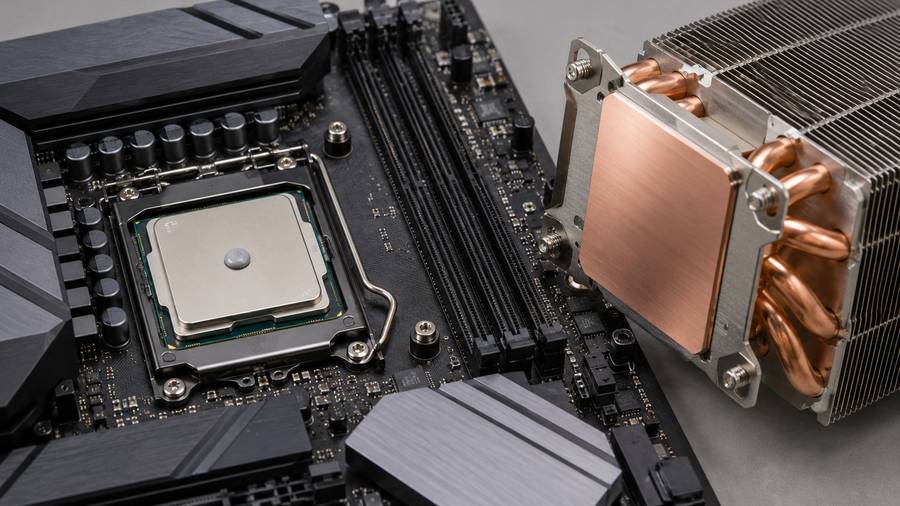
Tight, clamped interfaces are the usual starting point
Conventional grease commonly suits interfaces where two surfaces fit closely and a mounting system maintains contact. The material fills surface irregularities while the hardware controls the joint.
For this type of assembly, compare thermal grease for thin interfaces against your actual surface finish, pressure, temperature, and service requirements.
Serviceability can also matter. A removable cooler has different needs from a permanently bonded assembly. Confirm how the material will be cleaned and replaced before choosing it.
Real gaps need a different approach
A visible assembly gap is a different problem from microscopic roughness. If a component sits below a shared heat sink, a thin smear of ordinary paste may never bridge the space reliably.
Correctly selected thermal gap pads provide controlled material thickness. Their compression behavior matters: an overly thick or stiff pad can load the board or keep another component from contacting the cooler.
For assemblies with varying component heights, flüssige Spaltfüllmittel may offer a dispensable option. Check the intended gap range, assembly force, and whether the formulation cures. “Dispensable” does not mean interchangeable with grease.
| Material | Typische Schnittstelle | Main selection check |
|---|---|---|
| Wärmeleitpaste | Close, clamped surfaces | Finished thickness, wetting, and aging |
| Gap pad | A defined gap between parts | Thickness, compression force, and tolerance |
| Dispensable gap filler | Gaps or height variations | Dispense volume, cure behavior, and stress |
| Phasenwechsel-Wärmeleitmaterial | Compatible thin, clamped interfaces | Softening conditions and assembly procedure |
| Wärmeleitkleber | A joint needing both bonding and heat transfer | Adhesion, cure, stress, and rework |
Dünn Phasenwechsel-Wärmeleitmaterialien can be another option for suitable processor or module interfaces. They soften within a designed temperature range to improve contact. They are not automatically replacements for thick gap pads.
If the design needs a permanent bond, evaluate thermally conductive adhesives. Ordinary grease is not a substitute for a fastening or bonding system.
A GPU can need more than one thermal material
Imagine a graphics card with a GPU die, memory chips, and voltage regulators under one cooling assembly. The die may use a thin interface, while neighboring components need thicker materials to reach the cooler.
Replacing every material with the same paste can leave some components without contact. Changing pad thickness can also alter how the cooler sits over the die.
The useful question is, “What does each interface require?” Check the card’s service information and preserve the intended geometry.
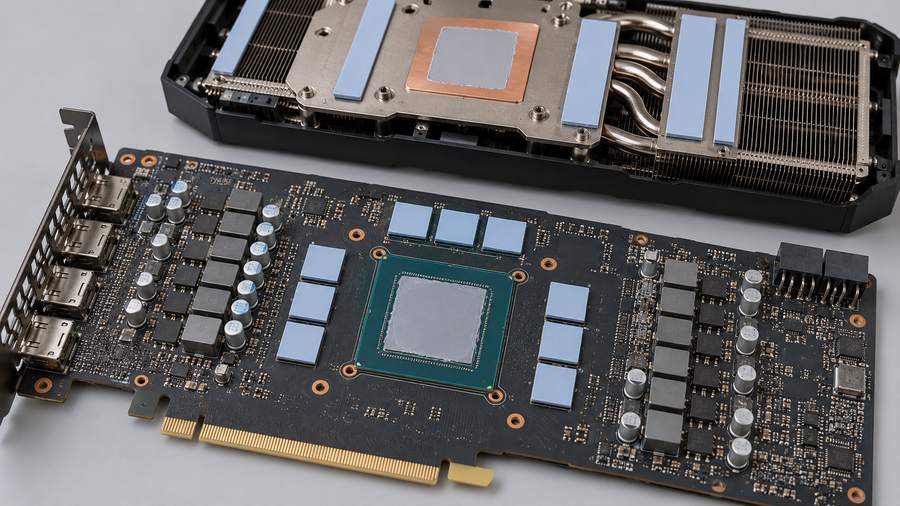
Where Is Thermal Compound Used Beyond Desktop PCs?
The same contact problem appears across electronics, although the operating conditions vary.
| Anwendung | Possible grease interface | What needs attention |
|---|---|---|
| Servers and workstations | Processor heat spreader to cooler or cold plate | Mounting load, heat flux, and service access |
| Netzteile | Suitable power packages or modules to a heat sink | Electrical isolation and operating temperature |
| Industrielle Steuerungssysteme | Power devices to a housing or heat spreader | Vibration, thermal cycling, and maintenance |
| LED equipment | A designed board or module interface to a heat sink | Contact area, flatness, and electrical requirements |
| Telekommunikationsausrüstung | Suitable component or module cooling interfaces | Temperature swings and long service periods |
| Transportation electronics | Qualified power electronics interfaces | Durability under the specified duty cycle |
These are possible applications, not blanket approvals. A grease suitable for a desktop cooler may lack the evidence required for an outdoor controller or a transportation module.
Likewise, using compound in an inverter does not establish that it belongs in a battery pack’s larger gaps. The geometry and mechanical demands can be very different.
For each application, trace the intended heat path first. Confirm that the chosen interface connects the heat-producing part to a cooling surface that can actually carry the heat away.
How to Apply Thermal Compound Without Creating New Problems
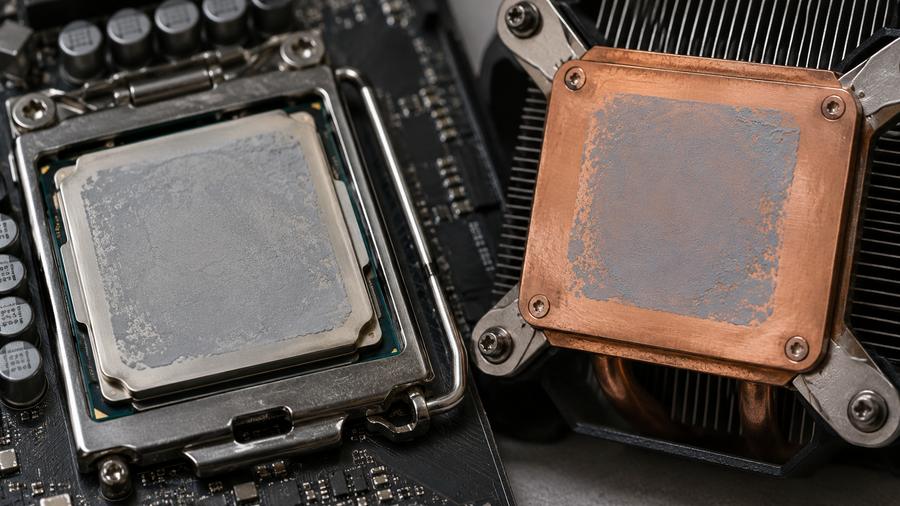
Check the existing interface first
Before opening the syringe, identify what is already installed. A cooler may arrive with pre-applied paste or another TIM. An intact, suitable pre-applied layer generally does not need additional compound on top.
Follow the equipment’s shutdown and service procedure. Where applicable, disconnect the battery and use the specified electrostatic discharge precautions.
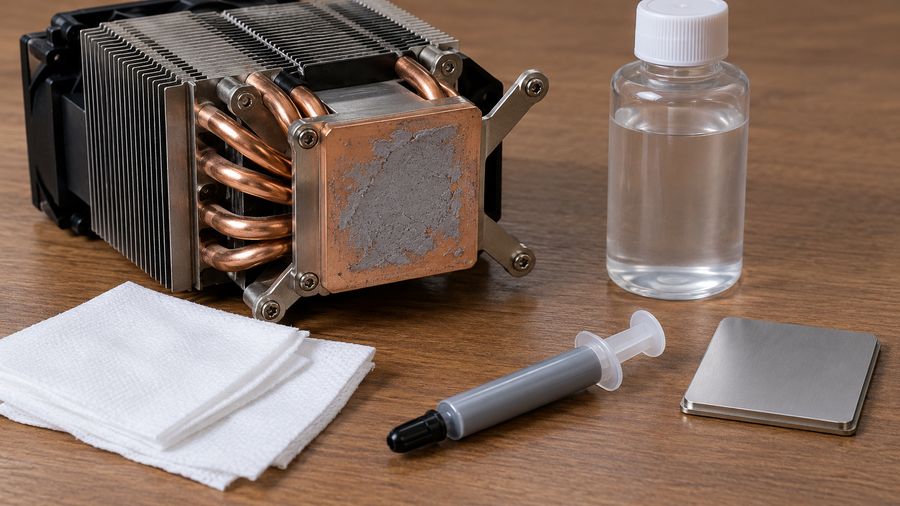
For a joint that needs fresh paste, remove the old material using a compatible cleaning method. A lint-free wipe and suitable isopropyl alcohol are common choices for accessible metal surfaces, but coatings, plastics, and surrounding parts may need different treatment. Let the surfaces dry fully.
Intel’s thermal paste application guidance is a useful reference for compatible CPU installations. A bare GPU die or industrial power module still needs its own assembly instructions.
Control coverage, pressure, and placement
The target is complete coverage of the required contact area with a controlled final layer. There is no single dot size that works for every processor, module, or material.
A small desktop heat spreader and a large power module have different areas. Paste consistency and the mounting mechanism affect spreading too. Follow the recommended pattern and amount for that combination.
Place the cooler carefully, then tighten the mounting hardware in the specified sequence. Use the manufacturer’s torque limits where provided. Extra force can damage the assembly without solving a material mismatch.
Avoid repeatedly lifting the cooler to inspect the spread and then putting it back unchanged. Opening the interface disturbs the layer and may introduce voids. Treat an inspection teardown as a step that can require cleaning and reapplication.
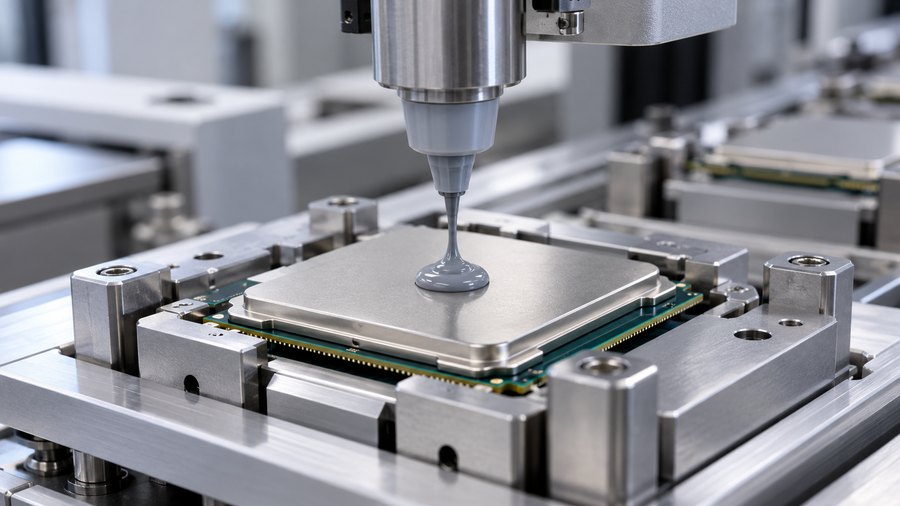
In production, control the process as well as the material. Record the dispense pattern, shot quantity, material condition, and assembly sequence. Confirm coverage on representative parts before locking the recipe.
A consistent shot weight is helpful, but it cannot prove good contact by itself. The parts still need to close to the intended position. Inspection and thermal testing should reflect the finished assembly.
Why Temperatures Rise Even After You Replace the Compound
Fresh compound can help when the interface is the problem. It cannot repair a stalled pump, blocked fins, or a cooler that is not seated correctly.
Compare temperatures under similar conditions. Keep the workload, power settings, fan or pump settings, and measurement points consistent. Record ambient temperature too.
A hotter room can raise component temperature even when the interface has not changed.
| Symptom | Mögliche Ursache | Check first |
|---|---|---|
| High temperature immediately after service | Poor seating, missed film, or incomplete coverage | Assembly position and installation steps |
| Temperature rises gradually | Dust, cooling-system changes, or material aging | Airflow, fan operation, and comparable load data |
| One component heats up after pad replacement | Changed contact geometry | Pad thickness and cooler seating |
| Paste appears outside the joint | Initial excess or later migration | Whether the active contact area has lost coverage |
| High temperatures despite a good interface | Insufficient downstream cooling | Heat sink, coolant flow, and heat load |
Material aging also needs careful language. Abpumpen describes movement of material out of the interface, often associated with repeated thermal expansion and contraction. Ölaustritt is separation or migration of the carrier. Austrocknung describes loss or change of the fluid phase that can impair the interface.
They can be related, but they are not identical. A little visible material at an edge does not prove a failed joint.
Replacement intervals should follow the material, equipment, and duty cycle. For example, Noctua specifies up to five years of CPU use for NT-H1 and NT-H2. That product-specific guidance should not become a five-year rule for every thermal compound.
What to Check Before Buying a Thermal Compound
Read the test conditions
Request the technical data sheet and safety data sheet. The TDS describes properties and processing guidance; the SDS covers hazards and handling. Neither alone proves suitability for your assembly.
Das ASTM D5470 thermal transmission test method addresses thermal impedance measurement and apparent thermal conductivity for relevant materials. A reference to this method is not a product safety certification or a universal performance grade.
Ask what thickness, pressure, and temperature were used. Confirm whether a value describes bulk material behavior or includes contact effects. Resistance in K/W and area-normalized values such as K·cm²/W cannot be compared without accounting for area.
Where insulation is required, review separate electrical data and the complete insulation design.
Ask for evidence that matches your assembly
Give the supplier a useful starting brief:
- Contact area, surface materials, and finishes.
- Expected gap or finished bond line.
- Available mounting force.
- Heat load and operating temperatures.
- Manual or automated application method.
- Electrical, contamination, and maintenance requirements.
Then request storage limits, packaging options, batch traceability, and reliability evidence under relevant conditions. Typical data-sheet values may not be guaranteed purchasing limits; agree on acceptance criteria.
Qualification should compare initial performance with performance after representative aging or cycling. Define what counts as an unacceptable change before testing begins.
For a HAKTAK material discussion, sharing a drawing and operating conditions gives the team a clearer basis for selection than asking for the highest conductivity available.
Fazit
Thermal compound helps heat cross the small gaps between a component and its cooling surface. Choosing it well starts with understanding that interface: its geometry, mounting load, electrical needs, and operating conditions.
Use a suitable material, assemble it consistently, and compare performance under controlled conditions. Where the design calls for a thicker filler, a phase-change film, or a bonding material, select that option deliberately. The goal is reliable contact throughout service, backed by evidence from the actual assembly.
Häufig gestellte Fragen
Is thermal compound the same as thermal paste?
Usually, yes, in computer cooling. Thermal compound, thermal paste, and thermal grease commonly describe the same general material type. Industrial naming is less consistent, so check the data sheet before treating a gel, adhesive, or gap filler as equivalent.
Ist Wärmeleitpaste elektrisch leitfähig?
It depends on the formulation. Some compounds are electrically insulating; others conduct electricity or have other electrical characteristics that matter near circuitry. Verify the exact product’s documentation and keep it away from sockets, pins, and electrical contacts.
Can I use thermal compound instead of a thermal pad?
Only when the interface is designed for that substitution. Ordinary grease generally cannot replace a thick pad bridging a real gap. Changing the material can also alter mounting pressure and prevent nearby components from contacting the cooler.
Does thermal compound work as glue?
Ordinary thermal grease should not be relied on to hold a heat sink in place. The assembly needs its intended fastening system. A thermal adhesive is a separate choice with bonding, curing, stress, and rework requirements.
Should I add compound over pre-applied thermal material?
Generally, no. If the pre-applied material is intact, suitable, and installed according to its instructions, extra paste is unnecessary. If it is contaminated or damaged, follow the manufacturer’s replacement procedure rather than covering the problem with another layer.
How much thermal compound should I apply?
Use the amount and pattern specified for the material and interface. The aim is coverage of the required area after mounting. A fixed “pea-sized” amount does not account for different chip sizes, surface shapes, or paste behavior.
Does a higher W/m·K rating always mean better cooling?
No. Conductivity describes heat transfer through the material, while the assembled joint also depends on thickness, contact resistance, pressure, and coverage. Compare materials under matching conditions and confirm the result in the intended cooling assembly.
How often should thermal compound be replaced?
There is no universal schedule. Follow the equipment and material guidance, and investigate meaningful temperature changes under comparable operating conditions. Avoid dismantling a stable assembly merely because an unrelated product recommends a particular maintenance interval.
Can thermal compound be reused after removing a cooler?
Fresh application is generally the preferred service approach for conventional grease. Removing the cooler disturbs the layer and can introduce contamination or voids. Clean and reapply as directed, rather than assuming the previous contact pattern will reform reliably.
Can new thermal compound fix every overheating problem?
No. It addresses the thermal interface. Overheating may also involve airflow, fan or pump failure, heat sink capacity, mounting problems, or increased power consumption. Diagnose the full cooling path before repeatedly replacing otherwise suitable compound.