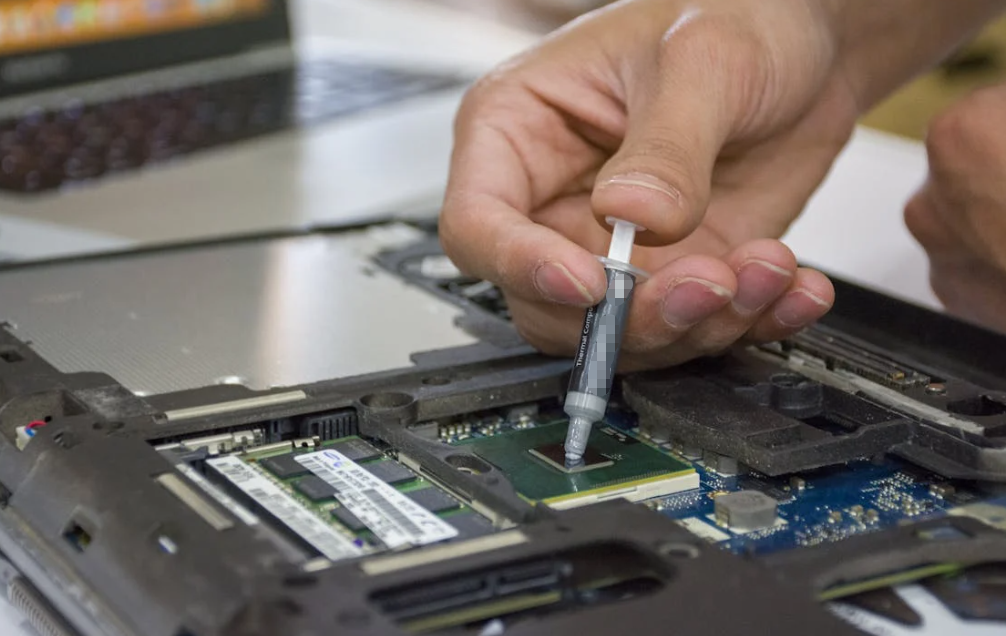
Imagine a little LED driver tucked into an aluminum box. Its inductor is warm. The board has to survive dust and damp air, so somebody suggests pouring resin over the whole thing. Fair enough. But then the awkward question arrives: will the resin cool the driver, or will it just make a warm brick?
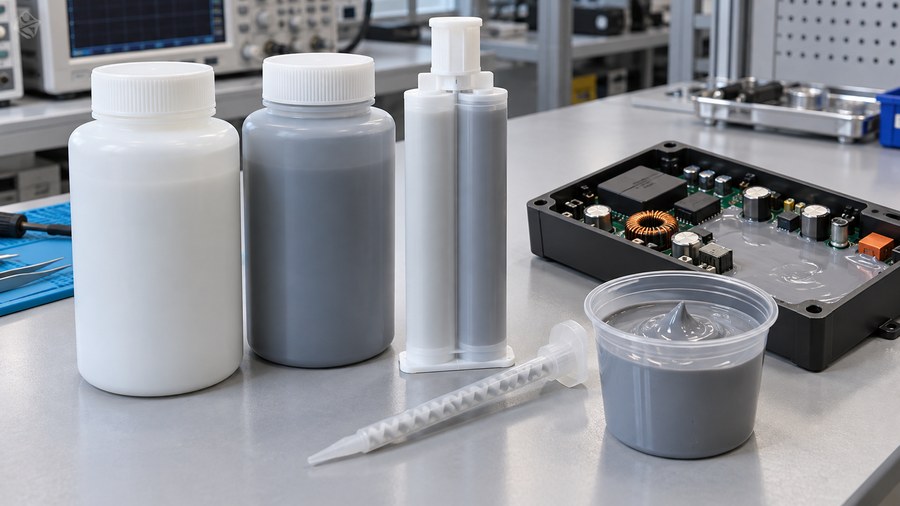
A thermally conductive potting compound is a liquid encapsulation material that cures around electronic parts and can carry heat through the filled space. It may also protect those parts from vibration, contamination, and moisture, depending on the grade and the enclosure design. The useful word is can. Heat still needs a route out of the compound and into a housing, heat sink, or other cooling surface.
Let’s follow that route. It makes the material choice much less mysterious.
What thermally conductive potting actually does
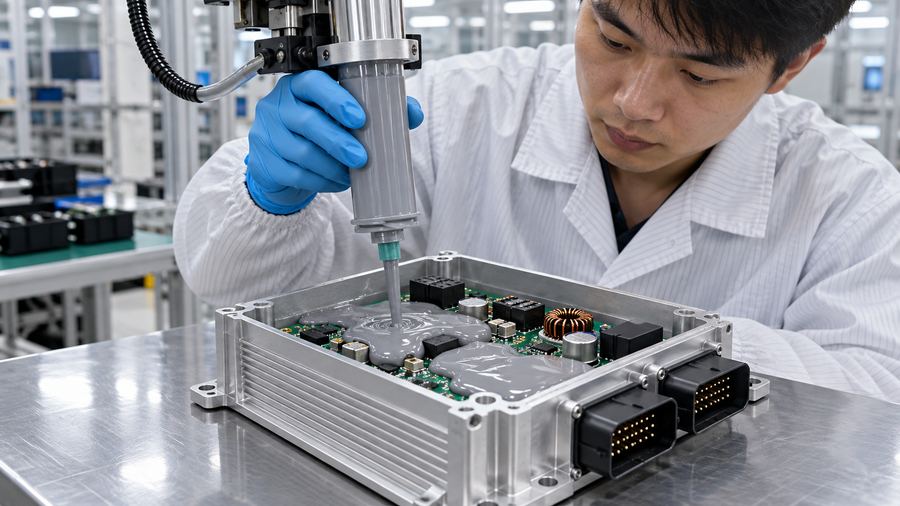
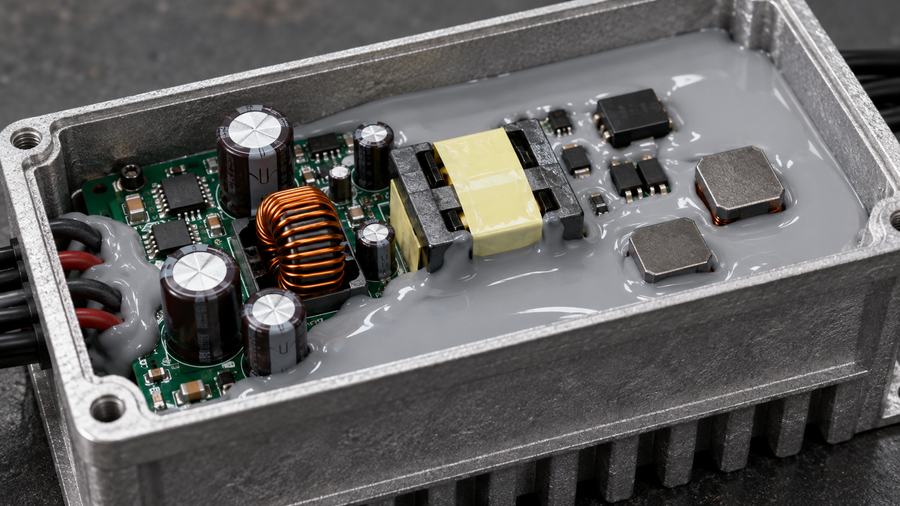
In electronics, potting usually means placing a circuit or component in a cavity, adding a flowable material, and letting it cure. The housing often remains around the cured material. A local encapsulant may cover just one part, while a full pour can surround almost everything on a board. Supplier language is loose here, so specify the required coverage on the drawing.
The resin is commonly based on silicone, epoxy, or polyurethane. Its polymer portion provides the body of the material. Thermally conductive particles, often ceramic fillers such as aluminum oxide or boron nitride, help heat pass through it. Aluminum nitride appears in some specialized formulations. The filler, resin, and cure system also affect flow, weight, hardness, electrical behavior, and cost. A material cannot be reduced to its conductivity number.
Before cure, the compound must reach between components and around wires without trapping big pockets of air. After cure, it forms a protective mass that may be rubber-like or fairly rigid. The job is different from putting a dab of paste under a heat sink. Thermal grease serves a thin clamped interface; potting surrounds a larger volume and becomes part of the package.
Follow the heat all the way out
Think of a relay race. Heat leaves a transistor or inductor, passes through its package, crosses the resin, reaches a case wall, and finally goes from that wall to the surrounding air. If the handoff at the wall is poor, a faster runner in the middle will not win the race.
A metal housing that touches a well-filled region can be a useful destination. A thick resin layer inside a poorly ventilated plastic box may offer little improvement. Potting might even change airflow that once cooled a part. There is no contradiction: the compound can conduct heat better than the air it replaces, while the complete device can still run too hot.
Also ask which hot spot matters. A thermocouple on the outer wall is not the same as the temperature of a power semiconductor junction. A coil buried inside a transformer will have its own path through insulation and the winding structure before heat ever reaches the potting. Measure the critical component, not merely the easiest visible surface.
Full potting, a small local fill, or something else?
The first design choice is how much material the device really needs. Filling every empty corner is easy to describe and expensive to undo. If a product needs environmental protection, inspect its lid, gasket, cable exits, and connectors too. Resin inside the box does not automatically seal every external path.
| What the assembly needs | Candidate approach | Question before choosing it |
|---|---|---|
| A hot part must reach a nearby metal wall across a defined gap | Local thermal gap filler or pad | Can the wall reject the heat, and will the joint stay in contact? |
| A board needs a barrier against contamination, but service matters | Conformal coating plus enclosure design | Are exposed connectors and housing seals dealt with? |
| A small coil or power component needs local protection and heat transfer | Local encapsulation or a targeted potting pocket | Will resin flow to the heat source without overloading nearby parts? |
| A module needs full environmental and mechanical protection | Full-cavity potting | Are cure heat, mass, stress, venting, and loss of repair access acceptable? |
| A heat spreader must also be bonded in place | Thermally conductive adhesive | Is a structural bond required, and is its thin bond line controlled? |
A liquid gap filler for a controlled thermal joint may be the cleaner choice when protection of the entire board is unnecessary. It is designed to occupy a selected space between a heat source and a cooling surface. Potting, by contrast, fills a cavity around electronics. Some materials blur the names, but the assembly drawing and cure behavior settle what they actually do.
For a permanent, weather-exposed module, full potting can make sense. For a controller that a technician must open next year, it may be a headache. You could spend an afternoon digging out a failed connector to save a part that took ten minutes to replace before potting. That’s a rather practical cost.
Silicone, epoxy, or polyurethane: start with the failure you fear
There is no single winning resin family. Compare a specific formulation at the intended fill depth and operating conditions. The following tendencies help narrow candidates, not predict how every grade will behave.
Silicone when the assembly needs to move a little
Many silicone potting systems cure to a flexible elastomer or gel-like material. That flexibility can help when an aluminum case, a ceramic part, and a PCB expand by different amounts as the product heats and cools. Silicone is worth considering for outdoor controls, telecom modules, LED drivers, and vibration-exposed electronics. Still, softness is not a promise of good adhesion. Check surface preparation, contamination sensitivity, and the grade’s chemical compatibility.
Epoxy when rigidity is part of the job
Epoxy often suits a module that needs firm support, strong adhesion, or chemical resistance. It can be attractive for a transformer, power supply, or sealed industrial sensor when permanent encapsulation is acceptable. The tradeoff is stress. A hard mass around delicate solder joints and dissimilar materials can pull or push on them during cure and thermal cycling. The larger and deeper the pour, the more seriously the team must assess cure heat and shrinkage.
Polyurethane as a different balance
Polyurethane grades can offer a softer, tougher cured body than some rigid epoxies. Certain grades are useful around coils, sensors, and control electronics. Their moisture handling during processing and their upper service temperature vary widely, though. Do not pick polyurethane just because a three-column chart calls it “the middle option.” Read the actual processing sheet.
High filler loading may raise conductivity but also make a material heavier or harder to pour into a narrow space. Two products can post similar thermal numbers yet behave quite differently during dispensing and cure. The material also has to wet the part and cure correctly. A wonderful number on a data sheet does not fill an air pocket behind a transformer.
If you want the wider chemistry and application survey, HAKTAK’s guide to thermally conductive potting compounds covers those families in more detail. Here we are keeping the question closer to the real box on the bench.
Why higher conductivity does not guarantee a cooler board
Thermal conductivity, written as k and reported in W/m·K, describes a material property under a stated test method. It does not describe the entire route from a semiconductor to room air. For an ideal, uniform slab, a rough conduction estimate is R = L/(k × A). Here L is the distance heat travels, A is the cross-sectional area, and R is thermal resistance in K/W.
Take a deliberately tidy example: 5 W crossing 2 mm of resin over 10 cm², with a conductivity of 1 W/m·K. The ideal slab term is 2 K/W, so its estimated temperature drop is 10 K. Doubling conductivity to 2 W/m·K would halve that term to 1 K/W and 5 K. Real power electronics do not send all their heat uniformly through one neat square. Package resistance, imperfect contact, spreading, other paths, and enclosure cooling remain in the picture. This little calculation is a comparison tool, not a predicted product temperature.
Now imagine both candidate resins in the same plastic box on a hot factory wall. The enclosure-to-air part of the path may dominate. Changing only the resin might barely move the component temperature. Or imagine a large void between the potting and the metal case. Heat cannot take advantage of a path that is broken at the last inch.
So test conductivity and geometry. Map the component height, nearest cooling surface, resin thickness, likely air traps, and the case temperature at worst-case ambient. If the housing has fins or is bolted to a larger structure, include those conditions in the test. A bench sample on an open table is not the same as a sealed controller mounted beside a warm motor drive.
From mixing cup to cured module
Even a sensible formulation can disappoint if the pour is inconsistent. Think of making a cake with oddly shaped ingredients: the mixture has to reach every corner, and the center still has to set. The comparison is a bit clumsy, sure, but it captures the production problem.
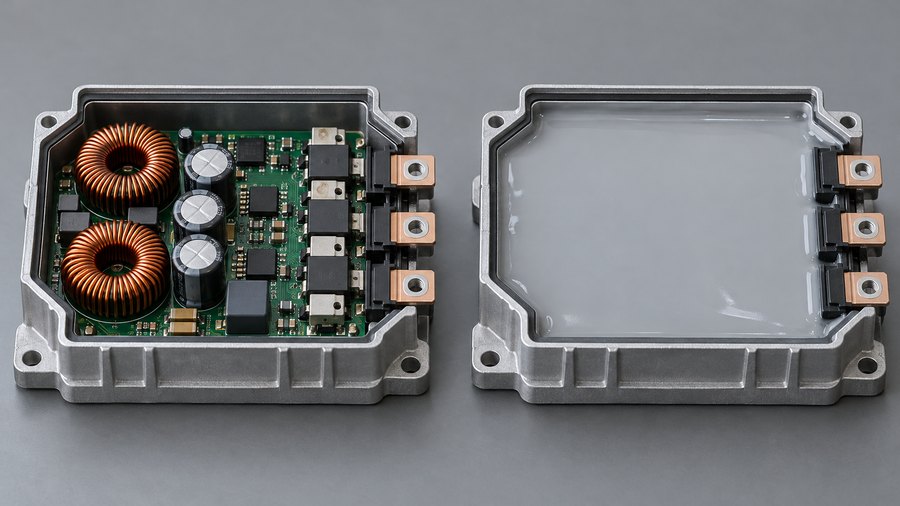
Start with a clean, dry assembly and a fill drawing. Show the approved resin level, keep-out areas, vent route, and which surfaces should be wetted. Examine electrolytic capacitor vents, adjustable components, connectors, test points, labels, and cable exits. Do not bury anything that the component maker says must breathe, move, or remain accessible.
Mixing, flow, and trapped air
For a two-part system, control the specified mix ratio, mixing method, working time, and temperature. “One to one” may refer to weight or volume; they are not interchangeable unless the supplier says so. A poorly mixed corner can remain tacky even while the top looks cured. A one-part material has its own storage and cure rules, so follow its specific sheet too.
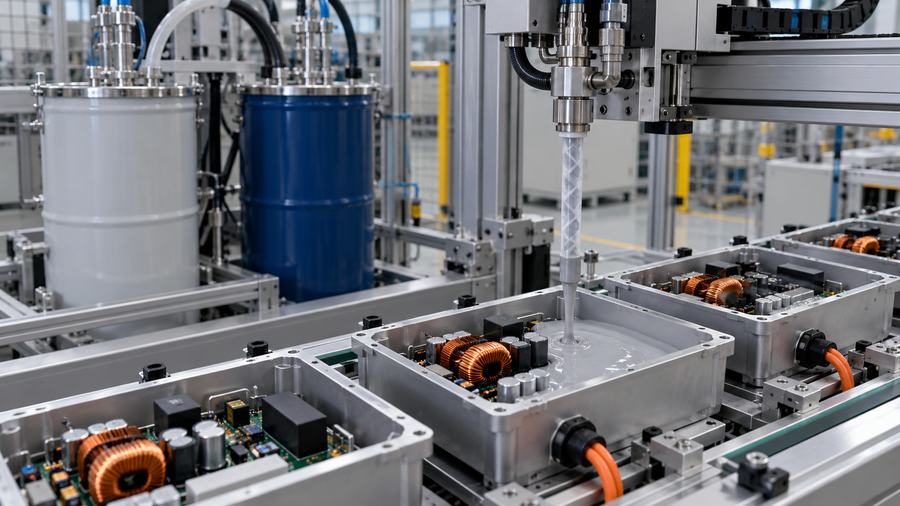
The resin must flow around tall parts and under ledges. Lower viscosity can help, but fill geometry and air escape matter just as much. Dispense at a location that gives air a way out. Degas the mixed material or use vacuum/pressure steps only when the chosen process and components allow it. On trial builds, cross-section or image representative samples to see what the surface hides. The shop-floor recipe should record dose, nozzle, mix settings, waiting time, and cure profile. HAKTAK’s dispensing process support is a relevant next step when hand pours have to become repeatable production.
Deep pours and cure heat
Some resin systems generate appreciable heat as they cure. In a large volume, that rise can be much greater than in a thin laboratory specimen. Check the maximum pour depth and cure schedule for the exact grade. A staged fill may help in a validated process, but it can introduce a new interface or trap air if performed carelessly. Heat-sensitive parts need a measured cure-temperature limit, not a reassuring guess.
| What you see | What to investigate | A useful next trial |
|---|---|---|
| Bubbles near a coil or wall | Fill direction, ledges, moisture, viscosity, degassing | Alter the pour and vent route; inspect sectioned samples. |
| Soft or tacky patches | Ratio, mixing, expired material, temperature, inhibition | Check metering and cure on a retained witness sample. |
| Cracks after cycling | Cure stress, hardness, housing and component expansion | Trial a lower-stress grade and retest the actual module. |
| Hot spot stays hot | Resin thickness, voids, weak case contact, limited case cooling | Map temperatures from component to housing under load. |
| Resin pulls away from a wall | Surface condition, adhesion, shrinkage, thermal cycling | Clean or prepare the substrate as the grade specifies; age a trial build. |
For broader protection and material choices beyond thermal performance, HAKTAK’s electronics potting process and selection guide is a useful companion. The two reads serve different moments: this one asks where the heat goes; that one covers the wider potting decision.

Electrical insulation and standards are separate decisions
“Thermally conductive” says nothing by itself about electrical conduction. Many electronic potting products use electrically insulating ceramic fillers. Others may use different conductive particles. Ask for dielectric strength, volume resistivity, and relevant aged or conditioned data for the specific grade. Then check whether the assembled geometry and required insulation system actually support the voltage involved. A dielectric number on a small laboratory specimen does not approve a mains power supply.
Standards help frame different parts of that work. The IPC-HDBK-850 potting and encapsulation handbook is design, selection, and application guidance for electronics assemblies. It is not a blanket safety certificate for any resin. ASTM D5470-17(2024) describes a method for measuring thermal impedance and calculating apparent thermal conductivity of thermally conductive electrical-insulation materials, including compounds; its result must be read with the specimen thickness and test conditions. UL 94 concerns small-scale material flammability. A V-0 claim, where a grade has one, does not alone certify the completed electronic product.
The applicable end-product safety requirements depend on the equipment and market. A drive, industrial controller, and communications power module may face different standards. Keep creepage, clearance, insulation construction, and component limitations in the safety review. Potting is part of that construction only when the complete design is qualified for that role.
Two ordinary design meetings where the choice changes
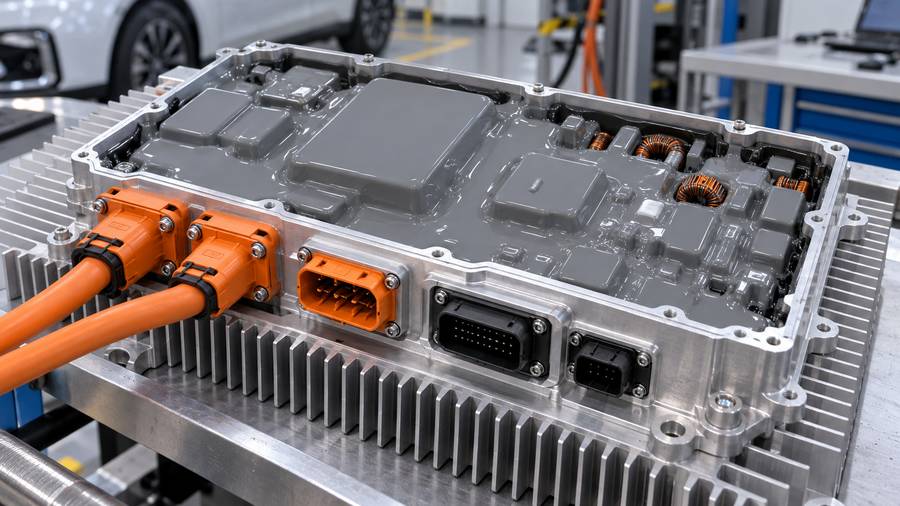
The sealed LED driver. Suppose a driver board sits close to an aluminum case. Its inductor is a hot spot, rain exposure is plausible, and field repair is not planned. A thermal potting trial is reasonable. But first the team checks whether the inductor’s exterior is a useful heat-transfer surface, where air can escape during the pour, and whether the case can shed heat at the installed ambient temperature. A low-stress grade may matter if the board and housing move differently with temperature. The trial wins only if measured temperatures, electrical tests, and aging results pass.
The industrial controller with a replaceable connector. This board has two regulators that need a thermal path to its metal lid. A technician may replace its connector in the field. Full potting would turn a small repair into a destructive operation. A local filler at the regulators plus a sound enclosure seal may solve the actual two needs with less material and less grief. If the lid must be bonded, compare a thermally conductive adhesive as a separate design choice. Bond strength and service access then become part of the decision.
These are hypothetical design sketches, not test results or recommendations for a particular voltage or product. Their point is simple: “protect the board” and “cool the hot part” can call for different coverage.
What to test before approving the material
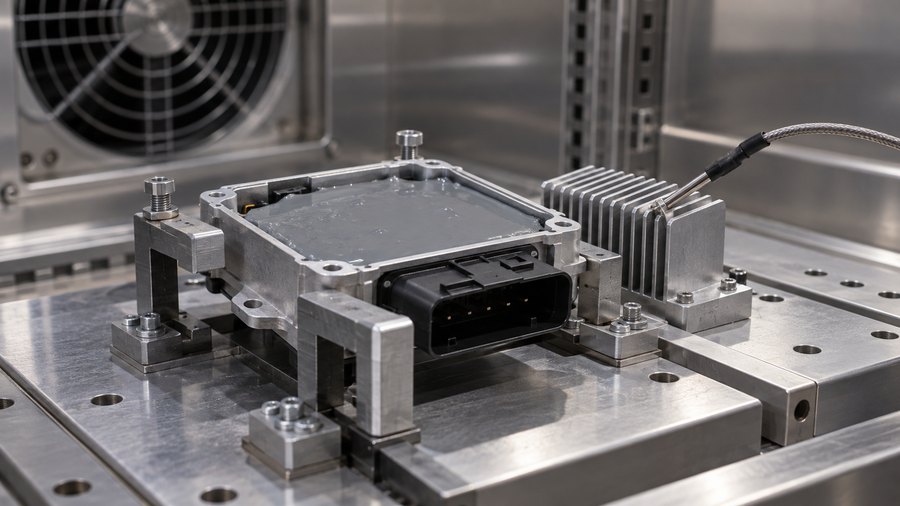
Write the pass/fail limits before sending parts to the lab. Measure the critical component temperature, resin-near-component temperature if accessible, housing temperature, power load, and ambient. Repeat on a realistic worst-case assembly: high-power parts, maximum allowed resin thickness, and a hot installation condition. Compare an unpotted or differently protected control build where that comparison is safe and meaningful.
Inspect cured fill for voids, incomplete cure, leakage into keep-out areas, and separation from the wall. Check dielectric and functional performance with the relevant end-product test plan. Then expose representative units to the specified thermal cycles, humidity, vibration, or chemicals. Recheck temperatures and insulation afterward. If a part needs repair, rehearse the repair before declaring the design serviceable.
Keep the formulation grade, batch, mix settings, dose, and cure record with those results. That paperwork sounds boring. When the fifth unit runs warmer than the first four, it becomes extremely interesting.
Conclusion
A thermally conductive potting compound is a protective encapsulant with a possible second job: carrying heat out of electronics. It works best when the heat source, resin, receiving surface, and surrounding air form a real path. Choose the amount of potting and the resin chemistry around that path, the electrical design, and the way the unit will be made and serviced. Then test the complete assembly. A filled box is not automatically a cooled box.
FAQs
1. What is a thermally conductive potting compound used for?
It encapsulates electronic parts while helping heat move toward a housing or heat sink. A suitable grade can also provide environmental or mechanical protection. The finished unit still needs a way to release that heat.
2. Is thermal potting electrically conductive?
Not necessarily. Many grades use electrically insulating ceramic fillers, but formulations differ. Check the exact material’s electrical data and verify the finished insulation system.
3. Does potting always make electronics run cooler?
No. It may replace air with a better heat path, but the result depends on resin thickness, voids, case contact, and how the case rejects heat. Measure the critical component in the assembled product.
4. Should I choose silicone or epoxy for thermal potting?
Start with the mechanical and chemical environment. A flexible silicone may better accommodate movement in a cycling assembly. A suitable epoxy may provide firmer support and stronger adhesion. Compare actual grades and tests, not just family names.
5. Can I use it in a plastic enclosure?
Yes for protection, if the grade and enclosure suit the environment. For cooling, a plastic wall may be the limiting part of the heat path. Test the real enclosure; consider a dedicated metal spreader or a different cooling route if needed.
6. What causes bubbles around coils and components?
Air can be trapped under overhangs or behind parts. Mix handling, moisture, viscosity, dispense location, and venting also matter. Trial the pour on real assemblies and inspect inside cured samples.
7. How long does a thermal potting compound take to cure?
It depends on chemistry, grade, temperature, fill depth, and the manufacturer’s cure schedule. Use the specified handling and full-cure criteria; a dry-looking surface is not proof that a deep pour has cured.
8. Can a clear potting resin also have high thermal conductivity?
It is difficult to combine optical clarity with heavy loading of the particles that often raise conductivity. Special formulations may exist, so compare measured optical and thermal properties for the actual grade rather than assuming either outcome.
9. Can cured potting be removed for repair?
Some soft materials can be cut away locally, but removal may damage a board or part. Rigid, strongly bonded systems can be especially difficult. Decide on the service plan before choosing full encapsulation.
10. Is a liquid gap filler the same as potting compound?
Usually no. A gap filler targets an interface between a hot part and a cooling surface. Potting fills a cavity around electronics for broader protection. Some product names overlap, so use the coverage drawing, cure behavior, and data sheet to decide.