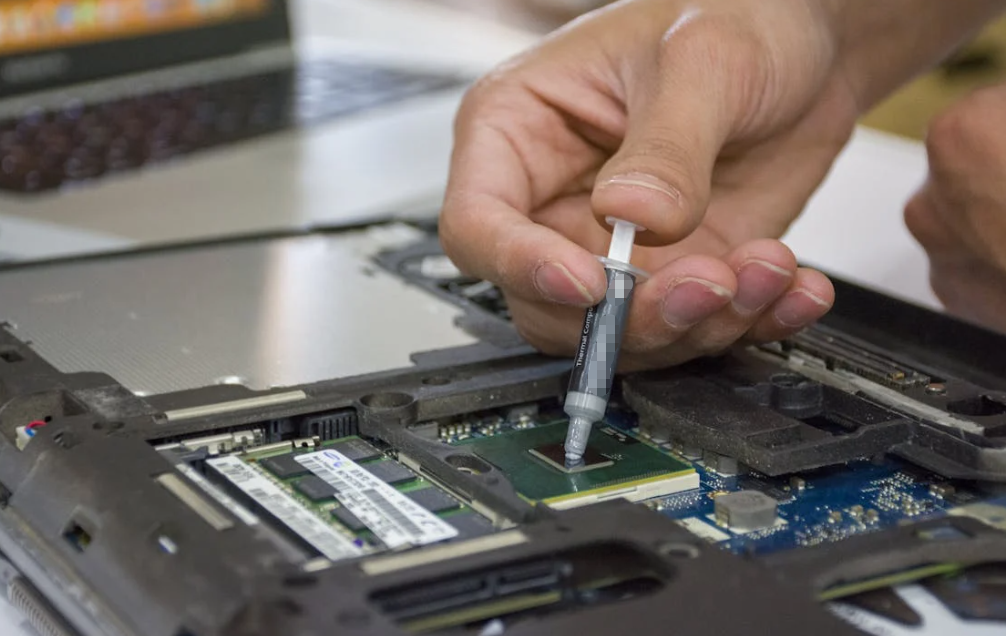
For most electronics, conventional thermal paste is the safer choice. It is easier to control, broadly compatible with common heat-sink materials, and usually electrically insulating. Liquid metal can move heat across a tight interface very well, but it is electrically conductive and gallium-based grades can seriously damage aluminum.

That does not make liquid metal a bad material. It makes it a specialist material. In a qualified direct-die assembly with compatible surfaces, controlled dispensing and a real containment system, it may solve a difficult thermal bottleneck. In an ordinary repaste job, though, the extra risk often buys less than the catalog numbers suggest.
This guide compares the two options from an electronics-safety point of view. We will look at CPUs and GPUs, but also laptops, servers, consoles, power devices and production assemblies where repeatability matters more than a flashy benchmark.
Thermal Paste and Liquid Metal Do the Same Job in Different Ways
Both materials replace insulating air between a heat source and a cooler. Conventional paste suspends conductive particles in an oil or polymer carrier. Liquid-metal TIM uses an alloy that stays liquid around room temperature. That alloy can conduct heat much more readily, but it also conducts electricity and interacts with certain metals.

Even a polished processor lid and a smooth cold plate touch only at their microscopic high points. The small valleys between them hold air. A thermal interface material, or TIM, wets those irregularities so heat has a better path from the component into the cooler.
What conventional thermal paste contains
Most thermal paste, also called thermal grease or heat-sink compound, combines a carrier fluid with solid filler particles. The carrier may be silicone-based or silicone-free. Fillers can include aluminum oxide, zinc oxide, boron nitride, carbon materials and other engineered particles.
The exact formulation changes viscosity, electrical behavior, oil bleed, thermal stability and how well the paste survives temperature cycling. That is why color is not a reliable safety label. A gray paste may be electrically insulating, while another metal-filled compound may require more care. Check the technical data rather than guessing from appearance.
Haktak’s industrial thermal grease options are intended for thin, clamped interfaces in electronics and power assemblies, where surface wetting and long-term process behavior matter alongside conductivity.
What liquid metal means in a thermal interface
Commercial liquid-metal TIMs are often based on low-melting gallium alloys that may also contain indium and tin. You may see names such as GaInSn, eutectic gallium alloy or Galinstan used in technical discussions. They are not the same thing as an ordinary gray thermal paste that happens to contain metallic filler.
This distinction matters. Metal particles trapped inside a grease matrix do not move like a free liquid alloy. A liquid-metal droplet can spread, bridge two conductors or creep beyond the contact area. It also wets surfaces differently and may react with the metal beneath it.
| Decision Factor | Conventional Thermal Paste | Liquid-Metal TIM |
| Electrical behavior | Usually insulating, but verify the datasheet | Electrically conductive |
| Contact-material compatibility | Broad; still formulation-dependent | Aluminum is a critical incompatibility; copper and nickel systems still need validation |
| Application tolerance | Relatively forgiving | Narrow process window and strict quantity control |
| Cleanup and rework | Usually straightforward | Difficult; conductive residue can remain hazardous |
| Thermal potential | Strong for most thin, clamped interfaces | Very high bulk conductivity and useful at high heat flux |
| Containment | Normal squeeze-out control | Electrical barriers and migration control may be required |
| Typical fit | General electronics, production and service | Qualified high-performance designs with engineered controls |
Which Is Safer: Thermal Paste or Liquid Metal?
Thermal paste is normally safer because a small application error is less likely to become an electrical or chemical failure. Liquid metal adds hazards that a properly selected insulating paste does not have. The right comparison is not only peak temperature. It is the chance and consequence of a spill, incompatible surface, migration event or difficult repair.
There are four separate safety questions to ask:
- Can the material conduct current into nearby circuitry?
- Can it attack or alter the metals in the thermal stack?
- Can it escape the intended interface during use or service?
- Can the factory and repair process control it every time?
If any answer is unknown, liquid metal is not yet a defensible choice.
Electrical safety: a droplet can become a circuit path
Liquid metal transfers current as well as heat. A small droplet on motherboard traces, socket pins or surface-mounted capacitors can create a short circuit when the device powers on. Around a bare GPU or laptop processor, these conductors may sit only millimeters from the die.
The difficult bit is scale. A spill does not need to look dramatic. A tiny silver bead can hide beneath a package edge or between closely spaced components. Wiping the visible area may not remove every conductive trace.
Most general-purpose pastes are electrically insulating, so a small squeeze-out is usually a cleanliness problem rather than an immediate short. “Usually” is doing useful work there. Carbon-rich or metal-filled greases can have different electrical properties. The product datasheet should state volume resistivity, electrical conductivity or dielectric behavior.
Gallium and aluminum are a hard stop
Gallium-based liquid metal should not contact aluminum. Gallium can penetrate and weaken the aluminum structure, producing severe embrittlement and loss of mechanical integrity. A clear or colored anodized layer is not a dependable workaround because scratches, edges and microscopic coating defects can expose the base metal.
Official liquid-metal compatibility guidance from Indium Corporation explicitly warns against aluminum and aluminum alloys. It also confirms that liquid metal is electrically conductive and should not contact circuitry.
Do not judge the cold plate by color. Nickel-plated copper, bare aluminum and anodized aluminum can all look silver in a finished assembly. Confirm the bill of materials, cooler documentation or supplier declaration before the tube is opened.
Copper and nickel are more suitable, but not consequence-free
Bare copper and nickel-plated copper are commonly used with liquid-metal TIMs. They do not present the same catastrophic compatibility problem as aluminum. Still, “compatible” does not mean “unchanged forever.”
Gallium alloys can wet and interact with copper, leaving a permanent silver-gray mark or altering the surface layer. Nickel plating provides a useful barrier, but the plating must be continuous and durable. Scratches, porosity and thin regions deserve attention in a long-life design.
These changes may not ruin thermal performance, yet they affect appearance, rework and warranty assessment. A repair technician opening the assembly two years later needs a procedure for the surface they will actually find, not the clean surface shown in a launch-day video.
Mechanical and service safety count too
A material can be chemically compatible and still be a poor service choice. Portable devices experience vibration, changing orientation and occasional impact. Coolers are removed at an angle. Assemblies get shipped, dropped on a bench, reopened and closed again.
Liquid metal has high surface tension, but that is not a universal containment system. Excess volume, an uneven gap, damaged barriers or careless disassembly can move material toward exposed electronics. Conventional paste is not immune to movement either, but its failure is more often a gradual thermal problem than a conductive contamination event.
W/mK Does Not Predict the Finished Device Temperature
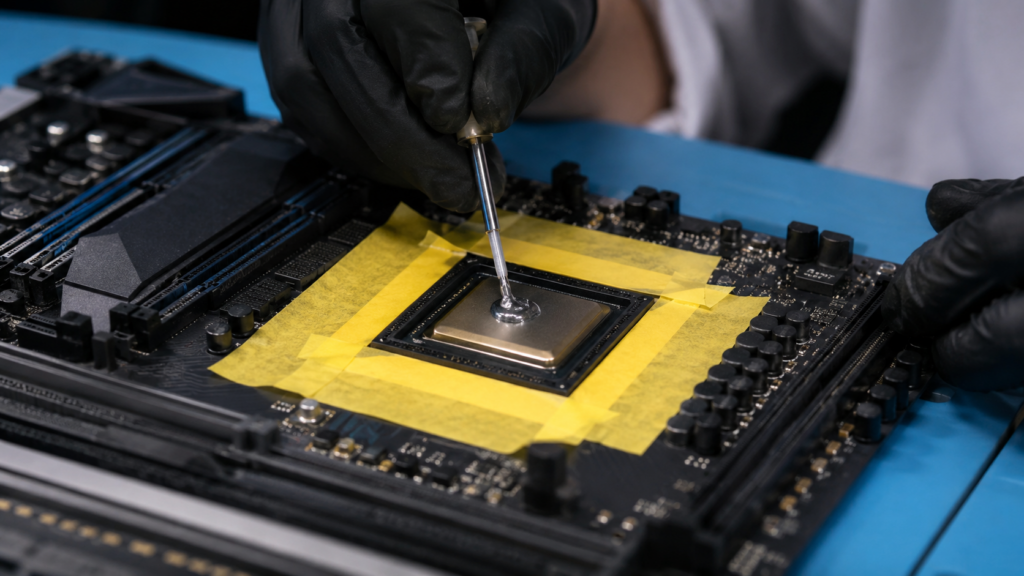
Liquid metal can have a much higher stated thermal conductivity than paste, yet the device-level temperature improvement may be modest. Heat still passes through the die, package, heat spreader, interface, cold plate and cooler. If another part is the bottleneck, replacing paste with liquid metal cannot remove that resistance.
Think of a wide highway feeding a narrow bridge. Widening the highway again does not clear the bridge. In a cooling stack, that bridge might be the silicon package, a thick heat spreader, poor mounting pressure, a saturated radiator or weak airflow.
Thermal conductivity is not thermal impedance
Thermal conductivity, measured in W/m·K, describes a material property under stated conditions. Thermal impedance describes how strongly the actual interface resists heat flow over a defined area, thickness and pressure. Contact resistance at both surfaces is part of the real result.
Haktak’s guide to why thermal conductivity and thermal impedance are not interchangeable explains why two materials with different catalog conductivity can perform surprisingly close in an assembly.
This is also why cross-brand W/mK numbers can mislead. Test fixtures, pressure, temperature, sample thickness and calculation methods may differ. A higher number is worth investigating, but it is not a guaranteed temperature drop.
Bond-line thickness and mounting pressure change the result
Paste should normally fill microscopic roughness, not become a thick spacer. As the layer grows, heat travels through more TIM. Too little material can leave dry areas. Too much may create a thicker bond line or squeeze into places where it is not wanted.
Liquid metal is also sensitive to coverage and volume. A micro-thin film can work well; a free pool adds risk without creating useful cooling.
The explanation of how final bond-line thickness changes interface performance is useful here. The final thickness is set by surface flatness, mounting pressure, paste rheology, fastener sequence and any hard mechanical stops in the assembly.
Read temperature claims with the test conditions attached
A statement such as “liquid metal is 10°C cooler” is incomplete by itself. Was the test on a desktop CPU lid or directly on a bare die? What paste was replaced? Were power, fan speed, ambient temperature and mounting torque controlled? Was the cooler already near its capacity?
For a useful A/B comparison, keep these conditions stable:
- Hardware and firmware settings.
- Actual component power during the test.
- Cooler, pump and fan control.
- Ambient and coolant temperature.
- Mounting hardware and tightening sequence.
- Workload duration and steady-state criterion.
- Sensor location and logging method.
ASTM D5470 thermal transmission testing provides a controlled method for thermal impedance and apparent conductivity measurements. ASTM also explains that the idealized test conditions do not directly reproduce most practical assemblies. Material data and device validation have different jobs.
Thermal Paste vs Liquid Metal by Device Type

Device geometry changes the safety decision. A covered desktop CPU leaves more distance between the TIM and exposed circuitry than a bare GPU die. A laptop adds transport and vertical use. Factory liquid-metal products may include physical barriers and controlled application steps that an ordinary repaste does not have.
Desktop CPU with an integrated heat spreader
A quality thermal paste is the sensible starting point for a normal desktop CPU. The metal lid, or integrated heat spreader, distributes heat over a larger area and keeps the TIM away from the processor’s bare-die components. Paste offers low risk, easy cleanup and enough performance for most stock and tuned systems.
Liquid metal may help when a high-power processor is genuinely interface-limited. Before considering it, verify the top of the IHS, the cooler base and every exposed edge. Also check the cooler and CPU warranty terms. A few degrees of headroom can matter for a competitive overclock; it may change nothing in a workstation that already stays below its thermal limit.
Delidded CPU and direct-die cooling
Direct-die interfaces have high heat flux because a large amount of heat leaves through a small area. Removing the intermediate heat spreader can make TIM performance more important, which is why liquid metal appears often in delidding discussions.
The same geometry raises the stakes. The die is fragile. Nearby components are exposed. Mounting pressure and cooler parallelism become critical. This is expert work, or a production design that has been engineered and validated as a complete system. It is not simply the desktop procedure with the lid removed.
Laptop CPU and GPU
Some high-performance laptops ship with liquid metal from the factory. That shows liquid metal can work in a mobile product. It does not show that every laptop is ready for an aftermarket conversion.
A factory design may include a foam dam, conformal barrier, controlled dispense mass, matched cold-plate surface and assembly inspection. The service manual may prescribe a specific replacement material and method. If those controls are missing or damaged, a device that spends months upright in a bag is a very different risk from a desktop that never moves.
Replacing factory liquid metal with regular paste may be possible on some products, but it can change the bond line and raise temperatures. Follow model-specific service information rather than a generic tutorial.
GPU die, memory and voltage-regulation components
Discrete GPUs often place tiny capacitors and resistors close to the exposed die. One escaped liquid-metal droplet can bridge them. Meanwhile, memory and VRM components commonly use thermal pads or putty because their gaps are much larger than the die-to-cooler interface.
Do not replace all these materials with one compound. Paste on the die, pads on memory and putty over variable-height components perform different mechanical jobs. Changing pad thickness can even lift the cooler away from the GPU die, creating worse temperatures after an otherwise neat repaste.
Liquid metal is possible in an engineered GPU design, but the consequence of uncontrolled application is high. For repair and general production, an approved paste or phase-change TIM is normally easier to defend.
Game consoles and compact consumer electronics
Compact electronics squeeze the cooler, power supply, storage and control boards into a tight enclosure. Some systems use factory liquid metal with a dedicated containment structure. Preserve that architecture during service.
Do not infer the vapor-chamber or cold-plate material from a product photo. Do not assume a console can accept regular paste merely because paste works on a desktop CPU. The original contact thickness, pressure and barrier design need to be understood first.
Servers, AI accelerators and industrial power electronics
In commercial equipment, a small temperature gain must be weighed against field service, uptime and production consistency. A material that performs beautifully in one hand-built sample may be wrong for 10,000 assemblies serviced in several countries.
Industrial selection should include vertical orientation, transport vibration, long thermal cycles, inspection capability and rework. For power modules, also consider electrical isolation, creepage, surface flatness and clamp load. Liquid metal may be technically attractive at extreme heat flux, but the complete process must control conductive contamination for the life of the product.
When Liquid Metal Can Be a Rational Engineering Choice
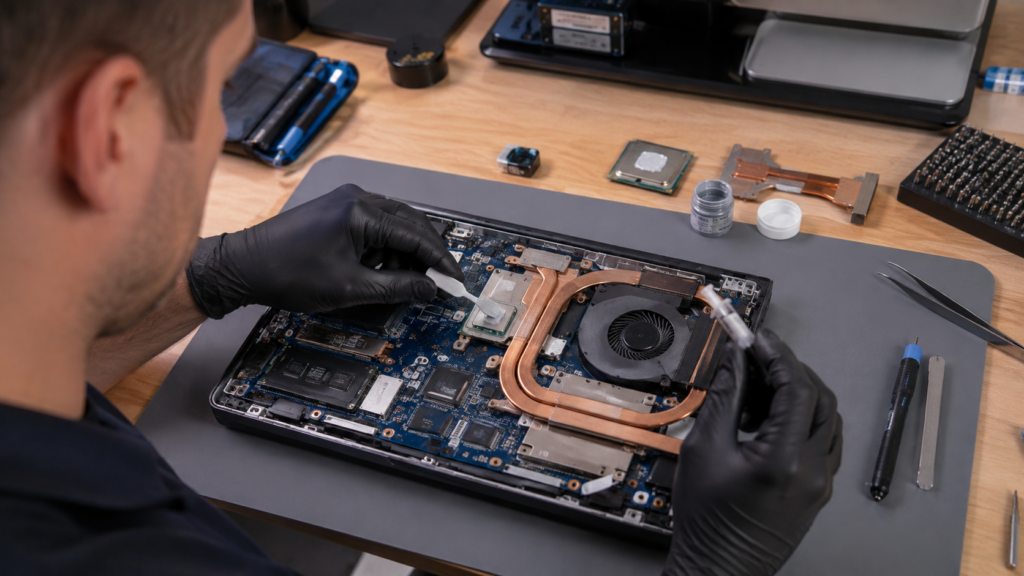
Liquid metal becomes reasonable when testing proves that the interface is the thermal bottleneck, conventional high-performance paste cannot meet the target, all contact materials are compatible, nearby circuitry is protected, dispense quantity is controlled and the device passes orientation and aging tests. Missing one of those conditions should pause the decision.
Use these six gates before approval:
- Prove the need. Show that reducing interface resistance changes junction temperature, throttling or reliability in a meaningful way.
- Verify the material stack. Record the die, IHS, cold plate, plating, coating and barrier materials. Do not rely on visual inspection.
- Design electrical protection. Define where escaped material would go and how exposed conductors are isolated.
- Control application. Specify dispense mass, coverage, mounting pressure and inspection criteria.
- Age the real assembly. Test thermal cycling, orientation, vibration and transport conditions.
- Plan service. Define removal, cleanup, inspection, replacement and warranty handling.
A direct-die accelerator module is a plausible example. If the interface limits performance and the cold plate is nickel-plated copper, an engineered liquid-metal system may recover valuable thermal headroom. But the useful product is not the alloy alone. It is the alloy plus barrier, controlled process, inspection and maintenance plan.
When Conventional Thermal Paste Is the Better Choice
Choose conventional paste when the device already meets its thermal target, the cooler contains aluminum, the metal stack is uncertain, general technicians must service the product, exposed circuitry cannot be reliably protected or the assembly lacks a validated containment structure. In these cases, liquid metal adds risk without solving a proven system limitation.

Paste is usually the better starting point for:
- Standard desktop and workstation maintenance.
- Aluminum cooler bases or undocumented cold plates.
- Dense boards where a conductive spill would be expensive.
- High-volume assembly without precise micro-dispense controls.
- Field equipment that must be reopened easily.
- Products exposed to rough handling and unplanned repair.
- Systems where cooler capacity, airflow or mounting is the real bottleneck.
Selection still needs care. Review the thermal-grease parameters that matter in practice, including viscosity, oil bleed, electrical behavior, operating range and cycling stability. A stable 6 W/m·K grease can be a better production choice than a difficult 12 W/m·K compound that separates or cannot maintain a thin interface.
Application and Containment Controls Change the Risk
Material choice alone does not make a thermal interface safe. Liquid-metal reliability depends on controlled quantity, complete but thin coverage, protection around exposed circuitry, parallel mounting and a process that prevents stray droplets during assembly and service. Paste is more forgiving, but contamination, poor torque and excess volume can still spoil the result.
Controls for thermal paste
Clean both surfaces with a compatible solvent and lint-free wipe. Keep fibers, fingerprints and old cured residue out of the interface. Apply a repeatable volume appropriate to the package shape and paste rheology, then lower the cooler without sliding it around.
For production, a controlled dot, line, stencil or automated dispense can all work. The correct method is the one that produces full coverage and a stable thin bond line across normal tolerances. Haktak’s comparison of controlled thermal-paste application methods covers the main process options.
Tighten fasteners in the defined sequence and confirm the final clamp load. If the cooler is lifted after wetting the paste, clean and reapply rather than hoping the disturbed layer will settle perfectly. These practical thermal-grease application tips can help diagnose high temperatures after reassembly.
Additional controls for liquid metal
Liquid metal needs every paste control plus several more:
- A documented compatible-metal stack.
- A controlled dispense mass, not an estimated puddle.
- A barrier system suited to temperature and service life.
- Protection for exposed conductors around the die.
- Adequate magnification for post-application inspection.
- A fixture or method that keeps the cooler parallel during closure.
- A cleanup plan for applicators, wipes and accidental droplets.
- A power-off inspection before electrical testing.
Polyimide tape or conformal coating is often discussed online. Either may form part of a design, but neither is automatically sufficient. Adhesive durability, coating coverage, edge geometry and the path available to an escaped droplet still need evaluation.
Long-Term Reliability: Dry-Out, Pump-Out and Migration
Neither material is maintenance-free in every assembly. Grease can separate, bleed, dry or move under cycling. Liquid metal does not dry like a polymer grease, but it can migrate, interact with contact surfaces and make later service more difficult. Reliability should be judged after aging in the final orientation, not from a fresh benchmark.
Conventional paste failure modes
Repeated heating and cooling make the component and cooler expand by different amounts. The resulting shear can gradually push grease away from the hottest region. This is commonly called pump-out. Low-viscosity oil may also bleed from the filler network, while volatile components can slowly leave the material at high temperature.
The detailed guide to thermal-grease pump-out under cycling explains why die size, surface finish, clamp pressure and formulation all affect the outcome. A paste that survives a desktop CPU may behave differently under a large power module or a thin laptop die.
Liquid-metal failure modes
Liquid metal avoids some polymer dry-out mechanisms, but it introduces its own concerns. The alloy may wet or absorb into a copper surface. It can creep along surface features, escape a damaged barrier or leave conductive residue during disassembly. These processes are not identical to classic grease pump-out, even if the visible symptom is material near the edge.
Monitor performance after initial operation and again after environmental aging. Inspect the barrier, contact surface and surrounding circuitry. For portable equipment, include realistic storage orientations and transport vibration instead of testing only a flat unit on a laboratory bench.
| Maintenance Question | Thermal Paste | Liquid Metal |
| Can a general technician service it? | Usually, with normal TIM training | Only with material-specific procedures |
| Is residue easy to see and remove? | Usually easier | Tiny conductive residue can remain hazardous |
| Can the interface be reopened casually? | Reapply after separation | Disassembly needs containment and cleanup planning |
| What can trigger inspection? | Temperature drift, aging interval or cooler removal | Temperature drift, barrier damage, transport event or planned service |
Safer Alternatives When Ordinary Paste Is Not Enough
The choice is not limited to basic paste or free liquid metal. A high-performance insulating grease, silicone-free formulation or phase-change material may improve thermal stability while avoiding conductive liquid near the circuit. The right alternative depends on gap, pressure, activation temperature, cleanliness and rework needs.
High-performance electrically insulating grease
A well-formulated grease can produce low interface resistance at a thin bond line without liquid-metal hazards. Look for application-relevant impedance data, stable viscosity, low bleed and resistance to the expected thermal cycle. Verify electrical properties, especially if squeeze-out could approach conductors.
This option suits many CPUs, LEDs, power modules and industrial controls. It is also easier to integrate into normal dispensing and service procedures.
Silicone-free thermal grease
Some optical, coating and contact applications restrict silicone oil or low-molecular-weight siloxanes. In that case, a silicone-free thermal grease may address contamination concerns without adding a free conductive alloy.
Silicone-free does not automatically mean higher conductivity or universal cleanliness. Outgassing, substrate compatibility, oil bleed and thermal aging still require testing.
Phase-change thermal interface material
A phase-change TIM is solid or tacky enough for clean handling at assembly temperature, then softens as the device warms. It can wet the interface with less process mess than grease and may improve placement repeatability.
It needs sufficient activation temperature and sustained contact pressure. If the device never reaches the phase-change range, or the cooler unloads during cycling, the expected wetting may not occur. As always, validate the finished stack.
Standards and Tests Behind a Defensible TIM Decision
A safe choice needs more than one conductivity number. Measure thermal impedance at controlled thickness and pressure, then qualify the actual device for cycling, orientation, vibration, electrical isolation and material compatibility. Standards make test conditions clearer, but they do not certify an untested assembly for you.
China’s current gallium-based liquid-metal TIM standard, GB/T 43611-2023, provides an official product-standard reference specifically for this material family. The customer, market and application may require additional methods.
For broader context, Haktak’s guide to common TIM test standards explains how thermal, electrical and environmental methods fit into material selection.
| Test Area | Control During Test | Measure or Inspect |
| Thermal | Power, ambient, pressure, bond line and orientation | Junction or case temperature, impedance and throttling |
| Electrical | Barrier design and nearby potentials | Insulation, leakage and conductive migration |
| Materials | Metals, plating, coatings and cleaners | Corrosion, staining, pitting, delamination and residue |
| Mechanical | Clamp load, shock and vibration | Coverage shift, edge escape and package damage |
| Aging | Temperature cycles, dwell, humidity and service time | Performance drift and barrier integrity |
| Process | Dispense mass, applicator and inspection | Repeatability, stray droplets and reject conditions |
Test both fresh and aged units. A liquid-metal interface that passes a ten-minute thermal run has not yet demonstrated transport safety or long-term containment. Likewise, a paste that looks clean after assembly has not yet demonstrated pump-out resistance.
A Practical Selection Matrix
| Situation | Preferred Starting Point | Reason |
| Standard desktop CPU IHS | Quality thermal paste | Low risk and normally sufficient performance |
| Aluminum or uncertain cooler contact | Thermal paste | Avoid gallium-aluminum incompatibility |
| Qualified direct-die, high-heat-flux design | Evaluate liquid metal | Potentially useful interface gain with engineered controls |
| Bare GPU with exposed nearby SMDs | Approved paste or phase change | Conductive-spill consequence is high |
| Factory liquid-metal laptop service | Follow OEM procedure | Preserve the original barrier, quantity and material stack |
| Field-serviceable industrial equipment | Stable insulating grease | Easier controlled repair and lower contamination risk |
| Silicone-sensitive optical assembly | Silicone-free grease or approved alternative | Addresses contamination without free conductive metal |
If the assembly does not have a documented liquid-metal design, start with a proven insulating paste and validate the total interface. Escalate only when testing identifies a real interface bottleneck and the organization can control every added hazard. The safest material is the one the production and service system can manage repeatedly.
What to Prepare Before Requesting a Recommendation
A useful TIM recommendation starts with the assembly, not a target W/mK. Provide the heat source, power, interface area, contact metals, expected bond-line thickness, mounting pressure, operating temperature and reliability profile. Also identify exposed circuitry, insulation needs and how the product will be assembled and serviced.
Prepare these details:
- Device and component package.
- Normal and peak power.
- Contact metals, plating and coatings.
- Interface area, flatness and expected bond line.
- Clamp load and fastener pattern.
- Operating and storage temperature.
- Orientation, vibration and transport exposure.
- Electrical isolation and contamination restrictions.
- Current TIM, measured temperatures and failure symptoms.
- Production volume, application method and inspection capability.
- Required service life and field-repair process.
Haktak can support assembly-level material selection and testing for thermal grease and related interface materials. Bring the drawing and the real operating limits. That is far more useful than asking for the product with the largest conductivity number.
CTA: Discuss Your Thermal Interface Requirements
Conclusion
Conventional thermal paste is safer for most electronics. It offers broad surface compatibility, lower electrical consequence, simpler process control and easier repair. For CPUs, GPUs, industrial controls and field-serviceable equipment, those advantages often matter more than a small improvement in peak temperature.
Liquid metal is a specialist solution, not a routine upgrade. Its thermal potential can be valuable in a proven high-heat-flux bottleneck, especially in a qualified direct-die design. But the assembly must have compatible metals, reliable electrical protection, controlled dispensing, containment, aging data and a service plan.
In plain terms: use liquid metal because testing proves you need it and your design can manage it. Do not use it because the W/mK number looks exciting.
Frequently Asked Questions
Is liquid metal safer than thermal paste for a CPU?
No, not in a general sense. Conventional thermal paste is normally safer because most grades are electrically insulating and compatible with common cooler materials. Liquid metal can work on a suitably designed CPU interface, but it requires verified contact metals, protection around nearby circuitry, controlled application and careful service. A factory-engineered liquid-metal CPU is different from an improvised conversion.
Can liquid metal short a motherboard or GPU?
Yes. Liquid metal is electrically conductive. A small droplet can bridge motherboard traces, package capacitors, socket contacts or GPU SMD components. The device should never be powered until the work area has been inspected. Cleanup can be difficult because tiny droplets may hide beneath package edges or between closely spaced parts.
Why should liquid metal not be used on aluminum heatsinks?
Gallium-based alloys can penetrate and embrittle aluminum, seriously weakening the contact surface. Anodizing is not a reliable safety barrier because scratches, edges and coating defects may expose the underlying metal. Confirm the actual cold-plate material from documentation rather than assuming that a silver surface is nickel-plated copper.
Is liquid metal safe on copper or nickel-plated copper?
These materials are generally more suitable than aluminum, but the interface still needs validation. Liquid metal may stain or wet into bare copper, and nickel plating must remain continuous. Electrical containment, serviceability and long-term surface behavior still matter. Use the compatibility guidance for the specific liquid-metal grade and cold-plate construction.
How much cooler is liquid metal than thermal paste?
There is no universal temperature reduction. Results depend on die area, heat flux, cooler capacity, mounting pressure, the old paste, ambient temperature and whether the interface is actually the bottleneck. Direct-die systems can show a larger benefit than covered desktop CPUs. Compare both materials on the same assembly under controlled power and cooling conditions.
Can I replace factory liquid metal with regular thermal paste?
Sometimes, but not automatically. The factory design may rely on a certain bond line, wetting behavior, barrier and cooler pressure. A paste replacement can increase temperature or alter contact. Follow the device manufacturer’s service procedure. If no approved conversion exists, record baseline temperatures and consult a technician familiar with that model.
Does liquid metal dry out or need replacement?
Liquid metal does not dry in the same way as polymer-based grease, but that does not make it permanent. It can interact with copper, migrate, escape a damaged barrier or become difficult to service. Inspection intervals should follow the product design, operating environment and manufacturer guidance rather than a generic number of years.
Is liquid metal safe in a laptop that is often carried vertically?
Only when the laptop was designed or properly qualified for it. Factory liquid-metal laptops may include barriers, controlled dispense quantities and matched cold plates. A user conversion without those controls carries more risk during vertical storage, travel vibration and impact. Preserve the original containment structure during any authorized service.
What is the safest thermal paste near exposed electronic components?
Start with a paste whose datasheet confirms high electrical resistivity or non-conductive behavior. Also check temperature range, bleed, pump-out stability and substrate compatibility. Even insulating paste should be applied cleanly because contamination can interfere with connectors, coatings or future repair. Validate the final interface rather than relying on a product color or marketing label.
What can I use instead of liquid metal for better cooling?
Consider a high-performance insulating grease, a stable silicone-free grease for contamination-sensitive assemblies, or an approved phase-change TIM. Better mounting pressure, flatter surfaces, a thinner controlled bond line and improved cooler capacity may also deliver more benefit than changing material. Fix the real thermal bottleneck before selecting a more aggressive compound.