
Electronic assembly materials
Electronic Adhesives for Assembly, Protection and Thermal Management
Select an adhesive around the complete electronic assembly—not one headline property. Haktak helps engineers compare chemistry, cure, rheology, electrical behavior, stress, reliability and production fit for PCB, semiconductor, automotive, power and consumer electronics. The result is a material and process window designed around the finished device.

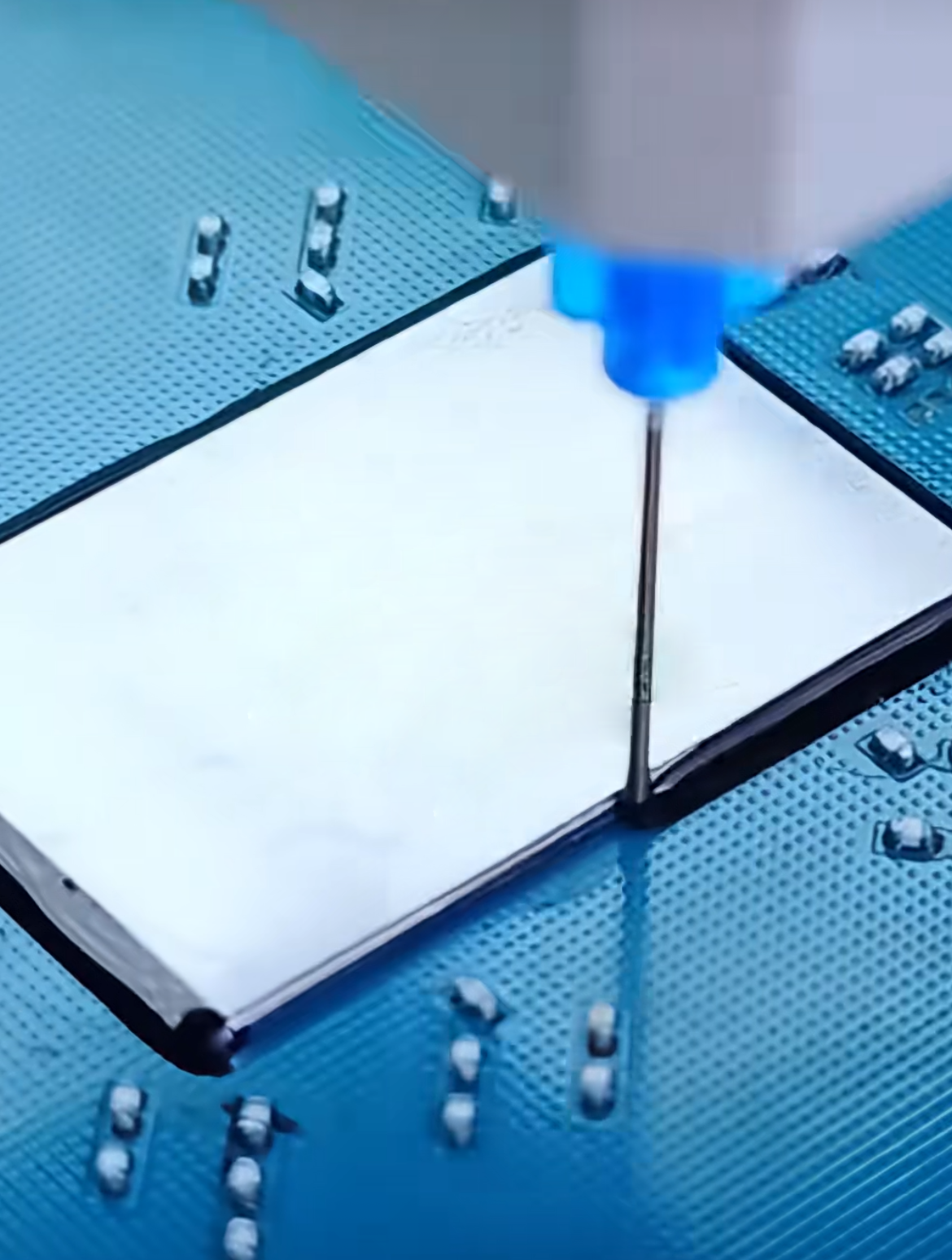 Electronic adhesives can locate, reinforce, seal, insulate, conduct heat or electricity, and control stress.
Definition and scope
What Are Electronic Adhesives?
Electronic adhesives are formulated bonding materials used to join, locate, reinforce or protect parts in an electronic assembly. Their job may be mechanical, thermal, electrical, environmental—or several of these at once.
A useful selection begins by defining the primary function. A rigid epoxy that holds a connector can be wrong for a temperature-cycled sensor. A soft silicone that relieves stress may be too compliant for precise alignment. A conductive adhesive can create an electrical path, while a visually similar filled adhesive may be designed to remain electrically insulating.
Creates the bond that transfers mechanical load or fixes a component in position.
Closes a joint against moisture, dust, chemicals or air while often allowing movement.
Fills a cavity or surrounds components to provide bulk protection, insulation or thermal transfer.
Forms a thin protective film over a populated PCB rather than a structural bond line.
Choose by chemistry
Types of Electronic Adhesives
Chemistry establishes a useful starting point, but the final choice still depends on formulation, cure condition, bond-line geometry and the complete reliability profile.
 01
01Epoxy Electronic Adhesives
One- and two-part epoxies support high-strength structural bonding, component staking, die attach, underfill and filled conductive systems.
- High strength and chemical resistance
- Broad thermal and electrical formulation range
- Modulus, shrinkage and cure stress require review
 02
02Silicone Adhesives and Sealants
Silicones combine flexibility, temperature capability and moisture resistance for electronics that move, cycle or require low mechanical stress.
- Good stress relief over temperature
- Useful for sealing, staking and optical assemblies
- Cure chemistry, residue and silicone sensitivity matter
 03
03Acrylic and UV-Curable Adhesives
Acrylic systems can offer fast fixture, broad adhesion and high-throughput light curing. They suit precise assemblies when light access and cure depth are controlled.
- Fast processing and automation potential
- Clear grades for optical applications
- Shadow zones may need secondary cure
 04
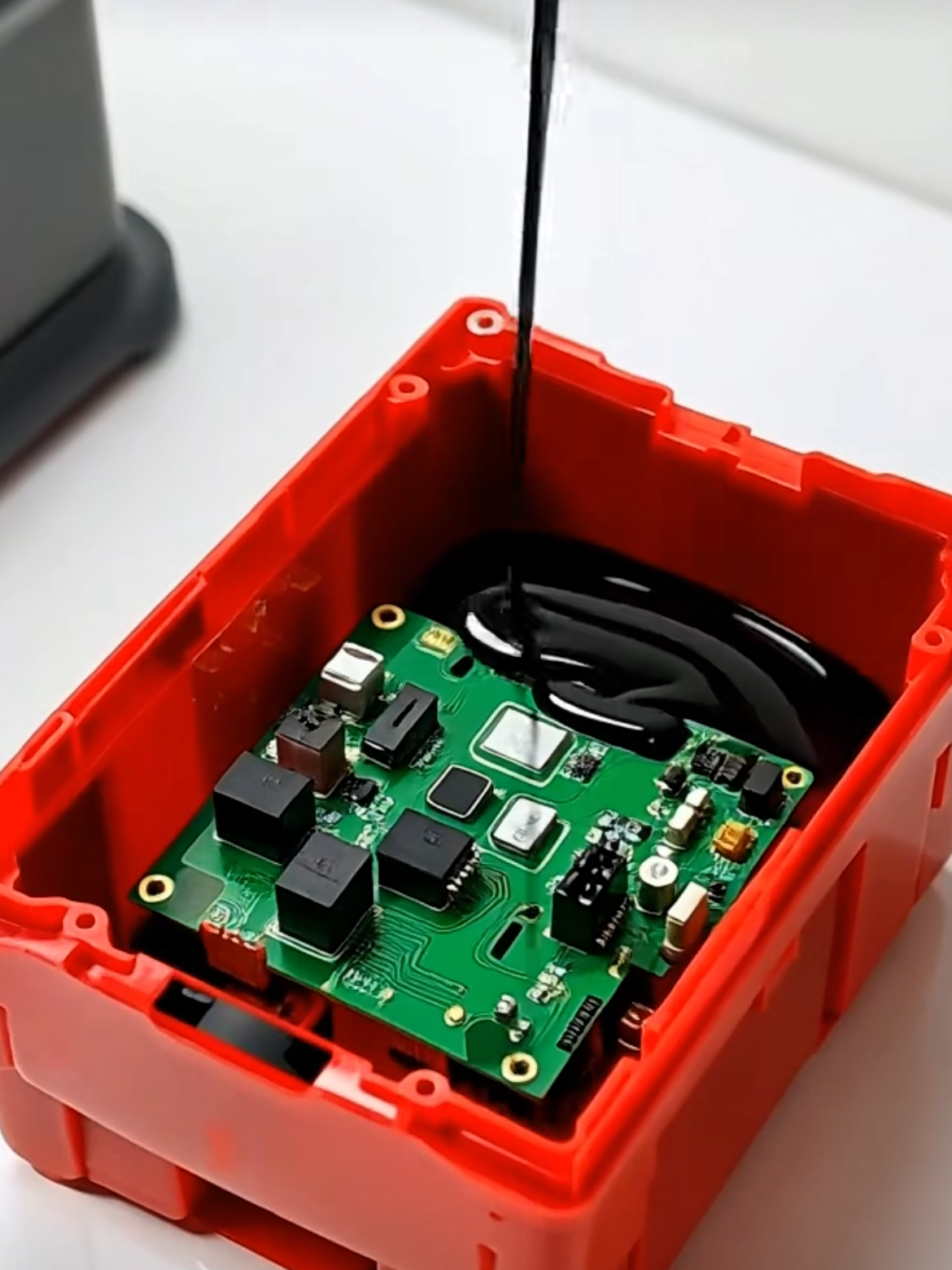
04Polyurethane and PUR Adhesives
Polyurethane systems balance adhesion, toughness and flexibility. Reactive hot-melt PUR can provide early handling strength followed by moisture cure.
- Useful impact and vibration tolerance
- Bonding for housings, displays and mixed substrates
- Moisture sensitivity and cure conditions need control
 05
05Cyanoacrylate Adhesives
Cyanoacrylates fixture small parts rapidly with thin bond lines and little mixing. Toughened and low-bloom grades extend their use in selected electronics.
- Very rapid room-temperature fixture
- Efficient for small, close-fitting joints
- Gap, humidity, bloom and long-term heat limit use
 06
06MS Polymer and Hybrid Sealants
Silyl-modified polymers offer moisture-curing, flexible sealing and adhesion without the same chemistry as conventional silicone or polyurethane.
- Flexible enclosure and joint sealing
- Useful adhesion across multiple substrates
- Confirm electronics cleanliness and cure access
 07
07Thermally and Electrically Functional Adhesives
Metal, ceramic or carbon fillers can add heat transfer or electrical conduction. Filler type and loading also change rheology, modulus, density and processability.
- Thermally conductive, electrically insulating options
- Electrically conductive interconnect grades
- Bond-line and contact resistance remain critical
Selection snapshot
Compare Electronic Adhesive Chemistries
No family is automatically best. Use the table to narrow the field, then qualify the exact formulation in a production-representative joint.
| Chemistry | Typical strengths | Typical flexibility | Cure routes | Common uses | Watch points |
|---|---|---|---|---|---|
| Epoxy | High structural strength, chemical resistance, broad filled-property range | Low to medium; toughened grades available | 1K heat, 2K ambient or heat accelerated | Staking, die attach, underfill, structural and thermal bonding | Mix ratio, exotherm, shrinkage, modulus and CTE stress |
| Silicone | Temperature range, flexibility, moisture resistance, stress relief | High | Moisture, condensation, addition or heat cure | Sealing, delicate component support, sensors and optical modules | Cure inhibition, volatile siloxanes, adhesion and contamination sensitivity |
| Acrylic / UV | Fast cure, broad adhesion, clear options and automation | Low to high by grade | UV, visible, heat, activator or dual cure | Display, camera, sensor, PCB and small-component bonding | Light access, oxygen inhibition, depth and shadowed areas |
| Polyurethane / PUR | Toughness, impact resistance and mixed-substrate adhesion | Medium to high | 2K, moisture or reactive hot melt | Housings, displays, cable and flexible assembly joints | Moisture handling, isocyanate chemistry and cure speed |
| Cyanoacrylate | Very fast fixture and simple thin-line application | Low to medium | Surface moisture; optional primer or light cure | Small parts, temporary fixture and selected plastic/metal joints | Bloom, gap filling, humidity, peel and high-temperature durability |
| MS Polymer | Flexible sealing, moisture cure and substrate versatility | High | Atmospheric moisture | Enclosures, seams and flexible environmental seals | Deep-section cure, cleanliness, strength and thermal limits |
Choose by assembly task
Electronic Adhesive Functions and Applications
The same chemistry can behave differently as a thin die-attach layer, a tall staking bead or a filled enclosure joint. Define the geometry and function before comparing datasheets.
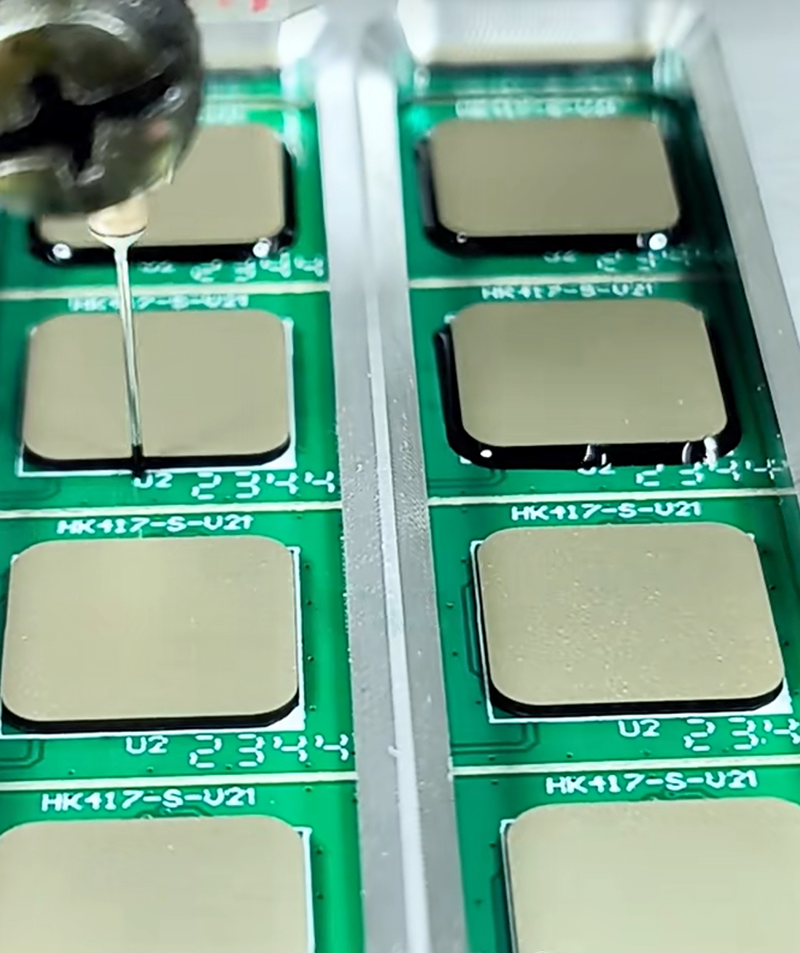 Component assembly
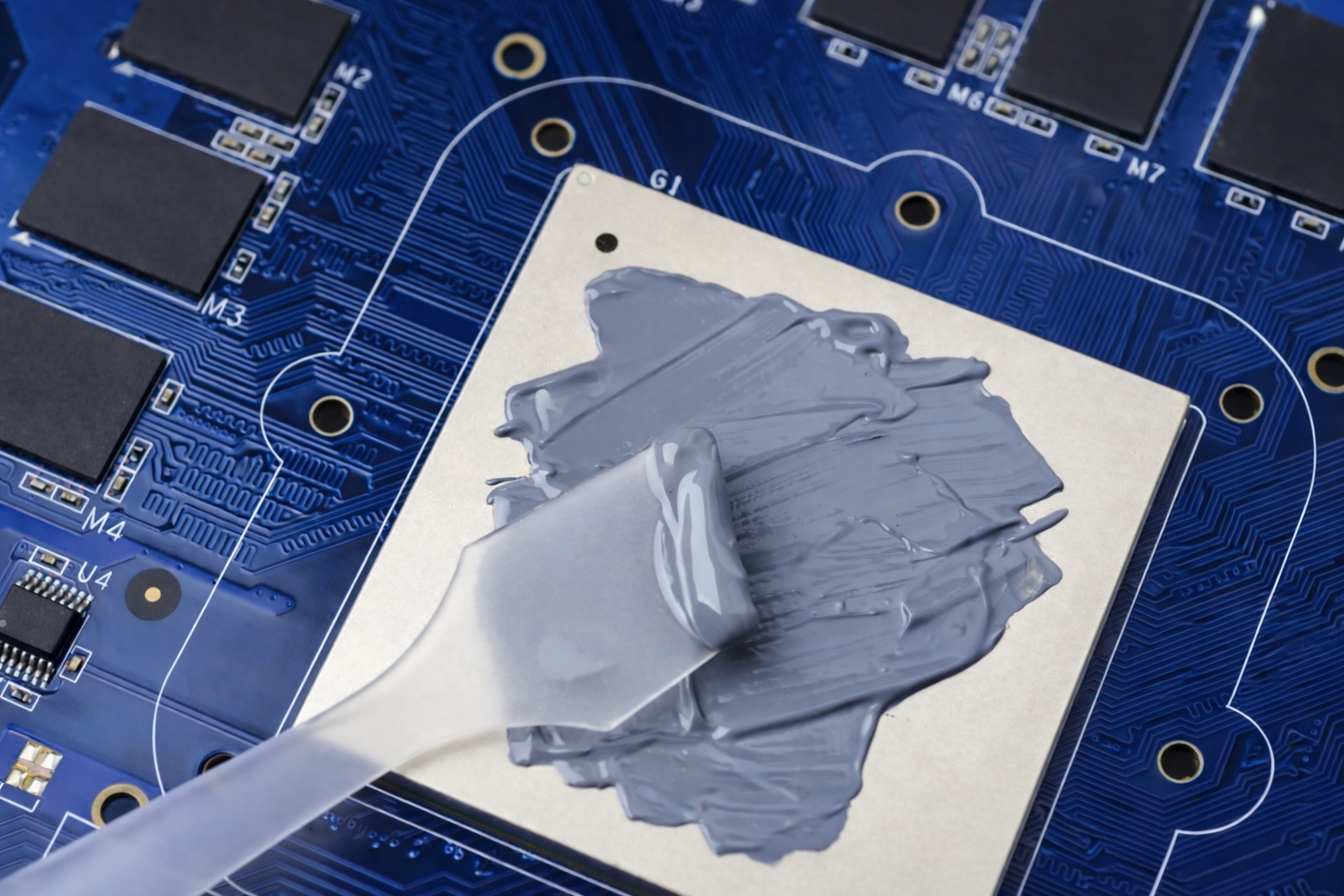
PCB Bonding, Staking and Strain Relief
Fix heavy parts, reinforce connectors and relieve cable strain while preserving clearances, inspectability and service access.
 High-volume placement
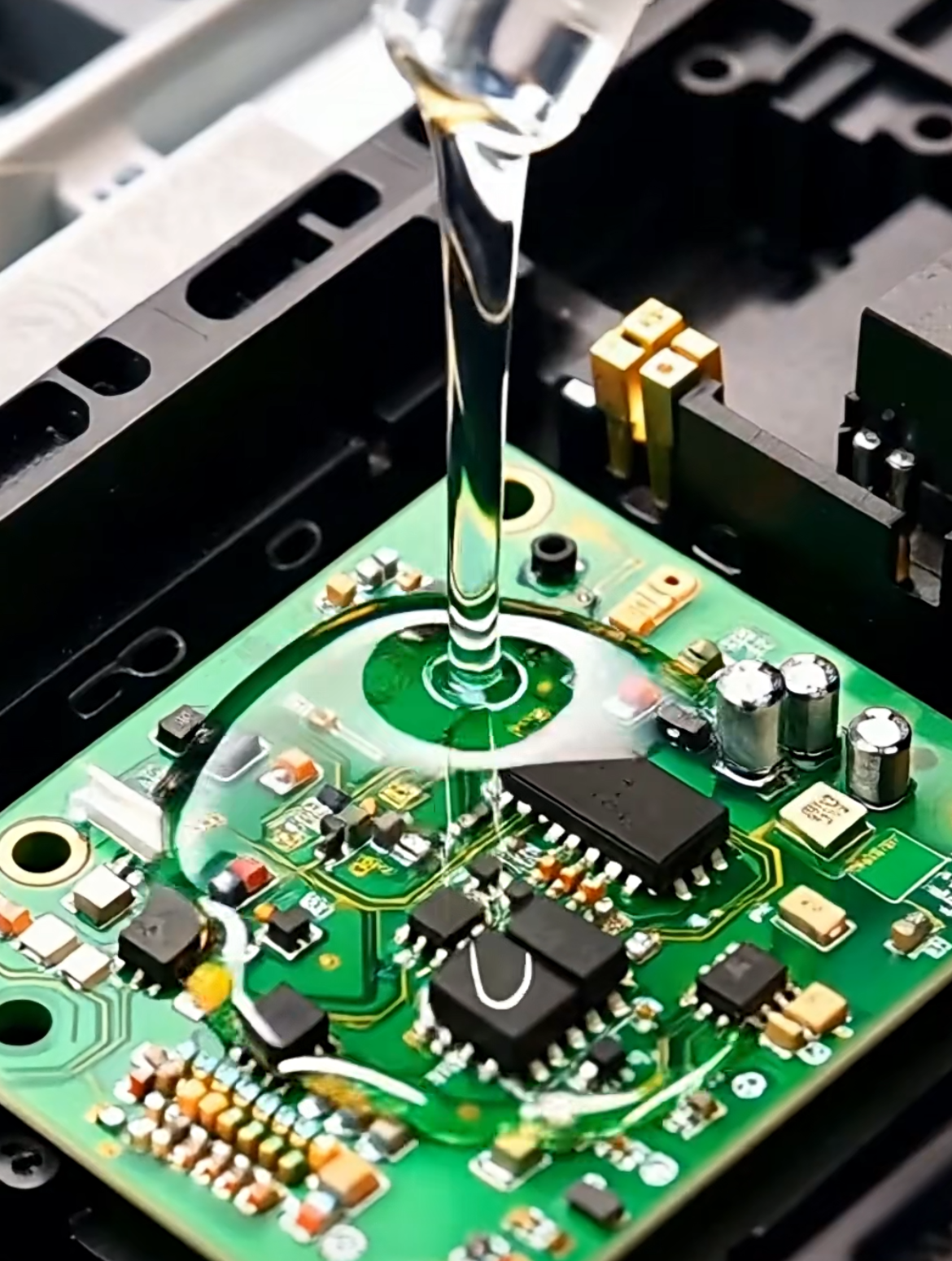
SMT and SMD Adhesives
Hold components during double-sided processing or wave soldering. Dot shape, green strength, snap cure, color and fluorescence support line control.
 Semiconductor package
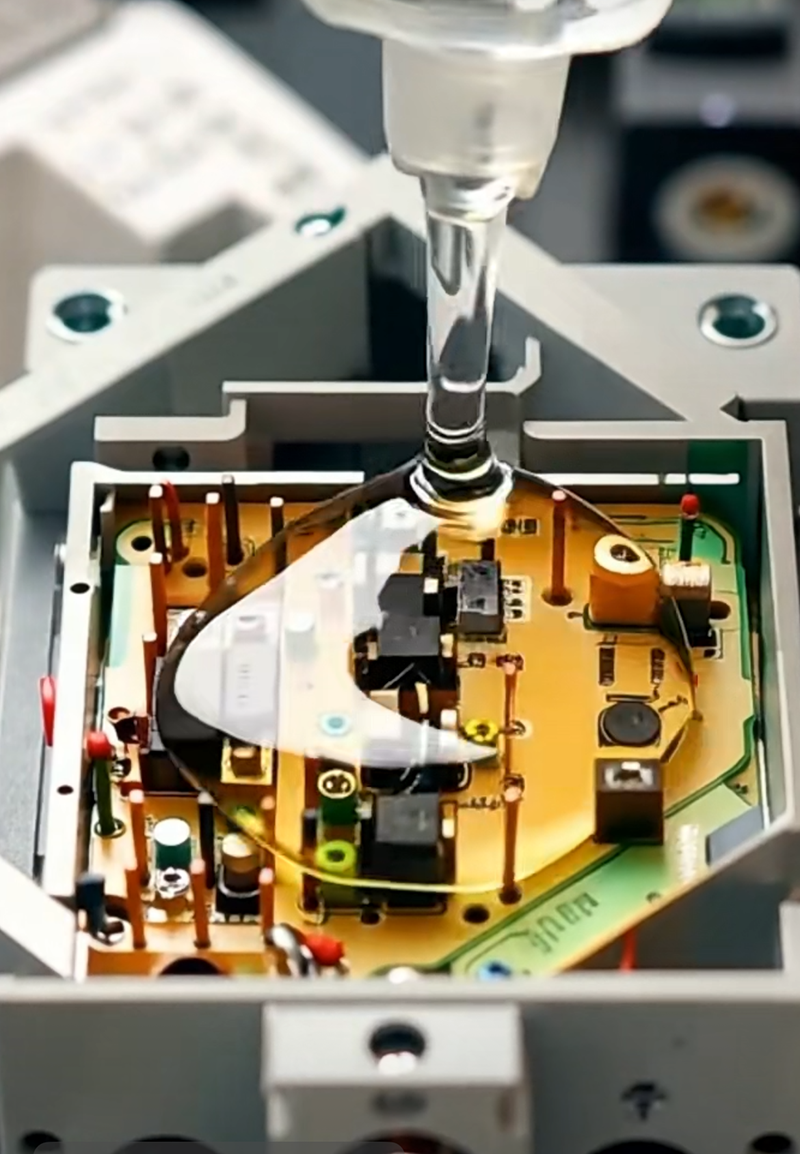
Die Attach, Underfill and Edge Bond
Control bond-line uniformity, voids, CTE mismatch, fillet shape, ionic cleanliness and cure stress around fragile packages.
 Protection
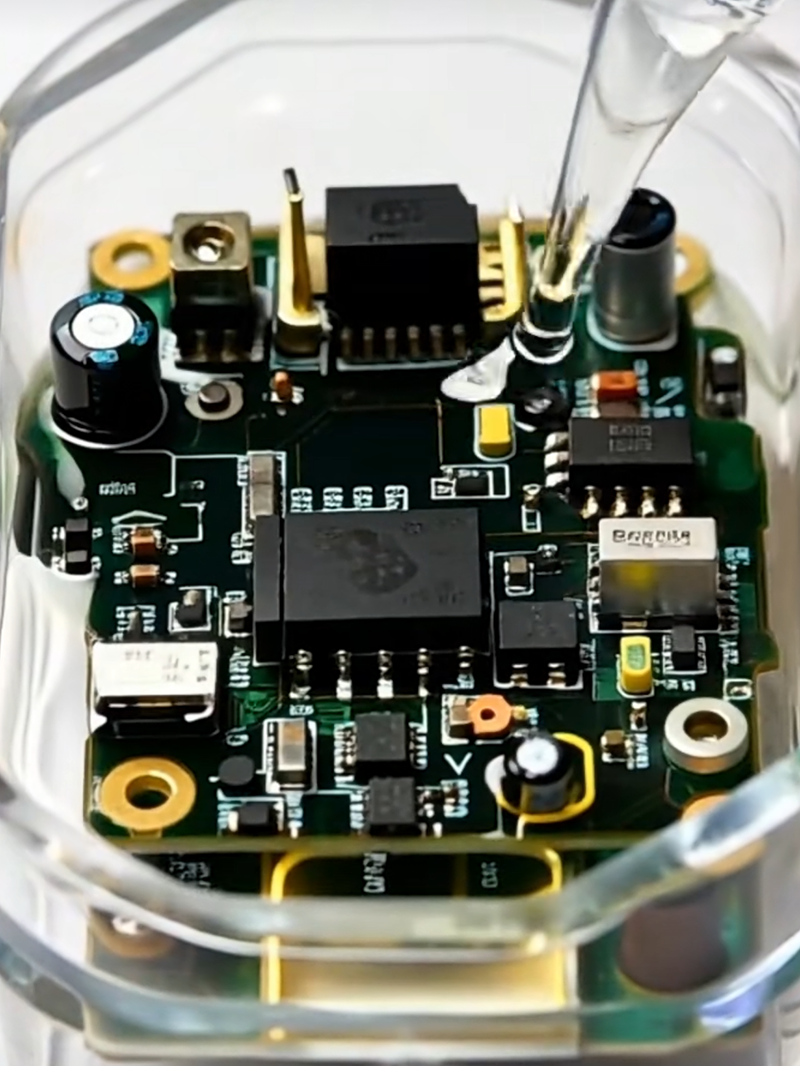
Glob Top, Dam-and-Fill and Encapsulation
Protect wire bonds, bare die and sensitive areas. Flow, filler settling, cure shrinkage and coverage are as important as the cured hardness.
 Precision modules
Display, Camera and Sensor Bonding
Manage optical clarity, haze, yellowing, alignment, low outgassing, moisture sealing and stress around glass and delicate components.
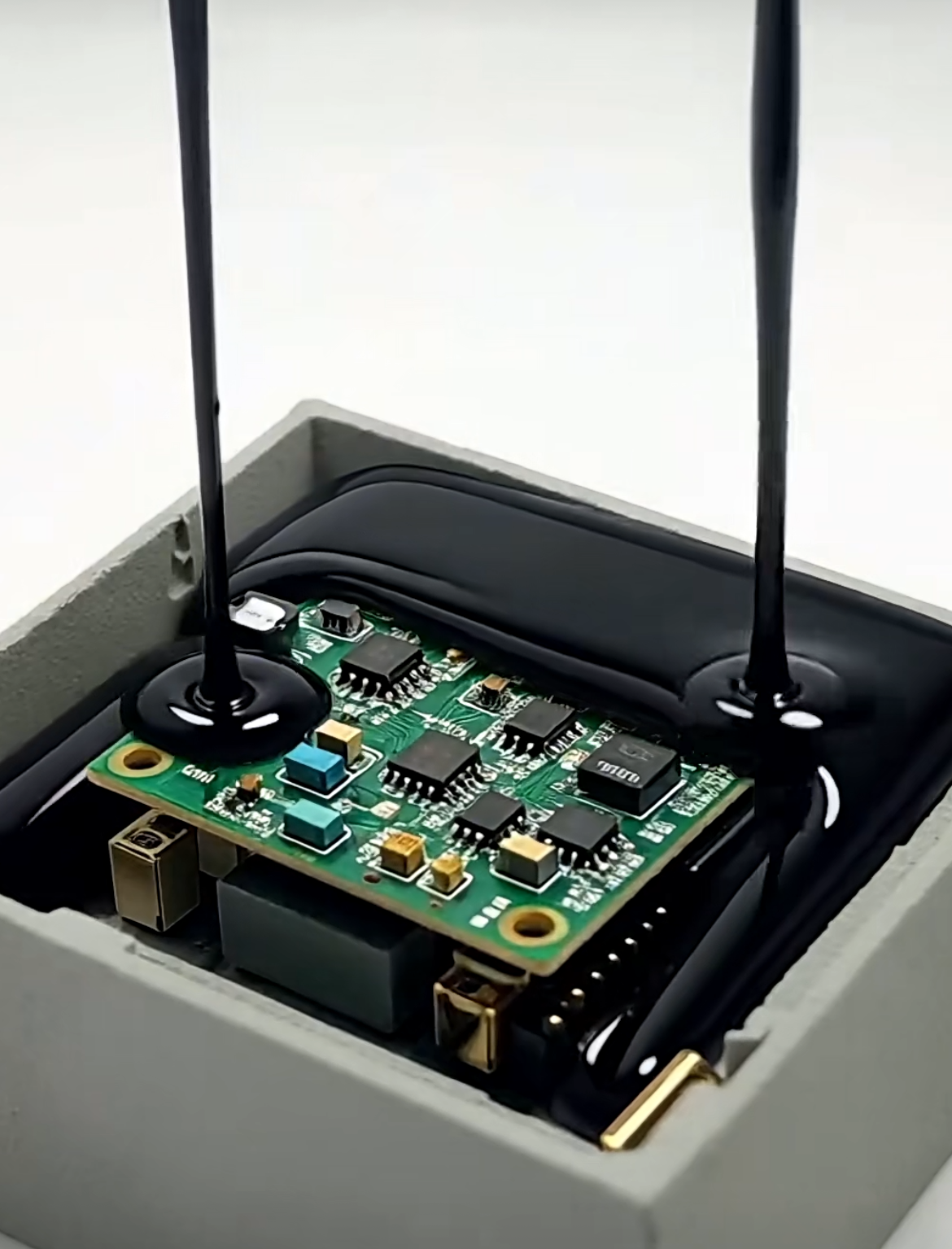 Thermal path
Heat Sink and Power-Device Bonding
Join heat sources to spreaders or housings while controlling bond-line thickness, electrical isolation, flatness and thermal cycling stress.
Production window
Electronic Adhesive Cure Methods
A compatible chemistry can still fail the manufacturing plan if cure access, temperature, work life or line takt is wrong. Select the cure route with both the joint and process in view.
One-Part Heat Cure
Premixed systems simplify ratio control and can provide fast, repeatable cure. Confirm storage, thawing, warm-up, oven uniformity and the thermal limit of nearby parts.
Best fit: automated lines with controlled thermal exposure.Ambient or Heat-Accelerated Cure
Two-part systems cure through their volume and work in shadowed joints. Metering accuracy, mix quality, static mixer residence time, pot life and exotherm require control.
Best fit: thick sections and assemblies without light access.UV and Visible-Light Cure
Light cure can fixture in seconds and enable inspection before cure. Wavelength, intensity, distance, exposure, pigment, depth and oxygen inhibition affect the result.
Best fit: high-throughput joints with verified light access.Understand UV-curable materials →Moisture Cure
Silicone, MS polymer and PUR systems can cure from atmospheric moisture. Skin time is not full cure: section thickness, humidity and joint exposure determine through-cure.
Best fit: flexible sealing and accessible bond lines.Dual Cure for Shadow Zones
A rapid light fixture can be combined with heat, moisture or chemical secondary cure. Verify that hidden material reaches its intended conversion and final properties.
Best fit: complex 3D assemblies needing immediate handling.Read the full datasheet
Electronic Adhesive Specifications That Matter
A single strength, viscosity or conductivity value cannot rank electronic adhesives. Test method, sample conditioning, cure, thickness and temperature determine what a number means.
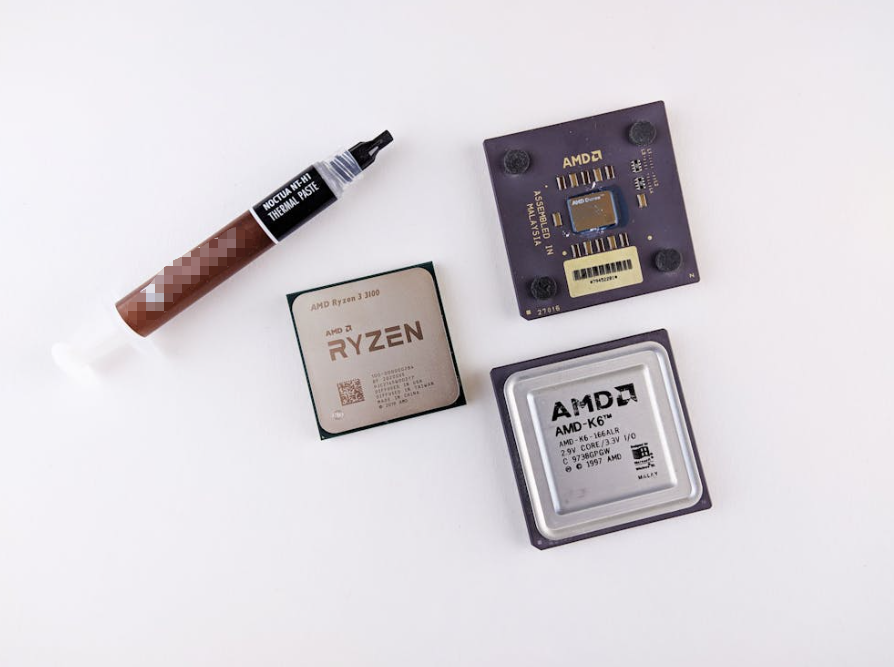 Compare data only when methods and test conditions are relevant to the real joint.
Viscosity and Thixotropy
Viscosity describes resistance to flow under stated conditions; thixotropy helps a bead or dot hold shape after dispensing. Temperature, shear rate and filler settling can change both process behavior and measured values.
Work Life, Open Time and Fixture
These terms answer different questions: how long mixed material remains usable, how long an applied bead can bond, and when the assembly can be handled. Define the test at the actual mass and temperature.
Strength and Failure Mode
Lap shear, peel and tensile data use different geometries. Record whether failure is adhesive, cohesive or within the substrate, and repeat on the production surface after environmental aging.
Modulus and Elongation
High modulus can stabilize alignment but transfer CTE strain into solder joints, glass or silicon. Lower modulus and higher elongation can relieve stress but may allow movement under load.
Tg, CTE and Cure Shrinkage
Glass transition changes material behavior, CTE mismatch drives cyclic stress, and cure shrinkage can shift optics or warp delicate parts. Consider the complete temperature range, not only the maximum.
Electrical Properties
Check dielectric strength, volume resistivity, insulation resistance, dissipation behavior and edge clearance. For conductive systems, evaluate bulk and contact resistance after aging.
Thermal Properties
Thermal conductivity describes the material body. Joint performance also depends on bond-line thickness, voids, wetting, contact area and interfaces. A thin controlled line can outperform a thicker higher-k layer.
Cleanliness and Outgassing
Ionic contamination can support corrosion; volatile loss can affect sensors, optics, relays and vacuum systems. Confirm test method, sample preparation, cure state and application-specific limits.
Engineering workflow
How to Select the Right Electronic Adhesive
Use this sequence to reduce a broad material list to candidates that can be dispensed, cured and qualified in the real assembly.
Define the Function
Separate structural bonding, fixture, sealing, stress relief, insulation, conduction and heat transfer. Rank primary and secondary requirements.
Map the Substrates
List base material, plating, coating, solder mask, release agent, surface energy and allowable cleaning or treatment.
Measure Geometry
Document contact area, gap, flatness, bond-line thickness, edge clearance, keep-outs and the method used to control volume.
Set Loads and Environment
Define static, peel, impact and vibration loads plus storage, operating, cycling, humidity, fluids and UV exposure.
Set Electrical, Thermal and Optical Targets
State isolation or conduction, heat flow, maximum temperature, clarity, refractive needs and acceptable yellowing.
Fit the Production Line
Confirm mix ratio, dispense method, available heat or light, cycle time, handling strength, inspection and rework plan.
Validate the Joint
Build representative assemblies, measure a baseline, age under combined stresses and confirm process capability before release.
Interface preparation
Substrate Compatibility and Surface Preparation
Adhesion is an interface property. The same adhesive may bond strongly to bare aluminum and poorly to a lubricated, oxidized, plated or low-energy surface.
Metals and Plated Surfaces
Identify alloy, oxide, plating, conversion coating and machining residue. Cleaning, abrasion or primer may improve consistency, but the approved process must not damage thin plating or electronics.
FR-4, Solder Mask and Flex Circuits
Test the exact solder mask, cure state and flex construction. Peel stress, board contamination, ionic cleanliness and bending around the cured fillet can dominate reliability.
Silicon, Ceramic and Glass
Control particle contamination, moisture and handling. Transparent or brittle parts may require low shrinkage, low stress, optical clarity and carefully designed edge geometry.
Engineering Plastics
Confirm resin grade, reinforcement, mold release, paint and surface energy. Plasma, corona, flame treatment or primer may help low-energy plastics, but treatment stability must be validated.
Manufacturing integration
Dispensing, Jetting, Printing and Process Control
The application method creates the bond line. Stable material properties are not enough if the package, filler, mixer, nozzle and motion profile cannot produce repeatable deposits.
Dispense and Jet
Match particle size, viscosity, thixotropy and filler settling to valve type, needle diameter, pressure and required dot or bead geometry.
Mix and Degas
For two-part systems, control ratio, mixer selection, purge, residence time, temperature and entrained air. Audit first and last material from the work window.
Print and Stencil
Screen or stencil application needs stable rheology, release, deposit thickness and open time. Check slump before cure and coverage after assembly compression.
Inspect and Trace
Use color, fluorescence, weight, vision or dimensional checks where appropriate. Record lot, thaw history, dispense settings and cure exposure for root-cause analysis.
 Packaging, flow, deposit geometry and cure must be designed as one process.
Application environments
Electronic Adhesives by Industry
Industry labels do not select a material by themselves. They help identify typical loads, service environments, manufacturing rates and qualification expectations.
 01 / SEMICONDUCTOR
Semiconductor and PCB Assembly
Underfill, die attach, component staking, glob top and FPC reinforcement demand precise flow, cure, cleanliness and dimensional control.
View semiconductor assembly materials → 02 / CONSUMER
Consumer Electronics and Wearables
Thin designs, mixed materials, drop impact, sweat, waterproofing, appearance and rework combine with high-throughput production.
Explore consumer electronics materials →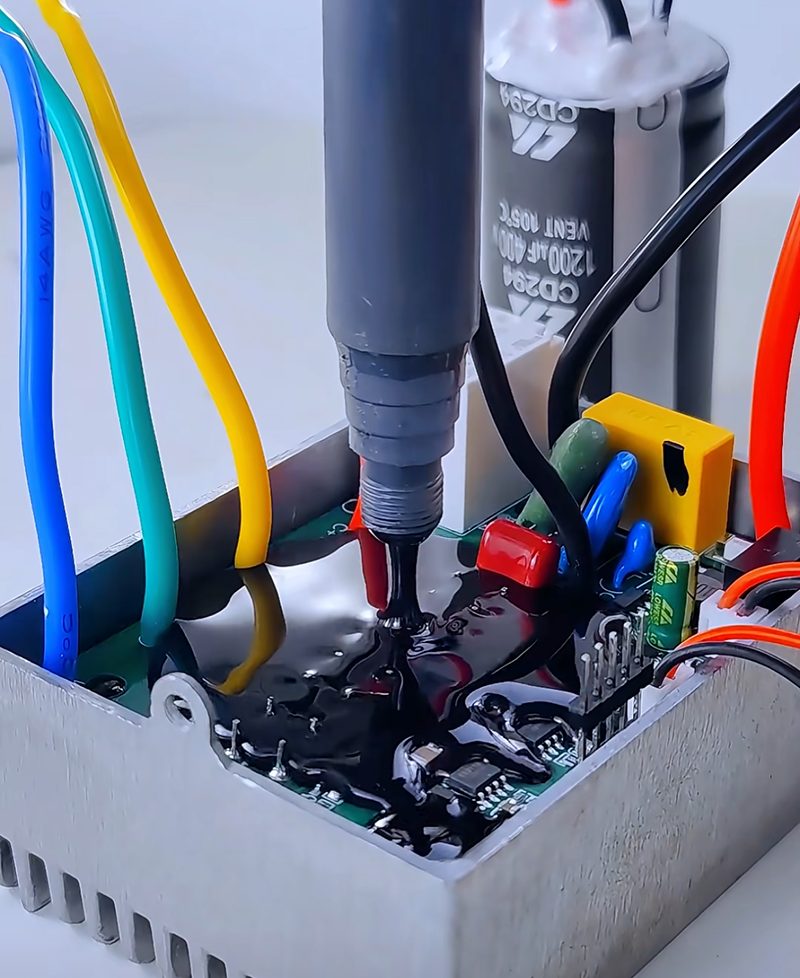 03 / AUTOMOTIVE
Automotive Electronics
Thermal cycling, vibration, humidity, fluids and extended service drive substrate preparation, modulus, sealing and qualification decisions.
See automotive electronics materials →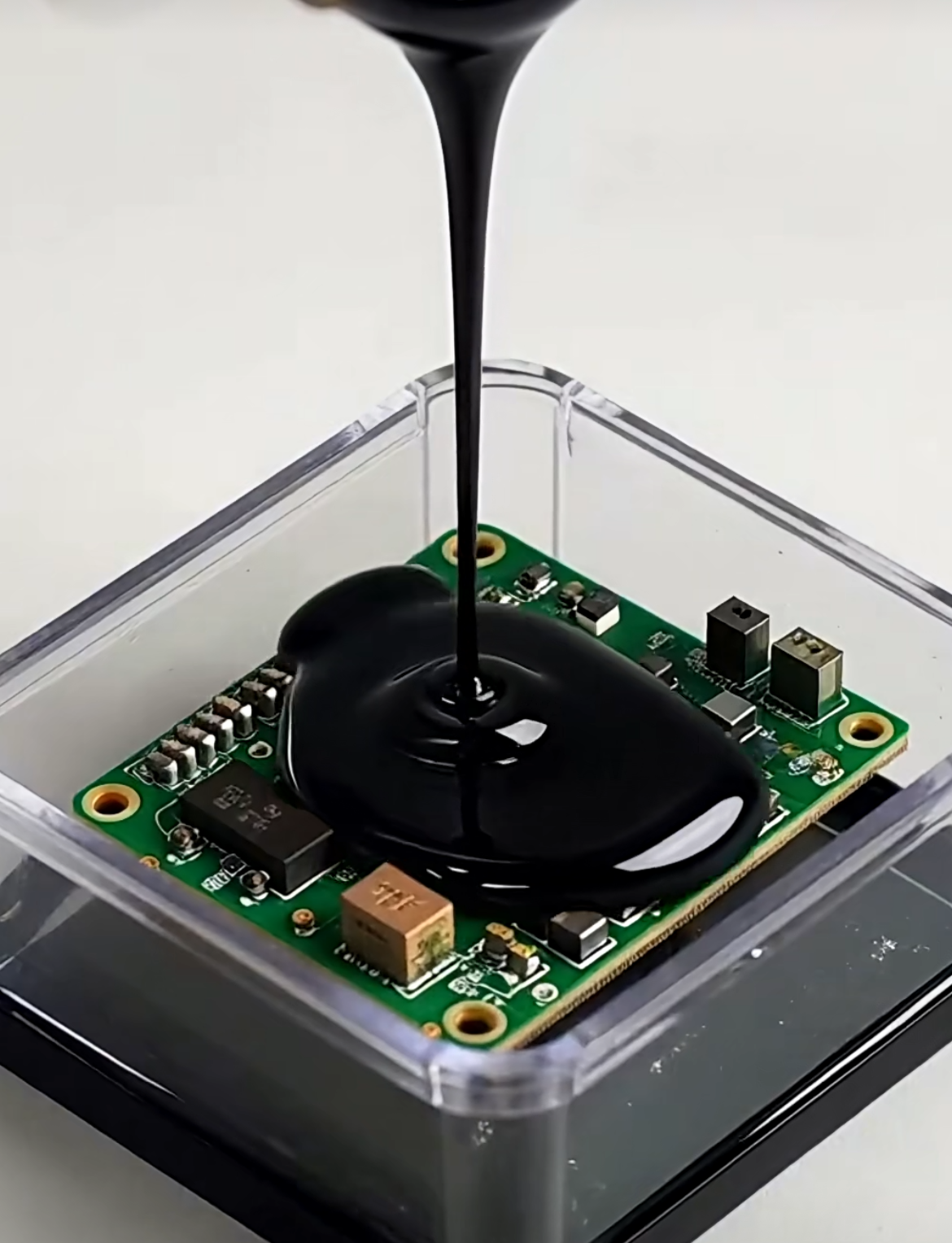 04 / POWER
Power Electronics
Large temperature gradients, high voltage, heavy components and broad interfaces require electrical clearance, bond-line and stress control.
Review power electronics solutions → 05 / EV & STORAGE
EV Battery and Energy Storage
Battery and control assemblies combine large bond areas, safety requirements, thermal paths, vibration and scalable dispensing.
View EV and energy-storage materials → 06 / CONNECTIVITY
Telecom and 5G Equipment
Outdoor enclosures, radios and antennas may combine weather sealing, RF-sensitive cleanliness, thermal cycling and field service.
Explore telecom and 5G materials → 07 / LIGHTING
LED and Industrial Electronics
Optical stability, heat, outdoor exposure, chemical contact and long service life must be balanced with repair and production needs.
See LED lighting materials → 08 / COMPUTE
Data Centers and AI Hardware
High power density, serviceability, vibration and accelerated technology cycles place unusual demands on thermal and structural joints.
Review data-center and AI materials →Qualification plan
How to Test and Qualify Electronic Adhesives
Qualification must use production-representative parts, bond-line geometry, cure equipment and process settings. Trend the joint through aging instead of checking only a final pass/fail result.

Incoming and Process Checks
Verify package, lot, storage, appearance, density or mix ratio, viscosity where relevant, dispense mass and bond-line dimensions.
Baseline Cure and Adhesion
Confirm surface condition, cure exposure, handling strength, failure mode and the target mechanical, electrical or thermal property.
Thermal Cycling
Cycle across realistic extremes and dwell times. Measure trend data to expose CTE-driven cracking, delamination or resistance change.
High-Temperature Humidity
Check moisture uptake, insulation, corrosion, swelling, hydrolysis, adhesion and dimensional stability under the intended bias condition.
Vibration and Mechanical Shock
Use the real mounting system and mass. Inspect component movement, fillet cracking, connector strain and loss of interface contact.
Chemical and Fluid Exposure
Test relevant coolants, oils, cleaners, flux residue, salt mist or body fluids with realistic temperature and mechanical constraint.
Electrical and Thermal Safety
Confirm dielectric withstand, insulation resistance, leakage, contact resistance or thermal impedance before and after aging.
Pilot Run and Process Capability
Run production-intent equipment, operators, takt time and inspection. Evaluate placement, cure, weight, voids and rework variation.
Root-cause thinking
Electronic Adhesive Failure Modes and Troubleshooting
A symptom rarely identifies one cause. Preserve failed parts, process records and uncured material so interface, cure, design and handling causes can be separated.
Interfacial Release
Possible drivers include contamination, low surface energy, condensed moisture, insufficient cure, oxidation or high peel stress. Compare the fracture surface and test production-cleaned substrates.
Bulk Material Fracture
Review modulus, toughness, cure conversion, bond-line thickness, sharp corners, impact and CTE mismatch. A stronger but more rigid grade may make the problem worse.
Bubbles and Incomplete Fill
Check mixing, degassing, dispense path, substrate temperature, trapped geometry, vacuum profile, material flow and cure ramp. Identify whether voids formed before or during cure.
Soft, Tacky or Weak Material
Audit mix ratio, expired mixer, cure temperature at the bond, lamp spectrum/intensity, shadow areas, moisture access and chemical inhibition.
Bleed, Bloom or Corrosion
Review formulation, cure state, cleaning compatibility, ionic residue, volatile condensation and material migration. Sensitive optics and electrical contacts may need stricter limits.
Inconsistent Dot or Bond Line
Trend material temperature, pressure, valve timing, needle condition, filler settling, mixer residence, part gap and compression. Inspect volume at the point of use.
Design inputs
Eight Design Decisions That Control an Electronic Adhesive Joint
Material selection and joint design are inseparable. These decisions determine whether the adhesive sees mostly shear, peel, compression, thermal strain or environmental attack in service.
Thickness and Volume Control
A very thin line may reduce thermal resistance and cure quickly, yet starve a rough or uneven interface. A thick line can fill tolerance but increases material volume, shrinkage, exotherm and dimensional variation. Use spacers, stops, glass beads, controlled dispense mass or fixture geometry where thickness is critical. Record delivered volume and final compressed thickness as separate process variables.
Shear, Peel and Cleavage
Adhesives generally use area efficiently in shear but are more sensitive to peel and cleavage concentrated at an edge. Change overlap length, add a fillet, move the load toward the bond plane or add mechanical support where possible. Datasheet lap-shear strength cannot predict a small corner bond or a cable that repeatedly pries at one end.
Gap, Flatness and Part Variation
Minimum, nominal and maximum assembled gaps may require different rheology and compression behavior. Warpage can create a thin center and thick edges; plated surfaces or molded housings add local variation. Map the actual interface and test worst-case parts. Do not assume the drawing gap equals the cured bond line after clamp pressure and shrinkage.
CTE Mismatch and Compliance
Silicon, ceramic, copper, aluminum, glass, FR-4 and plastic expand at different rates. The adhesive transfers part of that mismatch into the assembly during every temperature excursion. Joint length, modulus, thickness and cure temperature determine strain. A compliant material may preserve fragile components even when its room-temperature strength is lower.
Fillets, Keep-Outs and Clearance
A fillet can reduce edge stress, but excess flow may cover test pads, optical surfaces, connectors or high-voltage creepage paths. Define acceptable fillet width, height and symmetry. Use dams, masks or programmed dispense boundaries when movement during cure is possible, and inspect the edge after environmental cycling for cracks, bleed or migration.
Fixture and Clamp Strategy
Pressure controls wetting and bond-line thickness but can squeeze out too much material, move a component or bend a PCB. Define how load is applied, tolerated and released. Springs, hard stops, vacuum fixtures and temporary clamps behave differently as the adhesive gels and shrinks. Qualify with production hardware and realistic torque variation.
Service and Removal Access
Permanent bonding may be appropriate for sealed modules but costly for field-replaceable boards. Determine whether heat, solvent, cutting or mechanical separation is permitted and what residue is acceptable. Protect adjacent solder joints, coatings and plastics during removal. Reworkability should be treated as a design requirement, not discovered after qualification.
Electrical and Thermal Boundaries
An adhesive near high voltage must preserve insulation after cutting, cure, humidity and contamination. A thermal adhesive must maintain contact without creating an unintended electrical path. Review dielectric strength, volume resistivity, edge distance, filler type, bond-line control and aging together. Never infer electrical insulation only from the appearance of a filled material.
Avoid one-number selection
Mechanical, Thermal and Electrical Tradeoffs in Electronic Adhesives
Performance targets interact. The engineering objective is not to maximize every property, but to find a stable operating window for the complete assembly.
Mechanical Balance
Increasing crosslink density or rigid filler can raise modulus and dimensional stability, but may reduce elongation and increase stress at glass, ceramic, silicon or solder joints. Toughening can improve impact resistance while changing viscosity, Tg and cure response.
- Use strength data with the actual substrate and failure mode.
- Compare properties across the full operating temperature range.
- Include peel, vibration and thermal-cycle loads—not only static shear.
- Check whether cure at elevated temperature locks in residual stress on cooling.
Thermal Balance
More conductive filler can improve bulk thermal conductivity while increasing viscosity, abrasion, density and stiffness. Large particles may restrict thin bond lines or fine needles; filler settling can create lot or dispense variation. Finished thermal resistance includes interfaces and geometry.
- Define heat source, contact area, power and cooling boundary.
- Measure bond-line thickness and voids in the assembled joint.
- Trend thermal performance after cycling and power aging.
- Review how bond-line thickness affects thermal performance when the interface controls heat flow.
Electrical and Optical Balance
Conductive filler can support electrical interconnect but creates spacing and migration concerns. Insulating systems must maintain dielectric behavior after moisture and contamination. Optical adhesives add requirements for transmission, haze, refractive behavior, bubbles and yellowing.
- Separate electrical conduction, thermal conduction and insulation targets.
- Evaluate contact resistance and galvanic compatibility for conductive grades.
- Test optical properties at realistic thickness after UV, heat and humidity aging.
- Confirm low outgassing where condensable volatiles could reach lenses or sensors.
Design examples
Electronic Adhesive Selection Scenarios
These examples show why similar headline requirements can lead to different adhesive families, formats and validation plans. They are screening frameworks, not automatic product recommendations.
Large Connector on a PCB
Interface: plated metal or plastic connector body to solder mask, with cable or mating loads transferred into the board.
Likely direction: a thixotropic epoxy, acrylic or flexible adhesive may stake the body and relieve solder-joint strain. The bead must remain clear of contacts, inspection points and creepage zones.
Critical questions: Is the load shear or peel? Will the connector be serviced? Can the board tolerate heat cure? How clean is the solder mask and is flux residue present?
Validation focus: connector insertion/removal load, vibration, board flex, thermal cycling, humidity, fillet inspection and electrical clearance.
Camera Module or Image Sensor
Interface: glass, plastic, metal and PCB elements with tight optical alignment and small bond volumes.
Likely direction: low-shrink UV/dual-cure acrylic, epoxy or selected silicone, depending on stiffness, light access and stress. Black, opaque or low-outgassing variants may be required around the optical path.
Critical questions: What alignment shift is permitted during cure? Are shadowed zones present? Can volatiles condense on the lens? Does the joint need moisture sealing?
Validation focus: position before/after cure, optical contamination, haze or yellowing, thermal shock, humidity, drop and long-term focus stability.
Power Module to Heat Spreader
Interface: a broad metal or ceramic baseplate to an aluminum or copper heat spreader, potentially with flatness and high-voltage constraints.
Likely direction: a thermally conductive, electrically insulating epoxy or silicone adhesive when permanent bonding is required. The formulation must wet the surfaces and reach a controlled thin bond line without unacceptable stress.
Critical questions: What is the real gap and clamping method? Is electrical isolation required? How will the assembly be repaired? What are the power-cycle temperature gradients?
Validation focus: thermal resistance, void coverage, bond-line mapping, dielectric withstand, power cycling, mechanical shock and delamination inspection.
Wearable Enclosure Seal
Interface: thin plastic, painted metal or glass housing with narrow flanges, cosmetic edges and limited clamp pressure.
Likely direction: flexible silicone, polyurethane/PUR, acrylic or hybrid sealant selected around line speed, adhesion and rework. A preformed adhesive film may offer cleaner geometry where tolerance allows.
Critical questions: Is the seal expected to provide structural retention? What cleaning chemicals, sweat and skin-contact requirements apply? Is the enclosure opened for repair?
Validation focus: leak test, drop, torsion, sweat/chemical exposure, humidity, aging, cosmetic residue and opening/reassembly behavior.
FPC Reinforcement at a Connector
Interface: polyimide flex circuit, stiffener, connector or rigid PCB under repeated bending and handling.
Likely direction: a flexible epoxy, acrylic, urethane or light-curable reinforcement adhesive that bonds the exact flex construction without wicking into contacts. The modulus transition at the fillet edge must be controlled.
Critical questions: Where does the bend radius begin? Can the adhesive contact exposed copper? Is rapid fixture necessary? How much cured thickness is acceptable?
Validation focus: bend cycling, peel, connector insertion, humidity, heat, edge cracking, wicking and electrical inspection.
Outdoor Sensor or Control Module
Interface: PCB, sensor, cable entry and mixed-material enclosure exposed to condensation, temperature swing, vibration and contaminants.
Likely direction: flexible silicone or hybrid sealant for joints and strain relief, with epoxy or urethane where structural fixing is needed. Potting may be considered for bulk environmental protection.
Critical questions: Must the sensor breathe? What fluids and pressure changes occur? Can cure by-products affect sensing elements? How will trapped moisture escape?
Validation focus: leak, condensation, salt or chemical exposure, thermal cycling, vibration, sensor drift, insulation resistance and field-service access.
Material logistics
Storage, Handling and Production Controls for Electronic Adhesives
Even a qualified formulation can produce weak or inconsistent joints if storage, conditioning, mixing or cure records are not controlled from incoming inspection to final assembly.
Receiving and Traceability
Confirm product designation, lot, manufacture or expiration date, package condition and required certificates. Link each production batch to material lot, equipment, operator, dispense program and cure record. Preserve representative retain samples when the application risk justifies them.
Cold Storage and Thawing
Frozen or refrigerated one-part materials need controlled transport, storage and thawing. Thaw the sealed package to prevent condensation, observe the approved time and orientation, and do not repeatedly refreeze unless specifically allowed. Track cumulative out-of-storage exposure.
Two-Part Ratio and Mixing
Ratio errors can leave excess resin or hardener even when the surface appears cured. Verify meter calibration, cartridge balance, purge quantity, mixer type and back pressure. Inspect color uniformity where applicable and test material from the beginning and end of a dispense run.
Filler Settling and Homogeneity
Thermal or electrically functional fillers may settle during storage or separate under heat and pressure. Follow the approved conditioning or mixing instruction without introducing air. Check whether vertical cartridge orientation, long hoses or machine idle time change delivered composition.
Cure Verification
Oven setpoint is not bond-line temperature, and lamp output is not dose at the adhesive. Use temperature profiling, radiometry or suitable process checks. Define the time origin, ramp, dwell and post-cure. Confirm final conversion with an application-relevant property rather than surface touch alone.
Change Control
Changes in substrate supplier, solder mask, cleaner, primer, dispense valve, mixer, lamp, oven loading, package size or adhesive formulation may affect the joint. Define which changes require engineering review, limited confirmation or full requalification before they occur.
Documentation boundary
Compliance, Cleanliness and Safety Requirements
State the actual requirement, test method, construction and region. Generic requests such as “flame retardant,” “halogen free” or “low outgassing” are too broad for reliable selection.
Restricted Substances
Identify the applicable RoHS, REACH, halogen, PFAS, heavy-metal, customer-specific or regional restrictions. Confirm whether the declaration applies to the supplied mixture, cured material or complete article and how future substance-list changes will be managed.
Flammability
Specify the required standard, thickness, color and construction. A rating on one cured specimen does not automatically transfer to a different bond-line thickness or composite assembly. Review whether the adhesive is structural, a thin coating or a bulk fill in the test configuration.
Ionic Cleanliness
Electronics exposed to humidity and voltage may need tight ionic limits. Consider raw material, cure by-products, cleaning residue, handling and interaction with flux. Evaluate insulation resistance or corrosion in a representative geometry instead of relying on an unrelated cleanliness number.
Low Outgassing
Vacuum, optical, relay and sensor assemblies may limit total mass loss or condensable volatiles. Results depend on cure state, sample thickness, conditioning and method. Define where condensed species could land and what functional change—fogging, signal drift or contact contamination—is unacceptable.
Worker and Process Safety
Review safety data, ventilation, skin and eye protection, heat or UV exposure, mixing and spill handling. Automation can reduce contact but introduces pressure, purge and maintenance risks. Select a process that can be operated consistently under the facility’s controls.
End-of-Life and Service
Document approved removal, cleaning, recycling or disposal routes. A permanent cured adhesive can prevent component separation; a flexible seal may contaminate adjacent surfaces during repair. Include residue inspection and replacement-material compatibility in the service plan.
Evidence behind the number
How to Read an Electronic Adhesive Technical Data Sheet
A data sheet supports screening; it is not a guarantee for every joint. Compare the method, specimen, cure and conditioning behind each value before ranking materials.
Method and Geometry
A property name may hide important differences. Lap shear varies with overlap, substrate thickness, pull rate and adhesive thickness. Thermal conductivity varies by method and sample preparation. Dielectric strength depends strongly on thickness and electrode geometry. Request the method when it is absent, and avoid comparing values produced by incompatible procedures as if they were measured on the same scale.
Substrate and Surface
Results on etched aluminum, glass or a laboratory coupon may not represent solder mask, plated copper, molded plastic or a painted housing. Note the exact alloy, grade, surface roughness, cleaning and primer. If the data sheet reports several substrates, look for the failure mode as well as the strength; substrate failure can hide the adhesive’s interface limit.
Cure Schedule and Conversion
Properties measured after a long laboratory post-cure may exceed those available from a short production cycle. Record mix temperature, ramp, dwell, part temperature, light dose and conditioning time. For room-temperature systems, determine when handling, testing and full service are allowed. If your process cannot reproduce the published cure, qualify the achievable state instead.
Typical Value vs Specification
A typical value describes representative data and may not be a controlled acceptance limit. A specification defines an agreed range or minimum with a method. Ask which incoming properties are batch-tested, what certificate data is available and how variation is managed. Design margin should account for material, process, substrate and measurement variation—not only the published average.
Continuous, Peak and Excursion Ratings
“Maximum temperature” can refer to a short excursion, a test condition or an estimated service boundary. Define duration, atmosphere, mechanical load and required retained property. A material may survive a high peak without retaining adhesion, insulation, color or flexibility for thousands of hours. Use aged functional data across the expected duty cycle.
Dry, Humid and Chemical States
Initial data are often measured after cure in a controlled laboratory environment. Electronics may operate after moisture uptake, chemical exposure, sterilization, salt contamination or repeated cleaning. Compare before-and-after values and observe whether the change is reversible after drying. Include electrical bias where moisture and voltage can interact.
Viscosity Measurement Conditions
A single viscosity value is not enough for thixotropic or filled materials. Record instrument, spindle or geometry, shear rate, temperature and preconditioning. The apparent viscosity in a slow data-sheet test may differ from behavior through a high-shear jet valve. Evaluate start-up, steady operation, idle recovery, stringing and filler separation on the production equipment.
Property Retention and Failure Mode
Percent retention can be misleading when the initial value or failure mode changes. Review absolute values, distribution and fracture location at each interval. Thermal, humidity and mechanical exposures may interact more severely than separate tests. Define what constitutes functional failure in the device and correlate coupon screening with representative assemblies.
Commercial engineering
Electronic Adhesive Supply, Scale-Up and Total Cost
Price per kilogram is only one cost. Yield, cycle time, storage loss, dispensing maintenance, inspection, rework and field reliability often have greater impact.
Package and Material Utilization
Small syringes or cartridges can simplify prototypes and reduce exposure, while pails or larger feed systems may reduce packaging cost at volume. The best format must fit turnover, storage, mixing and equipment cleaning. Include material left in mixers, hoses, purge shots and expired open packages when calculating yield.
- Match package size to realistic consumption before expiration.
- Define frozen, refrigerated or ambient logistics.
- Confirm cartridge ratio, outlet geometry and available dispensing hardware.
- Plan safe purge, changeover and disposal procedures.
Cycle Time and Process Capability
A faster nominal cure does not reduce total takt if the assembly waits for handling strength, inspection or cooling. A stable, slightly slower process may outperform a narrow high-speed window with frequent defects. Model dispense time, fixture occupancy, cure equipment capacity, WIP, maintenance and first-pass yield together.
- Measure actual part temperature or light dose at production rate.
- Include mixer changes, nozzle cleaning and line stops.
- Define acceptable deposit and cure variation statistically.
- Verify first-piece and restart behavior after idle periods.
Qualification and Change Management
Early engineering samples should lead toward the intended production formulation and package. Record differences so prototype success is not attributed to a process that cannot scale. Establish communication for raw-material, formulation, site, packaging or specification changes and define the evidence required before acceptance.
- Agree on prototype, pilot and production milestones.
- Preserve approved reference parts and process settings.
- Plan second-source or continuity needs without assuming materials are drop-in equivalents.
- Include warranty, service and rework consequences in total cost.
From candidate to production
Custom Electronic Adhesive Formulation and Supply Formats
A custom material is useful when standard products miss a critical combination of process, reliability, regulatory or packaging requirements. The objective is a balanced formulation—not the maximum of every property.
Haktak can start from the application boundary conditions, screen suitable chemistry, adjust targeted properties, prepare samples and support process trials. Formulation changes should be evaluated for their consequences: raising filler loading may improve conductivity but also increase viscosity, density, abrasion, modulus and dispensing pressure.
Rheology and Placement
Adjust flow, slump, thixotropy, gap filling and filler settling for the required bead, dot, film or cavity.
Cure Window
Balance work life, fixture, heat or light exposure, deep-section cure and final conversion around the production takt.
Functional Targets
Develop thermal, electrical, optical, mechanical or environmental behavior without overlooking interfaces and processability.
Packaging and Scale
Plan syringe, cartridge, dual cartridge, pail, film or roll format with storage, thawing, traceability and annual demand.


RFQ preparation
Information Haktak Needs to Recommend an Electronic Adhesive
A complete application brief shortens screening and produces more useful prototypes. Estimated values are acceptable early when they are clearly identified.
- Interface drawing and substrate stack
- Minimum, nominal and maximum gap
- Bond area, bead or dot geometry
- Mechanical load and movement
- Storage and operating temperatures
- Thermal, electrical or optical target
- Cure equipment and maximum cycle time
- Dispensing method and package size
- Humidity, fluids, vibration and service life
- Compliance, cleanliness and rework needs
- Prototype quantity and validation plan
- Annual demand and production location
Application support
Why Work With Haktak for Electronic Adhesives?
Material supply is one part of a reliable bond. Haktak connects selection with formulation, samples, processing and qualification planning.
Application-Led Screening
Start with the interface, loads, environment and manufacturing boundary instead of choosing by chemistry alone.
Custom Property Balance
Target the required rheology, cure, modulus, conductivity, insulation, clarity or compliance as a connected system.
Prototype Materials
Use representative samples to test placement, cure, handling and performance before a full production commitment.
Manufacturing Support
Consider package, mixing, dispensing, converting, inspection and storage while the material is being selected.
Evidence-Based Release
Build an application-specific plan for baseline, aging, failure inspection and pilot-line capability.
Common engineering questions
Electronic Adhesives FAQ
Short answers for early screening. Final selection still requires testing on the intended parts and process.
What are electronic adhesives?
Electronic adhesives are formulated materials used to bond, fix, reinforce or protect parts in electronic assemblies. Depending on the formulation, they may also seal against moisture, relieve stress, insulate electrically, conduct electricity, transfer heat or provide optical functions.
Which adhesive is best for PCB components?
There is no universal best PCB adhesive. Small staking joints may favor fast cure and good thixotropy; heavy components may require toughness and thermal-cycle durability; sensitive parts may need low modulus and low outgassing. Select with the exact solder mask, geometry, load, cure and service environment.
What is the difference between an electronic adhesive and a potting compound?
An adhesive is primarily designed to create a bond between surfaces. A potting compound fills a cavity or surrounds components for bulk protection, insulation or heat transfer. Some formulations can perform both functions, but flow, exotherm, cure shrinkage and section thickness are evaluated differently. See the thermally conductive potting compound guide for the adjacent category.
When should I choose epoxy instead of silicone?
Epoxy is often selected for high structural strength, chemical resistance, precise positioning or filled functional properties. Silicone is often selected for flexibility, thermal cycling, moisture sealing and low stress. Exact grades overlap, so compare modulus, adhesion, cure, cleanliness and aged performance rather than the family name alone.
How do UV-curable electronic adhesives handle shadowed areas?
Direct light must reach enough of the material at the required wavelength and dose. Complex joints may use light for rapid fixture plus a heat, moisture or chemical secondary cure. The hidden material must be verified for full conversion; surface tack or visible cure near the edge is not sufficient evidence.
Are electronic adhesives electrically conductive or insulating?
Both exist. Many unfilled epoxies, silicones and urethanes are electrically insulating. Metal-filled systems may be electrically conductive, while ceramic-filled systems can increase thermal conductivity and remain electrically insulating. Confirm volume resistivity, dielectric strength or contact resistance after aging.
Can thermally conductive adhesive replace thermal paste or a thermal pad?
It can in assemblies that need permanent bonding and a controlled thermal path, but it also transfers mechanical stress and is harder to rework. Compare interface flatness, gap, bond-line thickness, clamp pressure, dielectric need and service plan. Read how thermally conductive adhesive works before substituting materials.
What adhesive can survive solder reflow?
Use a grade with verified resistance to the intended peak temperature, dwell, atmosphere and number of excursions after its specified cure. Also check mass loss, softening, adhesion, electrical behavior and interaction with flux or cleaning. A generic maximum-temperature value does not qualify a reflow process.
What causes electronic adhesive delamination?
Common causes include contamination, moisture, low surface energy, oxidation, an unsuitable primer or cleaning method, insufficient cure, cure shrinkage, excessive peel stress and CTE mismatch. Fracture-surface inspection and controlled comparisons on production surfaces help separate these causes.
Can electronic adhesives be reworked?
Rework depends on chemistry, modulus, access, bond area, softening behavior and the fragility of adjacent parts. Some flexible or non-curing materials are easier to remove; high-strength epoxies may require heat or mechanical removal. Define the field-service and approved cleaning plan before selection.
Can electrically conductive adhesive replace solder?
Electrically conductive adhesive can provide interconnection at lower process temperature and may bond heat-sensitive or non-solderable surfaces, but it is not a universal drop-in replacement. Compare contact resistance, current density, joint geometry, mechanical load, moisture exposure, galvanic compatibility, curing and repair. Solder and conductive adhesive also respond differently to creep, vibration and thermal cycling, so qualification must use the intended component finish and circuit design.
Should I choose a one-part or two-part electronic adhesive?
One-part materials avoid ratio and mixing variation but may require frozen storage, refrigerated handling or heat cure. Two-part systems can cure through thick and shadowed sections at ambient temperature, yet depend on accurate metering, complete mixing and a controlled work life. Compare storage logistics, equipment, bond volume, cycle time, exotherm, maintenance and production interruption—not convenience alone.
When is a silicone-free electronic adhesive required?
Silicone-free requirements are typically application-specific. Optics, relays, contacts, coating or bonding operations may be sensitive to mobile siloxanes or silicone contamination, while many other electronic assemblies use silicone successfully for flexibility and temperature resistance. Define the measurable cleanliness or contamination limit, surfaces at risk and test method instead of treating “silicone-free” as an automatic indicator of reliability.
How do storage life and work life differ?
Storage or shelf life describes how long material remains within specification in an unopened package under stated conditions. Work life describes the usable period after a two-part material is mixed or a package is conditioned for use. Open time, skin time, fixture time and full cure answer other questions. Record package mass and temperature because a large mixed volume may react faster and generate more heat than a small laboratory sample.
How should electronic adhesives be tested?
Measure a production-representative baseline, then expose the complete joint to realistic thermal cycling, humidity, chemicals, vibration, electrical bias or optical aging. Trend the functional result and inspect failure mode. Coupon strength alone cannot validate a complete package.
What information is needed for a custom electronic adhesive sample?
Provide substrate details, joint drawing, gap, load, temperature range, environmental exposure, electrical/thermal/optical targets, cure equipment, dispense method, qualification plan, sample quantity, package preference and forecast volume. Clearly label estimates so they can be refined during trials.
Plan the complete bond
Discuss Your Electronic Adhesive Application
Share the interface, loads, environment and production process. Haktak can help narrow the chemistry, prepare samples and build a qualification path.